



403
Sorry!!
Error! We're sorry, but the page you were looking for doesn't exist.
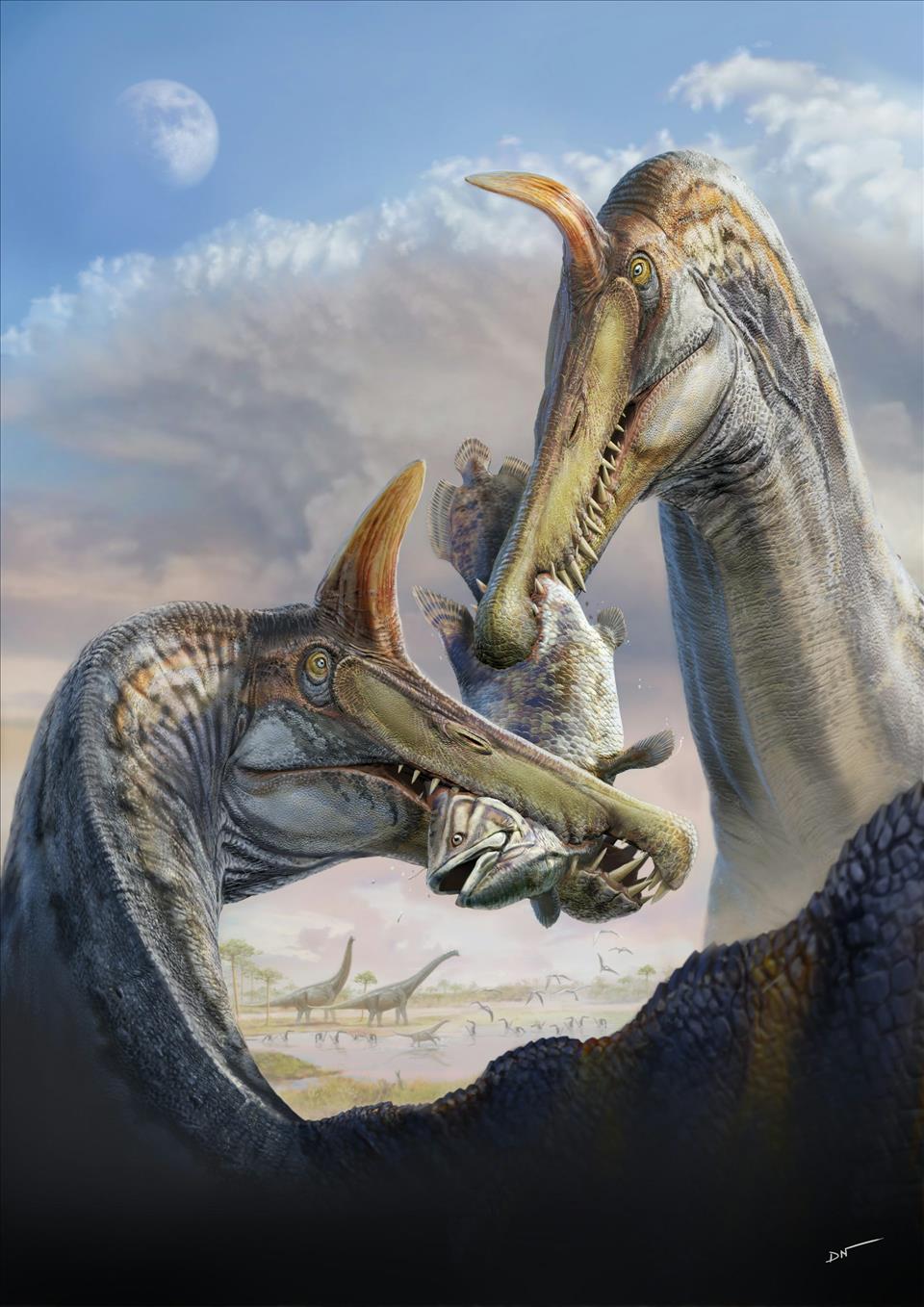
Paleontologists Uncover A New 'Spinosaurus' Species By Following A Clue From A Decades-Old Book Into The Sahara Desert
Author: Paul C. Sereno
(MENAFN- The Conversation) My fixation on a small, desolate locale in the heart of the Sahara Desert started with a single line buried in a 630-page tome in French about the rocks of the central Sahara:“Dent de Carcharodontosaurus saharicus Depéret,” which translates to“tooth of Carcharodontosaurus saharicus Depéret” –“Depéret” refers to the scientist who originally named the species.

The intrepid French geologist Hugues Faure (1928-2003) had collected one saber-shaped tooth in the early 1950s at a small exposure he labeled“Akarazeras” on one of his maps, identifying the tooth as belonging to the T. rex-size predator Carcharodontosaurus. That beast was named years before based on fossils in the Western Desert of Egypt, and Faure correctly figured the tooth and outcrop in Niger might be the same age. Faure's tooth, unfortunately, was never figured or photographed and has been lost.
In the 70 years since Faure's account, no paleontologist had ventured back to this hyperarid, windswept landscape to attempt to relocate Akarazeras. In truth, the tooth might have been all that was there, and the site itself could easily have disappeared under drifting dunes. Yet, after reading about it early in my career as a paleontologist, Akarazeras became my fossil Shangri-La, a place I dreamed of visiting.
Akarazeras relocatedWith a small exploratory team in 2019, I followed a desert trail to the remote oasis of Tanout, the closest inhabited point to Akarazeras. There we refreshed our supplies – food, water and fuel – to survive a three-day foray in the open desert in search of the locale. Besides binoculars, we had a few gadgets Faure couldn't have imagined: GPS hand units and a drone.
Navigating using Faure's map brought us to a flat, barren spot with nothing in sight to the horizon. We drove several kilometers to the north, climbed to the top of our vehicles and launched the drone. One of my team members spotted a low rocky outcrop at distance.
Soon after arriving at the exposure, we found several Carcharodontosaurus teeth and, a short distance away, the rim of an infilled, hand-dug well. We had found Akarazeras. By the next afternoon, we had finished packing up a few dozen fossil teeth and bones. We probed in every direction and sent the drone farther to see if there was anything else to find. Nothing but sand.
A chance encounterThat might have been the end of the story had not a tall, lanky man arrived in our Tanout campground the evening we returned. Looking like a Tuareg Marvel character, Abdoul Nasser stood next to his Honda motorbike, dressed in a full-length black overcoat, a cheche head wrap, sunglasses and a sheathed sword slung over his shoulder.
“I can take you to some large bones, farther than Akarazeras,” he said in Tamasheq, with guides translating to French. This seemed more than a boast or scam. I decided to devote our final three days to this venture.
A day and a half later, we had spent half our fuel chasing our motorbike guide over an endless dunescape. Just as we questioned going farther, Abdoul slowed to a stop in front of the largest fossil hind leg I had ever seen, its thigh bone nearly 6 feet (2 meters) long.
As the sun set, we scurried from skeleton to skeleton – it was a veritable dinosaur graveyard. The next morning we had a half-hour at this place locals called Jenguebi before we had to leave. I and my colleague, Spanish paleontologist Dan Vidal, quickly collected large jaw pieces of what we assumed was Carcharodontosaurus.
Epiphany in the lab and fieldBack in Chicago, the cleaned and assembled jaw pieces told another story. They belonged to the giant fish-eating dinosaur called Spinosaurus, which refers to a group of semiaquatic, T. rex-size beasts known from the northern shores of Africa.
For more than two years, plans to return to Niger were scuttled by the pandemic. Finally, in 2022, I led an international, 20-person field crew with a larger guard back to Jenguebi to see whether we could turn up more of the elusive predator.
I was busy arranging the campsite an hour after arriving when Dan Vidal approached, wide-eyed.
“You won't believe what we just found... the snout end of our skull!”
The team quickly gathered around the toothed bone jutting from the surface of the desert, some in tears, bearing witness to an extraordinary discovery. The snout end fit onto one of the jaw pieces we had collected in 2019. Hours later, Dan approached again with a curved bone in hand.
“What do you think this is?” he asked, wanting confirmation for what we both immediately recognized as a landmark discovery.
The scimitar-shaped bone he held came from the top of the skull. Unlike the low, fluted crest atop the cranium of Spinosaurus from Egypt, called Spinosaurus aegyptiacus, this bone swept upward and backward over the orbital – the space for the eyes. In the cool of the evening, the team gathering around Dan and his laptop to get a glimpse of an initial skull reconstruction, an assembly of digital versions of the bones we had discovered. In awe, we saw the Jenguebi spinosaurid for the first time, a spectacular southern variant of the sail-backed predator first described in Egypt in 1915.
Back in the lab, we coined a species name in Latin that captured our collective“astonishment” upon its discovery, Spinosaurus mirabilis.
An organization I launched with Nigeriens, NigerHeritage, has visualized new museums in the country's capital, Niamey, and closer to the fossil sites in Agadez that will preserve and display these and many other fossils. A secure homecoming for these remarkable finds also involves a new generation of Nigerien museologists, scholars and museums.
An inland fish-eaterOther animals at the site included two new long-necked plant-eaters, a partial skull of Carcharodontosaurus, a large skull of a freshwater fish and fossil wood. All of the fossils came from a layer of river-borne sediment less than a meter thick, indicating they lived in the same forested inland area far from a marine coastline.
In recent years, the giant fish-eater Spinosaurus has been depicted in Hollywood's“Jurassic World Rebirth” as a swimming, diving ocean predator alongside other undoubtedly marine creatures like mosasaurs. In 2020, a team of researchers had reinterpreted Spinosaurus aegyptiacus in this way.
Dubbed the“aquatic hypothesis,” the key inspiration was the discovery that the sail on its back extended over its tail. The structure of the tail and other lines of evidence, however, led me and my research team to an alternative view of the fish-eater – as a shallow-water, wading, ambush predator with little capacity for swimming and none for diving.
Aside from its crest, S. mirabilis is very similar to its cousin S. aegyptiacus from the northern coast of Africa. Their lifestyles likely also were very similar.
Evolutionary stagesThe early record of spinosaurids, known only from a few teeth, is rooted in the Jurassic, when they first gained a taste for fish. Over the past few years, researchers have found spinosaurid fossils in many locales in rocks of Early Cretaceous age in southern Europe and Asia, sites that once were near the ancient Tethys Sea. At that time, 115 to 130 million years ago, spinosaurids had split into two subgroups – baryonychines and spinosaurines – that collectively dominated the Tethyan realm as the largest predators of the day.
By the dawn of the Late Cretaceous, only spinosaurines remained as larger and more specialized and flamboyant fish-eaters on the southern side of the Tethys Sea in coastal and inland habitats.
S. mirabilis is among the last of these great predators. It is perhaps best understood as a“hell heron,” the likes of which we can only imagine when observing the more graceful, if less fearsome, herons of today.
Institution:University of Chicago

Legal Disclaimer:
MENAFN provides the
information “as is” without warranty of any kind. We do not accept
any responsibility or liability for the accuracy, content, images,
videos, licenses, completeness, legality, or reliability of the information
contained in this article. If you have any complaints or copyright
issues related to this article, kindly contact the provider above.
Most popular stories
Market Research

More Story







Comments
No comment