







403
Sorry!!
Error! We're sorry, but the page you were looking for doesn't exist.
'Our Fortune Should Spread To Our Brothers': Sheikh Zayed's Legacy Of Humanity
(MENAFN- Khaleej Times)
From 1971 to 2004, the UAE, under Sheikh Zayed's leadership distributed Dh90.5 billion in aid to 117 countries around the world
Every year on the 19th of Ramadan, the country marks the anniversary of the passing of the late Sheikh Zayed bin Sultan Al Nahyan, who transformed a desert nation into one of the world's most generous donors of foreign aid.
Zayed Humanitarian Day, established by the UAE Cabinet as an annual occasion to honour his legacy and carry forward his philosophy of giving, is not merely a commemoration. It is a commitment to renew the promise that the path he laid will not be abandoned.
Recommended For You UAE's e& announces special offers for customers affected by regional conflict Iranian attack hits hotel, 2 residential buildings in Bahrain; no casualties reported
Stay up to date with the latest news. Follow KT on WhatsApp channels.
From 1971 to 2004, the UAE, under Sheikh Zayed's leadership distributed Dh90.5 billion in aid to 117 countries around the world.
Five months before the formal union of the UAE on December 2, 1971, Sheikh Zayed, then Ruler of Abu Dhabi, had already established the Abu Dhabi Fund for Development, capitalised at Dh500 million, with a mandate to support developing and friendly nations.
The giving did not wait for the nation to be built. It was, in a very real sense, part of the foundation itself.
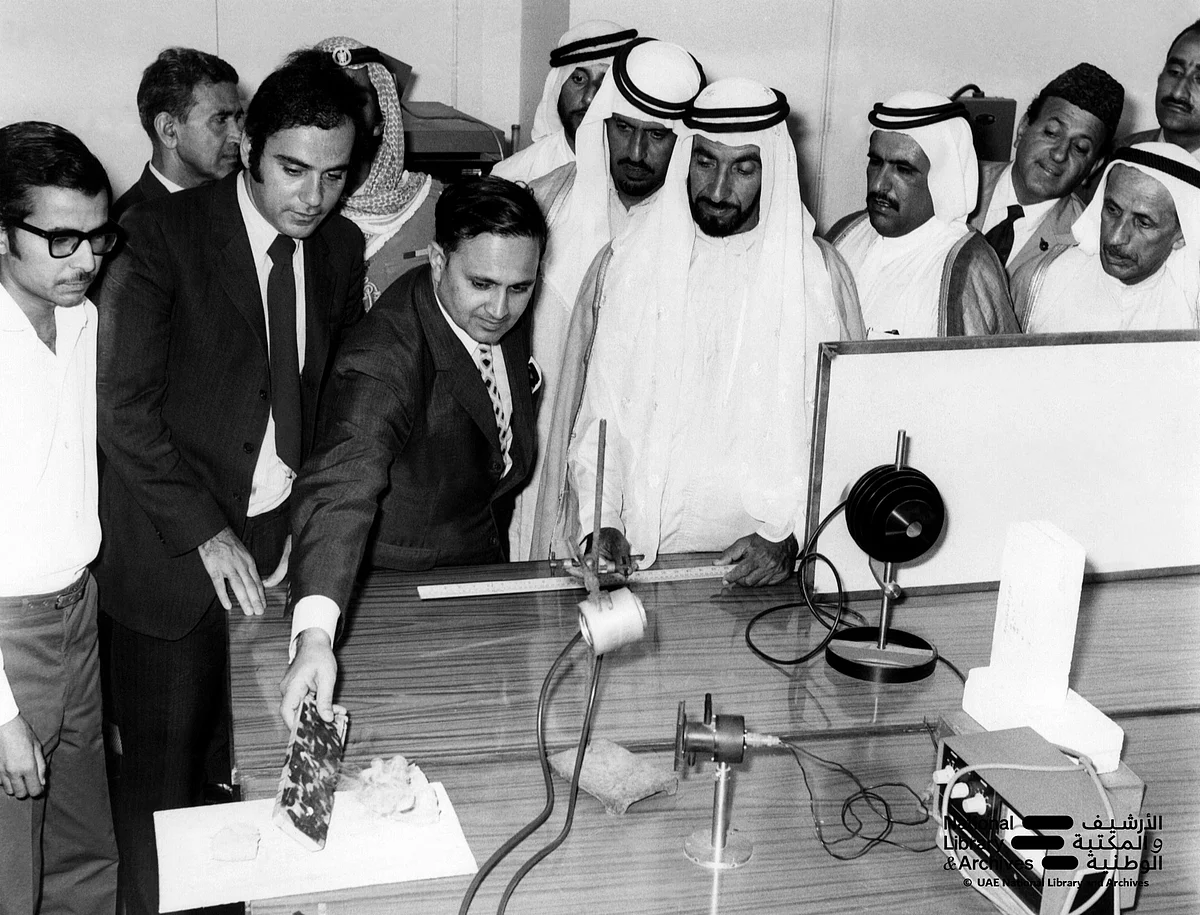
The archival photographs that follow are drawn from the collections of the National Archives and Library of the UAE; they form a visual chronicle of a man who understood that the wealth God had granted him was not his alone to keep.
“We believe that the benefit of the fortune granted to us by God should spread to cover our brothers and friends.” Sheikh Zayed bin Sultan Al Nahyan
Egypt: A relationship built on brotherhood, not transactions
The relationship between Sheikh Zayed and Egypt predates the UAE itself. As far back as 1959, Gamal Abdel Nasser agreed to send Egyptian teachers, engineers, and agricultural experts to Abu Dhabi; a gesture of solidarity that Sheikh Zayed never forgot.
From 1971 until 2004, the UAE provided almost Dh47.5 billion in humanitarian and development aid to Egypt, making it one of the largest single recipients of UAE assistance in the world.
The city that bears his name in Ismailia is among the most tangible expressions of that bond. In August 1974, Sheikh Zayed sat with Egypt's Minister of Housing and Reconstruction, Osman Ahmed Osman, to be briefed on the urban plans for Ismailia and the new residential city that would carry his name.
Two years later, in October 1976, he returned to walk through the city himself to see what had been built. Sheikh Zayed City in Ismailia stands today as a residential community that has housed generations of Egyptian families, a permanent mark of a partnership that was always about people, never about politics.
Pakistan: From hospitals to science, a partnership across decades
In May 1972, months after the UAE's founding, Sheikh Zayed was in Pakistan, inaugurating the reception hall of the Atomic Energy Research Institute. The photographs from that visit are among the earliest in the archive of his international humanitarian and development work.
Sheikh Zayed's giving was never confined to relief; he invested in the capacity of other nations to develop themselves.
Two years later, in March 1974, he stood at the inauguration of the Sheikh Zayed Hospital for Women in Larkana, in the Sindh province of Pakistan. The hospital was built to address a specific, documented need - access to maternal healthcare in a region where it was severely limited. It was one of many such institutions he funded across the country.
In 1975, the UAE loaned $100 million to support development programmes in Pakistan, one of its earliest diplomatic partners. The Sheikh Zayed bin Sultan Al Nahyan Bridge in Khyber Pakhtunkhwa province, which connected 15 towns and 45 villages across the Swat River, is another enduring example of infrastructure built for people.
Yemen: The dam that took twelve years to build
Of all Sheikh Zayed's international projects, the reconstruction of the Marib Dam in Yemen may be the most historically resonant. The original dam, built around 115 BC, had irrigated thousands of acres of agricultural land and sustained the ancient Sabaean civilisation for centuries.
When it collapsed around AD 575, the fields went dry, the people dispersed, and what had been one of the Arab world's most prosperous regions became desert. Some of those who migrated, historians note, travelled east to settle.
In the early 1980s, following flooding in the Marib governorate, Sheikh Zayed offered to fund the construction of a new dam. In 1984, he travelled to Yemen to lay the cornerstone of the project. The photographs from February 1974 show him receiving the company representatives who would undertake the reconstruction.
On December 20, 1986, Sheikh Zayed returned to Yemen for the inauguration of the completed dam, attended also by Yemen's then-President Ali Abdullah Saleh. The Abu Dhabi Fund for Development subsequently financed a second phase of the project, including 66km of irrigation channels, with the aim of restoring agricultural prosperity to a region that had been barren for over a millennium.
In 2002, Yemen's then-Vice President Abdrabu Mansur Hadi described the Marib Dam project as one of the most vital initiatives being implemented with UAE assistance.
Morocco: A hospital in Rabat
In November 1991, Sheikh Zayed stood alongside the late King Hassan II of Morocco at the inauguration of the Sheikh Zayed Hospital in Rabat. The hospital was one of many medical institutions he funded across the Arab world and beyond.
By 1983, he had established the UAE Red Crescent, which went on to implement health programmes in more than 100 countries and in 1992, he founded the Zayed Bin Sultan Al Nahyan Charitable and Humanitarian Foundation, which provided more than $460 million in assistance across its programmes.
The Abu Bakr Al Siddiq Medal for Charitable and Humanitarian Work of the First Class, presented to him in Abu Dhabi in July 2001 by the Secretary-General of the League of Arab Red Crescent and Red Cross Societies, was one of many international recognitions of a body of work that had, by that point, spanned three decades and touched dozens of countries.
Culture and civilisation: The Library of Alexandria
In February 1990, Sheikh Zayed attended the international celebration at the Cataract Hotel in Aswan, organised jointly by Egypt and Unesco, to mark the revival of the ancient Library of Alexandria. He was joined by Egyptian President Hosni Mubarak and a gathering of world leaders and scholars.
The Library of Alexandria once, the greatest repository of human knowledge in the ancient world was to be reborn as the Bibliotheca Alexandrina, a project that would eventually open in 2002.
Sheikh Zayed understood that development was not only material. The preservation of civilisational heritage - the knowledge, the memory, the culture of peoples - was as much a part of his humanitarian vision as the building of hospitals and dams.
Agriculture and the land: Al Salhiya, Egypt
In March 1988, Sheikh Zayed visited the Al Salhiya Agricultural Project in Egypt alongside former President Mubarak. The project, a large-scale land reclamation initiative in the eastern Nile Delta, was transforming desert into farmland.
Sheikh Zayed's interest in agricultural development was longstanding and personal; he had overseen the transformation of Al Ain and the broader UAE landscape through irrigation and afforestation, and his support for similar projects abroad was a natural extension of that commitment.
A legacy that outlives its architect
Sheikh Zayed passed away on November 2, 2004. In 2012, the UAE Cabinet adopted the 19th of Ramadan each year as "Zayed Humanitarian Work Day", a date that has since been observed annually across the UAE and by Emirati institutions worldwide. The day focuses on creating new humanitarian initiatives, preserving and reviving his legacy, and extending humanitarian work at local, regional, and international levels.
The institutions he built continue to operate. The Abu Dhabi Fund for Development has, over more than five decades, provided more than Dh150 billion in development funding and investments across 97 countries.
The UAE Red Crescent, which he established in 1983, continues to respond to emergencies across the globe. The Zayed Charitable and Humanitarian Foundation, founded in 1992, continues its programmes across multiple continents.
ALSO READ
- How Sheikh Zayed led UAE at age of 29: Emirati businessman pays tribute in new book
- UAE President honours first Emirati family to donate their 5-year-old child's organs
MENAFN08032026000049011007ID1110832189

Legal Disclaimer:
MENAFN provides the
information “as is” without warranty of any kind. We do not accept
any responsibility or liability for the accuracy, content, images,
videos, licenses, completeness, legality, or reliability of the information
contained in this article. If you have any complaints or copyright
issues related to this article, kindly contact the provider above.
Most popular stories
Market Research






Comments
No comment