



403
Sorry!!
Error! We're sorry, but the page you were looking for doesn't exist.
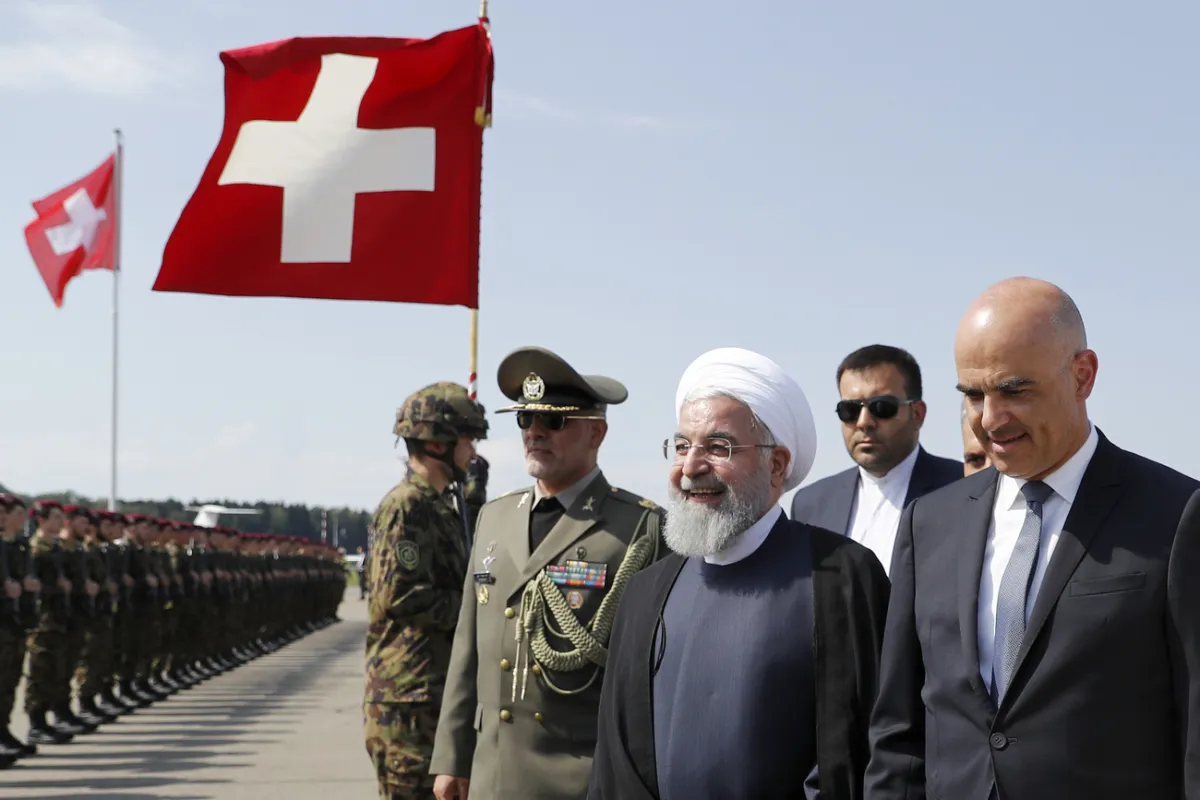
The Special Relationship Between Iran And Switzerland
(MENAFN- Swissinfo)
The US-Israeli attack on Iran brings renewed attention to Bern's special ties to Tehran. Switzerland has consistently maintained good relations with the Islamic Republic, no matter how violent it became. But economically, the Swiss calculus did not pay off.
Select your language
I work as editor and correspondent at the Federal Palace. I report on Swiss politics for the Swiss Abroad and manage our political talk show Let's Talk. I started in local journalism in the early nineties and have worked in many journalistic fields, held management positions and covered a range of topics. I joined SWI swissinfo in 2017.
-
More from this aut
German Departm
-
Deutsch
de
Der Iran und die Schweiz: eine spezielle Beziehung
Original
Read more: Der Iran und die Schweiz: eine spezielle Bezi
Français
fr
L'Iran et la Suisse: une relation particulière
Read more: L'Iran et la Suisse: une relation particul
Italiano
it
Iran e Svizzera: una relazione speciale
Read more: Iran e Svizzera: una relazione spe
Español
es
Irán y Suiza: una relación especial
Read more: Irán y Suiza: una relación esp
Português
pt
O Irã e a Suíça: uma relação especial
Read more: O Irã e a Suíça: uma relação esp
日本語
ja
イランとスイスの特別な関係
Read more: イランとスイスの
العربية
ar
إيران وسويسرا: علاقة ذات طبيعة خاصة
Read more: إيران وسويسرا: علاقة ذات طبيعة
Русский
ru
Иран и Швейцария: особые отношения
Read more: Иран и Швейцария: особые отно
No matter how the coming days unfold in Tehran, a change of power would be in“Switzerland's interest”, says Kijan Espahangizi, historian at the University of Zurich. Such a shift, he argues, would open up“incredible opportunities” for Switzerland.
But how to get there? Switzerland would first have to declare the Islamic Republic illegitimate and then convene an international conference on Iran.“Such a move would secure Switzerland premium access to the Iranian market virtually overnight,” according to the historian.
Swiss harvest never materialisedThe Iranian market boasts 90 million well-educated people, the second largest natural gas reserves in the world and a treasury filled with oil money.
When, after 1979, Swiss politicians flocked to Tehran to negotiate treaty after treaty with the Muslim clerics running the country, there was hope that business with Iran would soon flourish.
Yet the harvest never materialised, due to sanctions.
Sanctions were first imposed by the US in 1995, followed by the UN in 2006 and later by the EU. Philippe Welti, Switzerland's former ambassador to Iran, describes the current sanction cascade as a“dominant event” in the history of the relationship between the two countries. Welti is now the president of the Economic Chamber Switzerland-Iran (ECSI).
But how did this special, close relationship between two very different countries come about? Switzerland is small and freedom-loving, while Iran does not respect any of Switzerland's values of freedom, democracy and equality.
After the downfall of the Shah of Persia in 1979, Iran's theocracy firmly established itself. The president was overseen by the supreme religious leader, Ali Khamenei, who was killed on February 28, 2026. Serving under him was the Islamic Guardian Council, which controlled parliament.
A repression apparatus maintained order in the Islamic state. The Revolutionary Guards, the morality police and security forces brutally crushed every outbreak of public anger until early 2026.
In 2025, Iran ranked 153rd out of 180 countries on Transparency International's Corruption Perceptions IndexExternal lin. The Islamic state also scored near the bottom of the Democracy IndexExternal link, ranking 154th out of 167.
Iran wants to build nuclear weapons. It wants to destroy Israel, and it intervened in Iraq, Lebanon and Yemen. It fuelled dictator Bashar al-Assad's bloody war in Syria which, according to UN figures, claimed over half a million lives.
Tehran has supplied Russia with drones and supported Hamas, the Palestinian militant group that carried out the October 7, 2023 attacks in Israel that left 1,182 people dead.
New violence, new sanctionsMost recently, Iran's government has intensified its violent repression of its own citizens. In 2022, authorities crushed mass protests, killing more than 500 people and arresting over 25,000. Many detainees were subjected to torture, sexual violence, and other arbitrary abuses, accoring to rights groups. In January 2026, the regime launched another harsh crackdown in response to a new wave of unrest. An independent Iranian network of doctorsExternal link puts the death toll of that violent episode at more than 30,000. There is still uncertainty about this, partly because the regime strictly monitors the internet.
In a recent statementExternal link, the Swiss government expressed“great concern” over these deaths and summoned the Iranian ambassador. Compared with other countries such as CanadaExternal link, which called Iran the“principal source of instability and terror throughout the Middle East”, Switzerland once again stood out for its restraint.
External ContentSwitzerland's dealings with Iran have always followed a two-pronged approach: trade on the one hand, special diplomatic tasks and muted criticism on the other. Trade was the goal, diplomacy the means. But it was only by keeping both tracks moving that Switzerland managed to forge an ever-closer alliance with Tehran.
The more the Iranian regime manoeuvred itself into international isolation, the more important Switzerland became – not only for Tehran but also for other Western countries that had cut their ties with Iran. Switzerland was holding the fort, built bridges and acted as a mediator. This special role legitimised the friendship with the pariah state and protected Switzerland from being ostracised by other countries.
The dogma of change through tradeAt home, it also served as a justification for its close ties with Iran. Just like with China or Russia, Switzerland wanted to achieve“change through trade” in Iran. Whenever the Swiss criticised their government, the Swiss foreign ministry argued that a country could address human rights issues only if it was represented there.
In 1979 Switzerland was entrusted with its first protecting power mandate by representing Iranian interests in Egypt.
In 1980 it was mandated to represent US interests in Iran which, according to diplomatic circles, is the“crown jewel” of Swiss protecting power mandates. Saudi Arabia followed in 2017 with a double mandate (until 2023), and Canada was added to the list in 2019. That is why Switzerland owes several of its protecting power mandates to Iran, of which it has a total of seven today.
These remaining mandates are important considering that during the Second World War Switzerland held 200 such mandates.“Switzerland has a great interest in not losing these protecting power mandates,” Welti said at the time of the 2022 protests in Iran.
Yet Swiss foreign policy experts now argue that the current war has made Switzerland's power protecting mandate in Iran obsolete.“It has been the main reason for Switzerland's soft-pedalling towards the brutal mullah regime,” says foreign policy expert Franziska Roth, a Social Democratic senator, in reference to the Muslim Shiite clerics running Iran.
More More Best of SRG content Debate flares over Swiss protecting power mandate in IranThis content was published on Mar 2, 2026 Switzerland represents US interests in Iran - a long‐standing role now coming under scrutiny as tensions escalate in the Middle East.
Read more: Debate flares over Swiss protecting power mandate in
Legal Disclaimer:
MENAFN provides the
information “as is” without warranty of any kind. We do not accept
any responsibility or liability for the accuracy, content, images,
videos, licenses, completeness, legality, or reliability of the information
contained in this article. If you have any complaints or copyright
issues related to this article, kindly contact the provider above.
Market Research

More Story





Comments
No comment