


Tracey Emin: A Second Life Tate Modern's Must-See Retrospective Explores Trauma And Transcendence


The major retrospective of Tracey Emin's career at London's Tate Modern does just that, and features her most significant surviving works. It also reflects her characteristic subjects, techniques, materials and approaches.
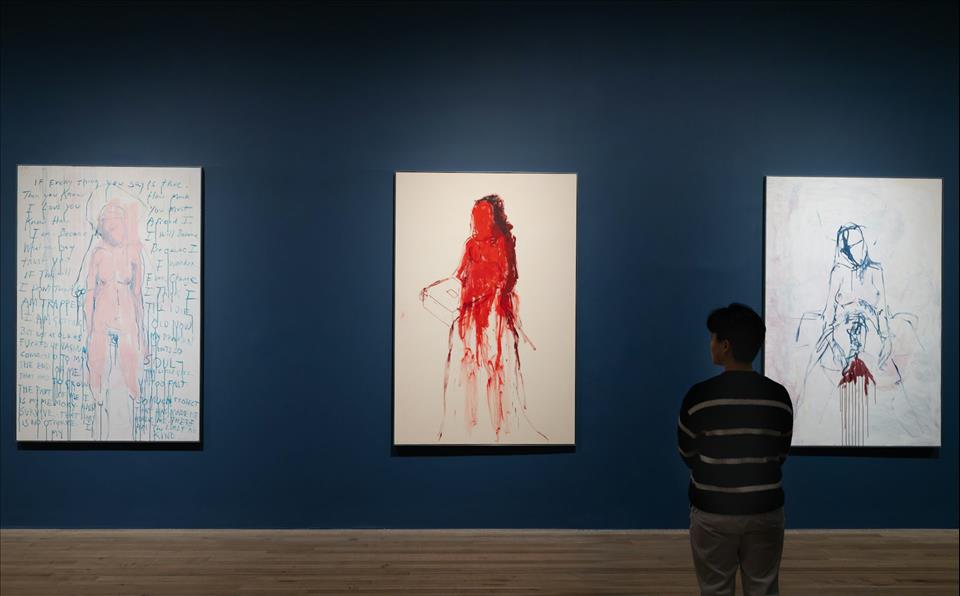
The monumental bronze I Followed You to the End (2024), displayed on the approach to the Tate, is a foretaste of the anguished bodies in the statues within. These and the agonised black lines, floods of blood-red and bleak white backgrounds of paintings like Rape (2018) graphically engage with such traumatic experiences.
Emin made her name in the 1990s through dramatic installations and art that unflinchingly confronted the visceral realities of women's bodies. These used her own body and experiences to create artworks that connected emotionally as raw cries of anguish. Or of lost innocence.
The latter comes out particularly in her short film Why I Never Became a Dancer (1995), deliberately placed near the start of the exhibition. In this, affectionate shots of Emin's childhood hometown of Margate jarringly contrast with her narration of sexual abuse and misogyny.
This voiceover reflects Emin's talent for pithy, poignant and allusive language. Appliqued into quilts such as Mad Tracey from Margate. Everyone's Been There (1997), or expressed in the emotionally charged titles of artworks and neon signs, Emin's words – as well as her body – confront her trauma.
Some of these works do so by foregrounding love, desire, longing, betrayal and abuse. Others resist the silence and stigma that have for so long shrouded women's bodily functions.
The exploration of the soulThroughout the exhibition, Emin's work is deeply personal. Yet, by centring her own experience, Emin also humanises and universalises it. You don't have to have had an abortion, or even be a woman, to respond emotionally to a work like The Last of the Gold (2002), publicly exhibited here for the first time.
Similarly, her textual contributions universalise the experiences of victimhood. Her handwritten memoir, Exploration of the Soul (1994), for example, movingly conveys a child's attempt to understand the cruelty of unspoken racism.
Despite the trauma, throughout there's an indomitable sense of defiance. Sewn into the quilt No Chance (WHAT A YEAR) (1999) a small text responds to her rapists pointing abusively at her:“I was only 13 and even then I knew they were pointing the wrong way.” In the same way, Why I Never Became a Dancer ends with Emin defiantly showing us her moves.
This combination of vulnerability and strength gives Emin's work its emotional richness. This also comes out in her determination to document the trauma of her cancer. In works that take on the taboos around this disease, Emin depicts the procedures that our society squeamishly hides away in hospitals and the impact that these have had upon her body.
Of course, one of the most celebrated of her works does not directly feature her body but its absence. Yet My Bed (1998) is still a self-portrait of the traces of her life. Alongside the dishevelled bed and assorted detritus on and around it, what really struck me, seeing it for the first time, were the adjacent suitcases, packed and ready and the layered stories wordlessly conveyed in this installation. My Bed may on one level be an extended metaphor for struggling with depression, but the suitcases also speak of the will to escape.
Exorcism of the Last Painting I Ever Made (1996) is another even larger installation dealing with depression. It takes up an entire room in this exhibition. During pregnancy and in the aftermath of her abortions, Emin found it impossible to paint. The text behind the box containing this installation states:“I hated my body... I was suffering from guilt and punishing myself so I threw myself in a box and gave myself three and a half weeks to sort it out. And I did.”
The result is an insight into the artist's studio as well as their body and mind. It reminded me of the installation of Francis Bacon's studio in Dublin. Emin has cited the Norwegian painter Edvard Munch as a major influence, even holding an exhibition of her own work alongside that of Munch entitled The Loneliness of the Soul at the Royal Academy in 2021. Yet, to me, the comparisons with Bacon are more striking, both in the subject matters of sex and trauma and in the solemnity of their larger canvases.
Read more: Francis Bacon: Human Presence – a compelling look at how the artist redefined portraiture
This was particularly marked in the final room. Throughout the exhibition the walls are painted a petrol blue, the same shade that Bacon used for oppressive interiors such as Man at a Washbasin (1954). This, combined with subdued lighting, produces a womb-like atmosphere. The intimacy this creates both heightens the emotional connection and impact on the viewer and shows Emin's work to best effect.
It might seem odd to create such an ambience when so many of the artworks deal with trauma. Yet, although Emin observes what is happening to her body, literally in the case of I Watched Myself Die and Come Alive (2023) that fills the final wall of the final room, her art also has a detached, transcendent quality.
The spiritual atmosphere of that final room, with identically sized canvasses hung along it like altarpieces – including one of The Crucifixion (2022) – speaks through the spectral traces of bodies in the artworks more of the soul than the body, less of trauma than of the transcendence of pain.
Tracey Emin: A Second Life is at the Tate Modern from February 27 2026 to August 31 2026.
Looking for something good? Cut through the noise with a carefully curated selection of the latest releases, live events and exhibitions, straight to your inbox every fortnight, on Fridays. Sign up here.


Legal Disclaimer:
MENAFN provides the
information “as is” without warranty of any kind. We do not accept
any responsibility or liability for the accuracy, content, images,
videos, licenses, completeness, legality, or reliability of the information
contained in this article. If you have any complaints or copyright
issues related to this article, kindly contact the provider above.


Comments
No comment