




403
Sorry!!
Error! We're sorry, but the page you were looking for doesn't exist.
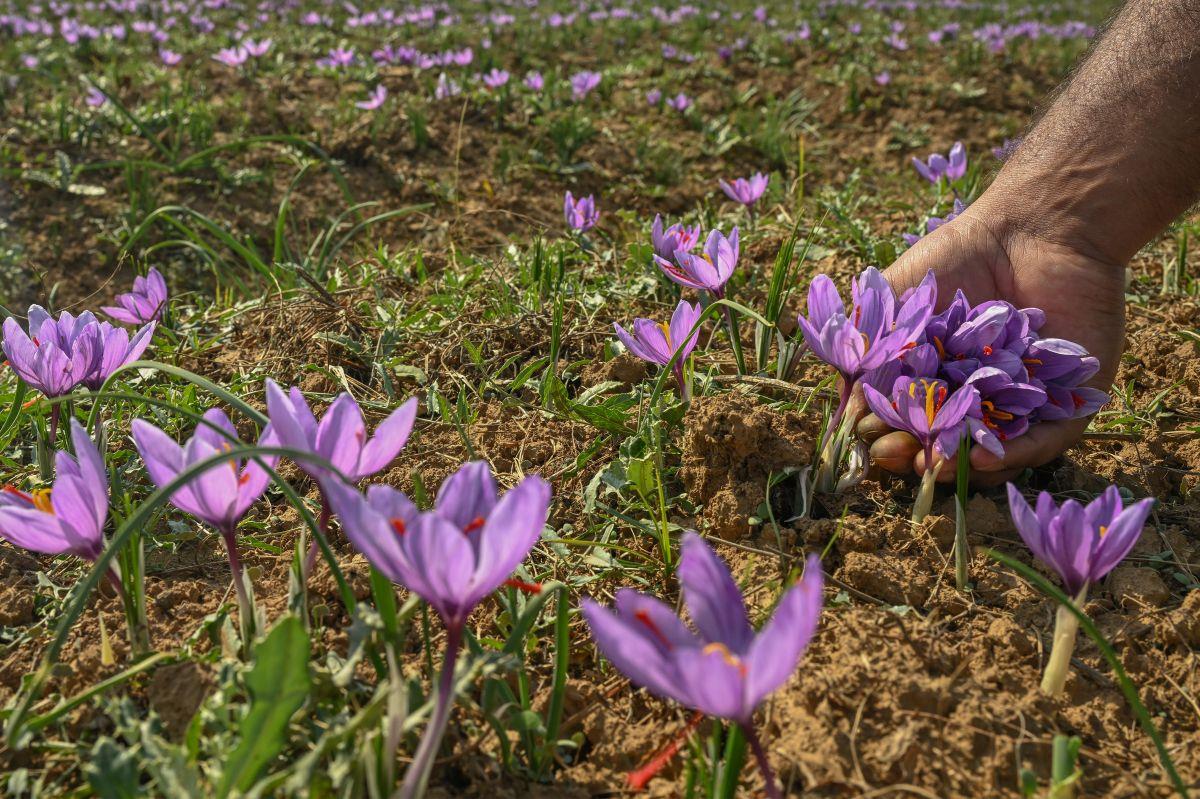
Is Kashmir's Saffron On Decline? Govt Rejects Claims
(MENAFN- Kashmir Observer)
ADVERTISEMENT
-
Says 90 MT Produced in Five Years; Over 80 MT Exported
-
'Area Stabilised at 3,715 Hectares, Farmer Income and Output Rise'
Srinagar- The Jammu and Kashmir government on Wednesday said that over 90 metric tonnes of saffron have been produced in the Union Territory during the last five years and rejected claims of a steep decline in output, asserting that productivity and farmer earnings have improved under the National Mission on Saffron.
Replying to a question by National Conference MLA Hasnain Masoodi in the Assembly, Agriculture Minister Javid Ahmad Dar said 90.28 metric tonnes of saffron were produced between 2021 and 2025, of which over 80 metric tonnes were exported.
ADVERTISEMENT
He said the value of production during 2024-25 stood at Rs 534.53 crore, while export value was pegged at Rs 486.43 crore.
Official data placed annual production at 17.33 metric tonnes in 2020-21, around 14.9 metric tonnes in 2021-22 and 2022-23, rising sharply to 23.53 metric tonnes in 2023-24 and remaining strong at 19.58 metric tonnes in 2024-25. Average productivity ranged between 4 kg and 6.33 kg per hectare in recent years.
The government said that prior to the launch of the Economic Revival of J and K Saffron Sector project under the National Mission on Saffron in 2010-11, cultivation had shrunk from 5,707 hectares to 3,715 hectares and productivity had fallen to critically low levels of 1.27 kg per hectare in 2000-01 and 1.68 kg per hectare in 2003-04.
After the Mission's intervention, the area under cultivation stabilised at 3,715 hectares, including 3,665 hectares in Kashmir division and 50 hectares in Kishtwar. Productivity in rejuvenated areas has improved significantly, reaching 6.96 kg per hectare in 2023-24 and 5.6 kg per hectare in 2024-25.
The government said temporary dips in output during 2014-15, 2017-18 and 2018-19 were due to floods and prolonged dry spells.
Highlighting financial gains, the department said grower realisation increased from around Rs 80,000 per kg before the Mission to nearly Rs 2.20 lakh per kg in 2021-22. Scientific post-harvest processing at the Indian Institute of Kashmir Saffron and Technology Centre improved colour strength and quality, while e-auctions reduced middlemen interference and enhanced price transparency.
Read Also Highways Redraw Kashmir's Saffron Map Kashmir's Saffron Town Gets a Reality Check from IranOn the Rs 400.11 crore Mission, Dar said Rs 269.915 crore has been released by the Centre so far, with total expenditure reaching Rs 321.37 crore, including farmer contribution.
Under the irrigation component, 124 community bore-wells were planned. So far, 85 have been handed over, though several remain non-functional due to maintenance issues and limited farmer participation. A monitoring mechanism has been put in place to address these gaps.
ADVERTISEMENTThe government maintained that the Mission has halted area decline, boosted productivity and strengthened export potential, while acknowledging that irrigation and infrastructure components require further attention to ensure sustained growth of the saffron sector.

Legal Disclaimer:
MENAFN provides the
information “as is” without warranty of any kind. We do not accept
any responsibility or liability for the accuracy, content, images,
videos, licenses, completeness, legality, or reliability of the information
contained in this article. If you have any complaints or copyright
issues related to this article, kindly contact the provider above.
Most popular stories
Market Research

More Story




Comments
No comment