



403
Sorry!!
Error! We're sorry, but the page you were looking for doesn't exist.
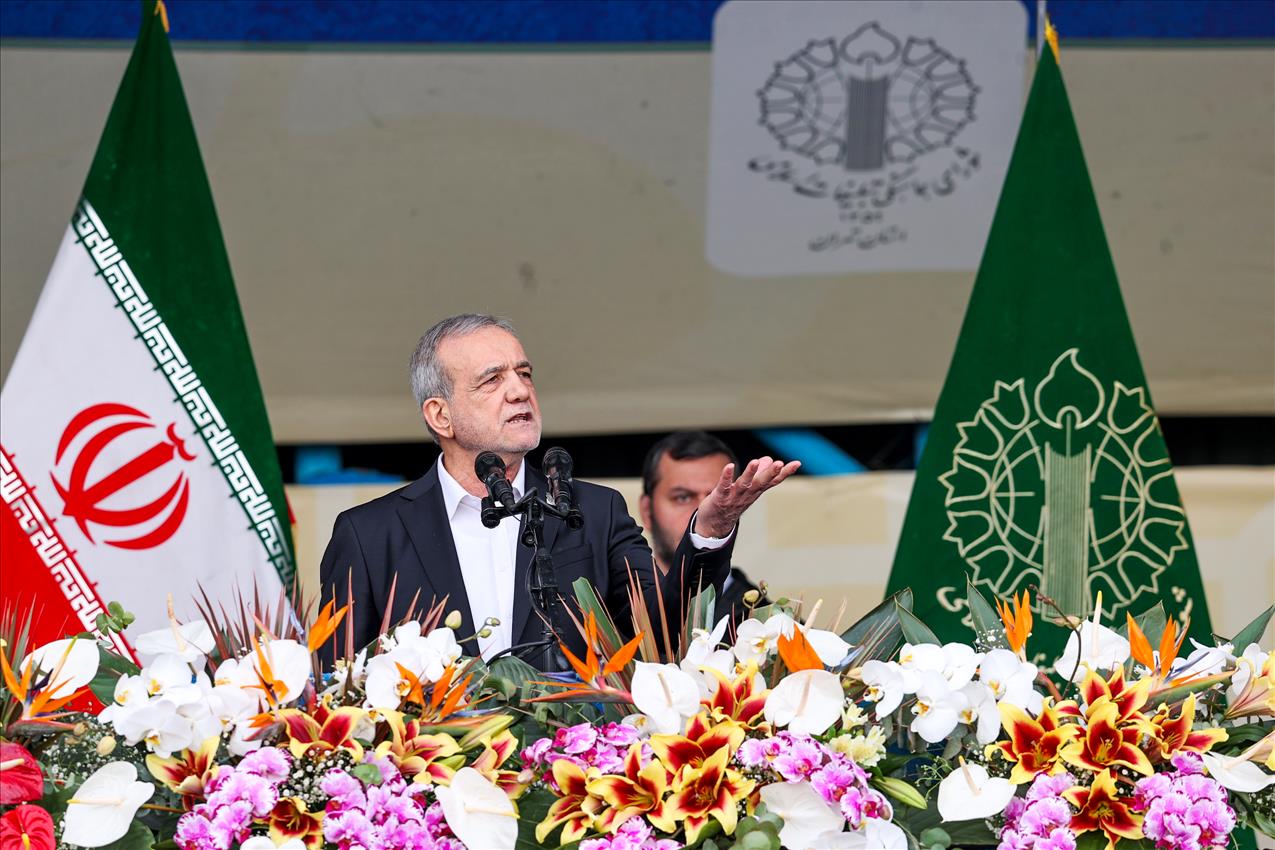
Pezeshkian: Iran Won't Yield On Nuclear Pressure
(MENAFN- Kashmir Observer)
Tehran – Iranian President Masoud Pezeshkian declared Wednesday that Tehran would“not yield to excessive demands” over its nuclear programme, even as the country resumed sensitive negotiations with the United States under mounting regional pressure.
ADVERTISEMENT
“Our country, Iran, will not yield to their excessive demands,” Pezeshkian said in a speech at Azadi Square in Tehran marking the 47th anniversary of the 1979 Islamic Revolution.“Our Iran will not yield in the face of aggression, but we are continuing dialogue with all our strength with neighbouring countries in order to establish peace and tranquillity in the region.”
ADVERTISEMENT
Addressing tens of thousands gathered for the 22 Bahman celebrations, Pezeshkian warned of foreign attempts to undermine Iran, praised the nation's military heroes and stressed the need for unity. He reflected on the country's post-revolution trajectory, recalling early ethnic unrest, coup attempts and outside interference.
“European nations and the United States sought to stall our revolution and waged an eight-year war against us to divide and subdue Iran,” he said, referring to the Iran-Iraq war. He added that from the first days of the Revolution,“the enemies tried to destroy our fledgling movement through actions such as creating division and staging coups.”
Despite that pressure, Pezeshkian said Iranian youth“courageously defended the nation, its system, and the Revolution, giving their lives in the process.” He criticised groups that once“looted the country's resources” yet now claim they can govern, contrasting them with martyrs who“had nothing but their lives, which they also sacrificed for the homeland and the nation's pride.”
The president emphasised internal solidarity as essential in the face of threats and misinformation.“Now more than ever, we need the wise guidance of the Leader of the Islamic Revolution to set aside problems and divisions, bring different views together, and lead toward a clear goal. The presence of the leader is a strength that has allowed the system and the revolution to move forward with power despite all challenges,” he said, reaffirming allegiance to Supreme Leader Ayatollah Seyyed Ali Khamenei.
State television showed crowds across the country waving portraits of Khamenei and Ayatollah Ruhollah Khomeini, the founder of the Islamic Republic, alongside Iranian and Palestinian flags. Some chanted“Death to America!” and“Death to Israel!” Pezeshkian said the world should witness Iranians taking to the streets“in millions to defend their proud homeland, renew their allegiance to Leader of the Revolution Ayatollah Seyyed Ali Khamenei, and honour the Revolution.”
In a separate ceremony marking the anniversary, Pezeshkian apologised to“all those affected” by nationwide protests and the subsequent crackdown while denouncing unspecified“Western propaganda” surrounding the unrest. He acknowledged the“great sorrow” felt by many.“We are ashamed before the people, and we are obligated to assist all those who were harmed in these incidents,” he said.“We are not seeking confrontation with the people.”
The president also reiterated that Iran was“not seeking nuclear weapons... and is ready for any kind of verification.”
The commemorations recall the overthrow of the US-backed Pahlavi monarchy in 1979. Ayatollah Khomeini returned from exile on February 1 that year to a massive public استقبال, and the regime collapsed on February 11 when the military withdrew support for the shah and aligned with revolutionary forces.
ADVERTISEMENTThe anniversary comes as Tehran and Washington pursue indirect talks over Iran's nuclear programme, with uncertainty over whether a deal can be reached. Foreign Minister Abbas Araghchi, speaking to Russia's RT channel, said Iran still does“not have full trust for the Americans”.
“Last time we negotiated, last June, we were in the middle of negotiation, and then they decided to attack us, and that was a very, very bad experience for us,” he said, referring to last year's 12-day Iran-Israel war in which the US struck Iranian nuclear sites.“We need to make sure that that scenario is not repeated, and this is mostly up to America.”
Read Also US-Israel Talks Highlight Rift Over Iran Approach Iran FM Seeks Genuine Talks, Power in Saying 'No'Despite mistrust, Araghchi said it could be possible“to come to a better deal than Obama”, referencing the 2015 nuclear agreement reached under former US President Barack Obama, from which Donald Trump later withdrew during his first term.
Regional diplomacy is intensifying alongside military pressure. Senior Iranian security official Ali Larijani travelled to Oman, the key mediator in the current talks, before heading to Qatar. Doha hosts a major US military installation that Iran targeted in June after American strikes on its nuclear facilities. Qatar has long served as a quiet intermediary and shares a massive offshore gas field with Iran.
Meanwhile, Israeli Prime Minister Benjamin Netanyahu is visiting Washington, with Iran expected to dominate discussions as he pushes for the strictest possible terms in any agreement.
The United States has reinforced its military presence in the region, moving the aircraft carrier USS Abraham Lincoln, additional ships and warplanes into Middle Eastern waters. Washington says the deployment is intended to pressure Iran diplomatically while preserving the ability to strike if ordered.
US forces recently shot down a drone they said approached too closely to the Lincoln and intervened when Iranian forces attempted to stop a US-flagged vessel in the Strait of Hormuz, the narrow gateway to the Persian Gulf. The US Transportation Department's Maritime Administration warned American ships to“remain as far as possible from Iran's territorial sea without compromising navigational safety.”
Trump told Axios he was considering sending a second carrier.“We have an armada that is heading there, and another one might be going,” he said. It remains unclear which vessel would deploy. The USS George H.W. Bush has departed Norfolk, Virginia, according to US Naval Institute News, while the USS Gerald R. Ford remains in the Caribbean following a US operation that captured Venezuelan leader Nicolas Maduro.
As celebrations, diplomacy and military manoeuvres unfold simultaneously, Iran's anniversary underscores a nation balancing revolutionary identity, domestic pressures and high-stakes negotiations that could shape the region's future.
Legal Disclaimer:
MENAFN provides the
information “as is” without warranty of any kind. We do not accept
any responsibility or liability for the accuracy, content, images,
videos, licenses, completeness, legality, or reliability of the information
contained in this article. If you have any complaints or copyright
issues related to this article, kindly contact the provider above.
Most popular stories
Market Research

More Story


Comments
No comment