



403
Sorry!!
Error! We're sorry, but the page you were looking for doesn't exist.
A Brief History Of Table Tennis In Film From Forrest Gump To Marty Supreme
Author: Jeff Scheible
(MENAFN- The Conversation) Table tennis and film have a surprisingly entangled history. Both depended on the invention of celluloid – which not only became the substrate of film, but is also used to make ping pong balls.

Following a brief ping pong craze in 1902, the game largely disappeared and was widely assumed to have been a passing fad. More than 20 years later, however, the British socialite, communist spy and filmmaker Ivor Montagu went to great lengths to establish the game as a sport – a story I explore in my current book project on ping pong and the moving image.
He founded the International Table Tennis Federation (ITTF) and codified the rules of the game in both a book and a corresponding short film, Table Tennis Today (1929).
Montagu presided over the ITTF for several decades. In 1925, the same year he founded the ITTF, Montagu also co-founded the London Film Society. The society helped introduce western audiences to experimental and art films that are now considered classics.
The game of table tennis has subsequently appeared at a number of moments when filmmakers and artists were experimenting with new technologies. An early example appears in one of the first works of“visual music”: Rhythm in Light (1934) by Mary Ellen Bute.
Meanwhile, an early work of expanded cinema, Ping Pong (1968) by the artist Valie Export, invited audiences to pick up a paddle and ball and attempt to strike a physical ball against the representation of one moving on the cinema screen. Atari's adaptation of the game into the interactive Pong (1972) is often considered the first video game.
Perhaps the most familiar cinematic example of all, however, is the digital simulation of a photorealistic ping pong ball – made possible by a then-new regime of computer-generated imagery. It helped Tom Hanks appear to be a ping pong whiz in the Academy-Award-winning Forrest Gump (1994).
There are a number of other fascinating moments in which the game surfaces meaningfully: in Powell and Pressburger's A Matter of Life and Death (1946), Jacques Tati's M Hulot's Holiday (1953), Michael Haneke's 71 Fragments of a Chronology of Chance (1994), and Agnes Varda and JR's Faces Places (2017).
And every day for more than two years, from 2020 to 2022, one of the world's most beloved filmmakers, David Lynch, uploaded YouTube videos in which he pulled a numbered ping pong ball from a jar and declared it“today's number”. It was a fittingly Dada-esque gesture that stands among the last mysterious works he shared with the world.
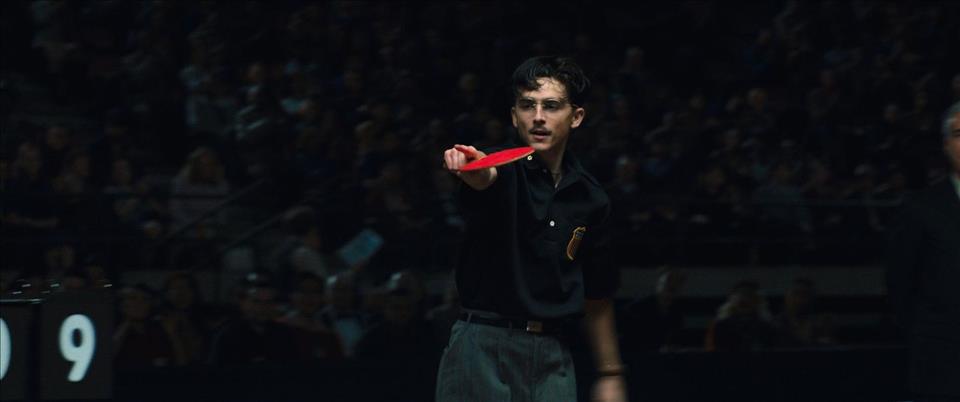
Enter Josh Safdie's Marty Supreme. The title sequence alone discovers a new way of visualising the game's iconography, as we see a sperm fertilise an egg, which then transforms into a ping pong ball (the digital effects first witnessed in Gump are now fully integrated into popular cinema).
Why Marty Supreme is differentMarty Supreme is very loosely based on the real-life player Marty Reisman (here Marty Mauser, played by Timothée Chalamet). What sets it apart from earlier cinematic appearances of table tennis is that it centres the game as a sport.
When table tennis has previously appeared in film, it is usually to help show off new special effects or as a brief plot device. Or it frequently appears in the background, helping to furnish the mise-en-scene of an office, basement, or bar. In these instances, we might not notice the game or its materials at all. When it does have a narrative function, it usually occupies a single scene, frequently serving to stage or resolve fraught interpersonal relations between the characters who are playing.
In Marty Supreme, however, table tennis seems neither tethered to special effects nor, certainly, to the game's“background” status. Chalamet trained extensively over the seven years he spent preparing for the role, even taking his own table to the desert while filming Dune (2021). And despite the film's sometimes compelling eccentricities, Marty Supreme in many senses follows the generic blueprint of a sports film.
Safdie has made a sports film, coincidentally or not, like his frequent collaborator and brother Benny Safdie, whose wrestling film The Smashing Machine was also released this past year. Marty Supreme, though, revolves around an athlete who plays a game that generally has been assumed to not have enough gravitas to command a place in the genre or to hold an audience's interest.
The absence of sports films about ping pong certainly speaks to ways in which it is perceived as something not worth taking too seriously, for reasons that are surely at least partially linked to the same reasons for which the game is often celebrated. It is perceived to be what I refer to as an“equalising” sport, open to people and bodies of all backgrounds and types.
As actor Susan Sarandon, who founded her own chain of ping pong bars, puts it:“Ping pong cuts across all body types and gender – everything, really – because little girls can beat big muscley guys. You don't get hurt; it is not expensive; it is really good for your mind. It is one of the few sports that you can play until you die.”
This perception of the game has perhaps also led it to appear in more comedic contexts, with athletes embodied by actors we might more readily laugh at, as source material for visual and sonic gags, from a slapstick scene in You Can't Cheat an Honest Man (1939) to the widely panned Balls of Fury (2007).
The tension between the game's perceived triviality and Mauser's extreme dedication lends Marty Supreme a vast blank canvas – or ping pong table – onto which its oscillations can be painted, or played... and in turn felt by the audience, with its high highs and low lows.
While it's great that a talented director has poured his heart into a cinematic treatment of Reisman for the screen, I'm holding out hope for an Ivor Montagu film, which could be even more beholden to its real-life character – and even more wild.
Looking for something good? Cut through the noise with a carefully curated selection of the latest releases, live events and exhibitions, straight to your inbox every fortnight, on Fridays. Sign up here.
Institution:King's College London

Legal Disclaimer:
MENAFN provides the
information “as is” without warranty of any kind. We do not accept
any responsibility or liability for the accuracy, content, images,
videos, licenses, completeness, legality, or reliability of the information
contained in this article. If you have any complaints or copyright
issues related to this article, kindly contact the provider above.
Most popular stories
Market Research

More Story








Comments
No comment