




403
Sorry!!
Error! We're sorry, but the page you were looking for doesn't exist.
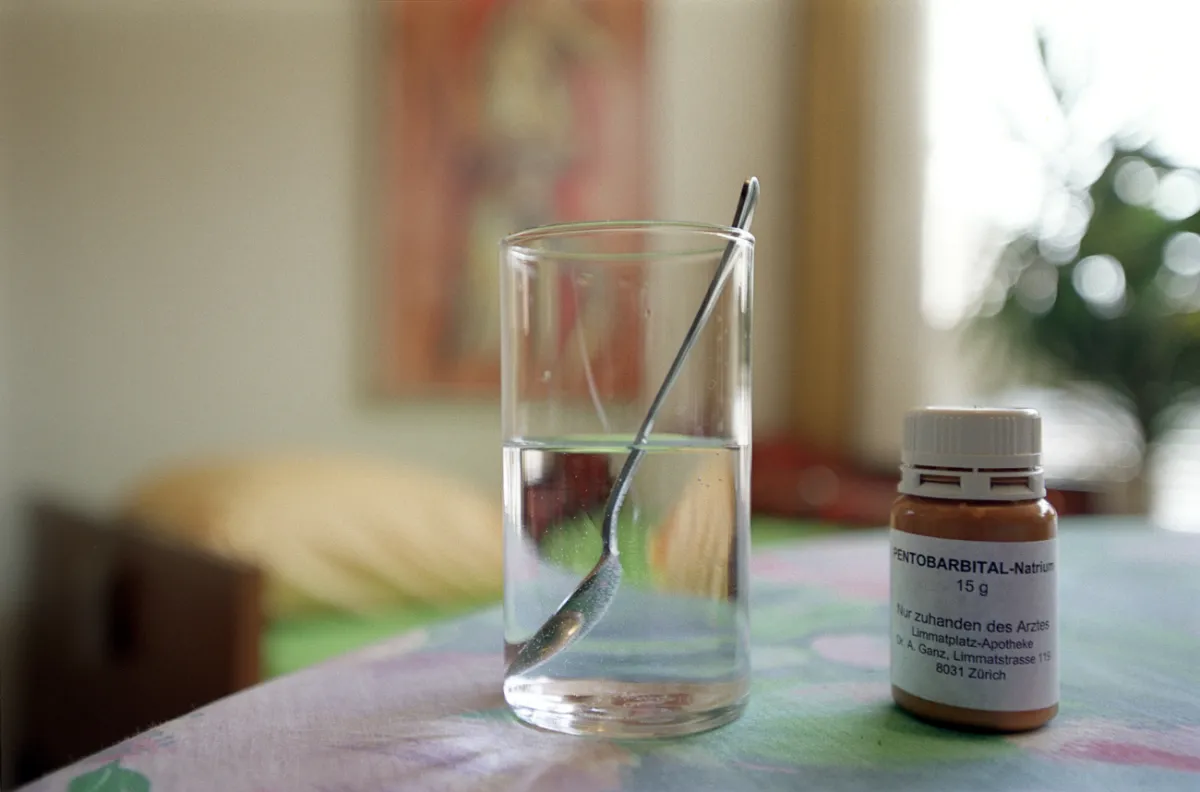
Swiss Politicians Decide Against Monitoring Assisted-Suicide Tourism
(MENAFN- Swissinfo)
How many people travel to Switzerland to end their lives? Swiss politicians do not want a precise count. Parliament has rejected a proposal to introduce monitoring, even though the data is available.
This content was published on
February 2, 2026 - 09:00
6 minutes
I write about demographic developments, societal trends and debates in Switzerland. I joined SWI swissinfo after 15 years at a local newspaper in Zurich.
-
More from this aut
German Departm
-
Deutsch
de
Die Schweizer Politik will beim Sterbetourismus nicht genau hinschauen
Original
Read more: Die Schweizer Politik will beim Sterbetourismus nicht genau hinsc
Français
fr
Pourquoi le Parlement suisse renonce à surveiller le tourisme de la mort
Read more: Pourquoi le Parlement suisse renonce à surveiller le tourisme de la
中文
zh
瑞士政界对安乐死睁一只眼闭一只眼
Read more: 瑞士政界对安乐死睁一只
Assisted-suicide tourism in Switzerland draws criticism both at home and abroad. Domestically, the associated costs for the cantons are among the concerns, while ethical objections dominate abroad. The recurring accusation is that access to assisted suicide is handled too lightly in Switzerland.
Cases involving people from the United Kingdom who sought assisted suicide in Switzerland without their relatives' knowledge have given rise to negative headlines. One such case involved a woman in her early fifties who suffered from depression following the death of her son.
The organisation involved did not break the law by assisting this woman's suicide. In Switzerland, end-of-life assistance does not require a terminal illness, nor is there any obligation to inform relatives.
Assisted suicide is regulated by an article of the Swiss criminal code, under which helping people to die is not a crime provided it is not carried out for selfish motives. In addition, there are professional guidelines issued by the medical profession and rules set by the assisted-suicide organisations themselves.
No regulation, no commentEvery political attempt to tighten regulation of assisted suicide in Switzerland has so far failed – most recently in parliament. Lawmakers returned to the issue after the “suicide pod” capsule known as Sarco brought calls for stricter rules back into focus.
Lengthy debates resulted in a minimal proposal put forward by the Senate's legal affairs committee. The motion called for overall monitoring of developments in assisted suicide in Switzerland, including the statistical recording and publication of assisted-suicide cases involving people from abroad.
At present, this only applies to assisted suicide involving Swiss residents. The proposal would also have required the collection of data on the assisted-suicide organisations involved.
However, the proposal failed in the lower house of parliament during the winter session. Few are willing to comment. Neither parliamentarians who supported the motion in committee nor its opponents responded to questions from Swissinfo.
The sole exception is Ueli Schmezer of the leftwing Social Democratic Party, who represented the House of Representatives' legal affairs committee when it argued against the proposal.
According to Schmezer, three considerations weighed against monitoring. First, he says, data on assisted suicides already exist, as such deaths are treated as“extraordinary deaths” and investigated accordingly. Politicians can also obtain information on suicides involving foreign nationals from the data of the assisted-suicide organisations, he adds.
Second, he says, the administration explained that collecting the data would involve a considerable administrative burden – at a time when the Federal Statistical Office is dropping the compilation of important statistics for budgetary reasons.
Third, Schmezer argues, Switzerland could ban assisted-suicide tourism at any point if it wishes, whether there is monitoring or not.
The government already has the dataThe member of government responsible, Elisabeth Baume-Schneider, had advanced similar arguments during committee deliberations.
Among other points, she said the issue was not simply about adding an extra field to an existing statistic, but about creating a new framework for data collection. This would require training and possibly a dedicated IT solution.
But why does recording a few hundred cases nationwide involve so much expense? Schmezer offered no explanation, referring the question to the administration.
Swissinfo asked the Federal Statistical Office to explain its data-collection process in detail. It emerged that cantonal data on assisted suicide involving people resident abroad is already transmitted to the federal authorities.
This has nothing to do with investigations of assisted-suicide cases as extraordinary deaths. The data is collected by the FSO in death certificates, in the same way as it is for people resident in Switzerland and for ordinary deaths.
“For reasons of resources, and because official statistics focus on Switzerland's resident population, no follow-up questions are asked,” the FSO writes. As a result, the information is not considered to have been systematically verified, and the figures are therefore not published.
Erika Preisig of Lifecircle – the only larger assisted-suicide organisation in Switzerland to advocate stronger regulation – does not understand why the FSO form cannot simply be expanded by a few points.
According to Preisig, the additional workload for official doctors or forensic pathologists would be minimal – especially compared with the amount of work that each assisted suicide already entails.
Assisted-suicide cases in Switzerland are officially investigated, with all the costs that entails.“Compared with the legal inspection and the report, filling in this form afterwards is small fry,” Preisig says. Nor would any special training for doctors be required.
A solution without a political mandate?After continued correspondence, the Federal Statistical Office wrote that despite the absence of a political mandate, it is nonetheless considering compiling statistics on assisted-suicide tourism.
“We are currently examining this matter proactively in order to find a possible solution that does not necessarily adhere to the wording of the motion and that would be realistic within the available financial resources,” the office wrote to swissinfo.
The Federal Statistical Office is continuously seeking to improve its range of services, it wrote.
Edited by Balz Rigendinger/Adapted from German by Catherine Hickley/ds
Popular Stories Most DiscussedIn compliance with the JTI standards
More: SWI swissinfo certified by the Journalism Trust Initiati
You can find an overview of ongoing debates with our journalists here. Please join us!
If you want to start a conversation about a topic raised in this article or want to report factual errors, email us at ....
Read more
Legal Disclaimer:
MENAFN provides the
information “as is” without warranty of any kind. We do not accept
any responsibility or liability for the accuracy, content, images,
videos, licenses, completeness, legality, or reliability of the information
contained in this article. If you have any complaints or copyright
issues related to this article, kindly contact the provider above.
Most popular stories
Market Research

More Story







Comments
No comment