




403
Sorry!!
Error! We're sorry, but the page you were looking for doesn't exist.
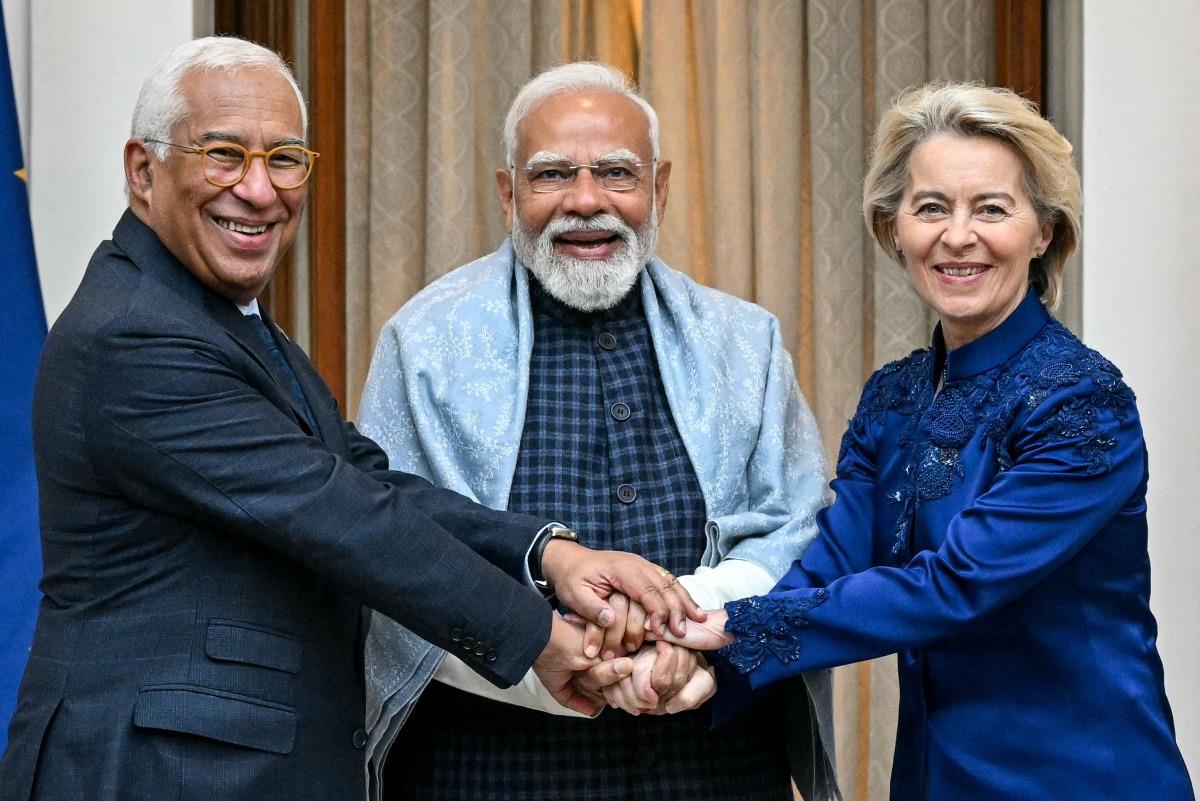
EU, India Agree 'Mother Of All' Trade Deals
(MENAFN- The Peninsula)
AFP
New Delhi: India and the European Union announced Tuesday the "mother of all deals", a huge trade pact to create a market of two billion people, reached after two decades of negotiations.
EU chiefs and Prime Minister Narendra Modi hope the pact will help shield against challenges from the world's two leading economies, the United States and China.
The agreement will cut or eliminate tariffs on almost 97 percent of European exports, saving up to 4 billion euros ($4.75 billion) annually in duties, the 27-nation bloc said.
"A mother of all deals," Modi said Tuesday in the capital New Delhi, where he met with European Commission President Ursula von der Leyen and European Council President Antonio Costa.
India's Prime Minister Narendra Modi (R) speaks as European Council President Antonio Costa listens during joint press statements after their meeting at the Hyderabad House in New Delhi on January 27, 2026. Photo by Sajjad HUSSAIN / AFP
"This deal will bring many opportunities for India's 1.4 billion and many millions of people of the EU," Modi said, adding the agreement "represents about 25 percent of global GDP, and one-third of global trade".
The EU has eyed India -- the world's most populous nation -- as an important market for the future.
"Europe and India are making history today," von der Leyen said in a statement, a day after she and Costa were feted as guests of honour at India's Republic Day parade.
"We have created a free trade zone of two billion people, with both sides set to benefit."
'Increasingly insecure world'
EU officials said the deal was the most ambitious India had ever agreed, and European companies would benefit from so-called "first mover advantage".
Europe's key agricultural, automotive and service sectors stand to gain.
But sensitive agricultural sectors, such as beef, rice and sugar whose inclusion in an earlier deal struck with South American bloc Mercosur sparked farmers' anger in Europe, were left out of the agreement.
New Delhi sees the European bloc as an important source of much-needed technology and investment to rapidly upscale its infrastructure and create millions of new jobs.
It also includes a security partnership, providing "new opportunities" for defence companies, Modi said.
European Commission President Ursula von der Leyen looks on as India's Prime Minister Narendra Modi (not pictured) speaks during the joint press statements after their meeting at the Hyderabad House in New Delhi on January 27, 2026. Photo by Sajjad HUSSAIN / AFP
"We are not only making our economies stronger -- we are also delivering security for our people in an increasingly insecure world," von der Leyen said, speaking alongside Modi after exchanging agreements.
"By combining these strengths, we reduce strategic dependencies, at a time when trade is increasingly weaponised," she added.
Bilateral trade in goods reached 120 billion euros ($139 billion) in 2024, an increase of nearly 90 percent over the past decade, according to EU figures, with a further 60 billion euros ($69 billion) in trade in services.
Under the agreement, India is expected to ease market access, and European firms will get privileged access to the Indian financial services and maritime transport market, the bloc said.
'Highest level of access'
Tariffs on cars will be gradually lowered from a top rate of 110 percent to as low as 10 percent -- with a quota of 250,000 vehicles -- while duties on wines progressively go down from 150 percent to as low as 20 percent.
Currently at 50 percent, tariffs on processed foods -- including pasta and chocolate -- will be eliminated, according to the EU.
Von der Leyen said she expected exports to India to double, and that the EU would "gain the highest level of access ever granted to a trade partner in the traditionally protected Indian market".
India's Prime Minister Narendra Modi (R), along with European Commission President Ursula von der Leyen (L) and European Council President Antonio Costa, addresses joint press statements after their meeting at the Hyderabad House in New Delhi on January 27, 2026. Photo by Sajjad HUSSAIN / AFP
For India, it would boost sectors including textiles, gems and jewellery, and leather goods, as well as the service sector, Modi said.
The accord comes as both Brussels and New Delhi seek to open up markets in the face of US tariffs and Chinese export controls.
"The unprecedented preferential access secured for over 99 percent of Indian exports is a game-changer for Indian industry," said Chandrajit Banerjee, director general, Confederation of Indian Industry.
India is on track to become the fourth-largest economy this year, according to International Monetary Fund projections.
New Delhi, which has relied on Moscow for key military hardware for decades, has tried to cut its dependence on Russia in recent years by diversifying imports and pushing its own domestic manufacturing base.
Europe is doing the same with regard to the United States.

Legal Disclaimer:
MENAFN provides the
information “as is” without warranty of any kind. We do not accept
any responsibility or liability for the accuracy, content, images,
videos, licenses, completeness, legality, or reliability of the information
contained in this article. If you have any complaints or copyright
issues related to this article, kindly contact the provider above.
Most popular stories
Market Research

More Story




Comments
No comment