






403
Sorry!!
Error! We're sorry, but the page you were looking for doesn't exist.
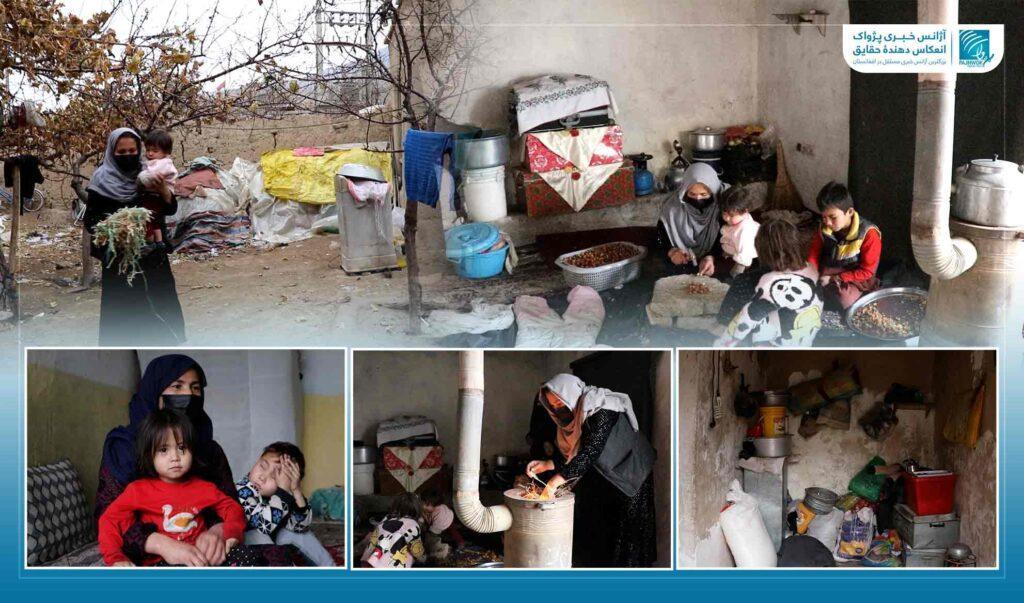
Winter Deepens Hardship For Female-Headed Households In Kabul
(MENAFN- Pajhwok Afghan News)
KABUL (Pajhwok): The harsh winter in Kabul has posed serious challenges for female-headed households. These women say that, to keep their children alive in the bone-chilling cold, they heat their homes with the most basic means available and are calling on well-off individuals, aid organizations, and the Islamic Emirate of Afghanistan (IEA) to assist them.
Pajhwok Afghan News has prepared a report on the living conditions of a number of impoverished, female-headed households in Kabul-women who, in order to cope with the winter cold, are forced to rely on rudimentary resources to heat their homes and protect their children.
Sarafnaz:“I burn almond shells so my children do not freeze”
Sarafnaz, 35, originally from Bamyan province, lives with her four children in a mud house in Kabul and uses firewood and almond shells for heating. She said she married 13 years ago and had two children, but unemployment and her husband's psychological problems made life increasingly difficult, eventually leading to divorce.
After moving to Kabul, she married again and had a daughter from her second marriage, but that relationship also failed. Her second husband, she said, was addicted to drugs, subjected her and the children to violence, and sold household belongings to buy narcotics. His addiction and abusive behavior ultimately resulted in another divorce. She now lives free from violence, but under severe economic hardship.
Sarafnaz currently resides with her four children in a mud house in the Sorkhabad area of Dasht-e-Barchi, Kabul.
Sitting among sacks of almonds and cracking them with her children, she said:
“I take almonds from shopkeepers, peel them, use the shells as fuel for the stove, and return the almond kernels to the shopkeepers. When there are no almond shells, we collect firewood from empty land so our stove can keep warm.”
Asked about other necessities such as food and clothing, she said:
“Sometimes there is bread, sometimes there is not. Neighbors help us, and many times out of desperation I go to charity gatherings to bring a piece of bread for my children.”
She urged the IEA, philanthropists, and charitable organizations to assist her, her children, and other families facing similar conditions.
Malika:“We collect cardboard from streets and shopfronts and burn it in the stove”
Malika, a resident of the Qala-e-Naw area of Dasht-e-Barchi, Kabul, said her husband disappeared in Ghazni province eight years ago, and his whereabouts remain unknown.
“Every day, my children and I go around the city and collect paper, cardboard, and other discarded items from streets and shopfronts, and burn them in the stove so my children do not freeze to death,” she said.
A mother of five, Malika said she works in people's homes to earn enough to provide dry bread, some sugar, and tea for her children.
She also called for assistance, saying:
“Traders, investors, and our government must help us during this cold season; otherwise, our children will fall ill because of the cold.”
Religious scholars: Supporting widows and orphans is a shared responsibility
Noorullah Kosar, a religious scholar, said assisting widows, orphans, and unsupported individuals is both a humanitarian duty and a clear Islamic obligation.
“Islam obliges us to support the oppressed, the needy, widows, and orphans. Cooperation and helping those in need are among the fundamental duties of our religion and have been repeatedly emphasized in religious texts,” he said.
He added:“Under Islamic law, we are commanded to support orphans, widows, and those facing hardship in life. In light of these principles, helping orphans, widows, and the poor is a duty, a mission, and a responsibility of all of us. It is a religious, moral, and humanitarian obligation.”
Similarly, Mawlawi Mohammad Hassan Haqyar, another religious scholar, said assisting widows and female-headed households is a religious obligation of their relatives and also a responsibility of the government.
“In assisting the needy, there is no distinction between men and women; in many cases, women are even more deserving than men,” he said.
Mawlawi Haqyar emphasized that every needy woman has the right to receive support from her relatives and the government, regardless of race, ethnicity, position, or region. What matters, he said, is humanity, responsibility, and adherence to Islamic teachings.
ARCS officials
Hafiz Abdul Qadeem Abrar, spokesman for the Afghan Red Crescent Society (ARCS), said the organization continuously provides support to female-headed and impoverished families, particularly through the central orphanage in Kabul and other orphanages.
He said ARCS has provided-and continues to provide-medicine, food, employment opportunities, and vocational training for these women.
The ARCS spokesman added that hundreds of needy individuals receive assistance through the organization, and addressing the needs of female-headed and impoverished families remains one of its top priorities.
“Hundreds of people receive assistance through the Red Crescent. Supporting female-headed families is among our priorities. Between 15,000 and 16,000 families are registered as external beneficiaries and receive assistance through Red Crescent funds,” he said.
sa

Legal Disclaimer:
MENAFN provides the
information “as is” without warranty of any kind. We do not accept
any responsibility or liability for the accuracy, content, images,
videos, licenses, completeness, legality, or reliability of the information
contained in this article. If you have any complaints or copyright
issues related to this article, kindly contact the provider above.
Most popular stories
Market Research

More Story





Comments
No comment