







403
Sorry!!
Error! We're sorry, but the page you were looking for doesn't exist.
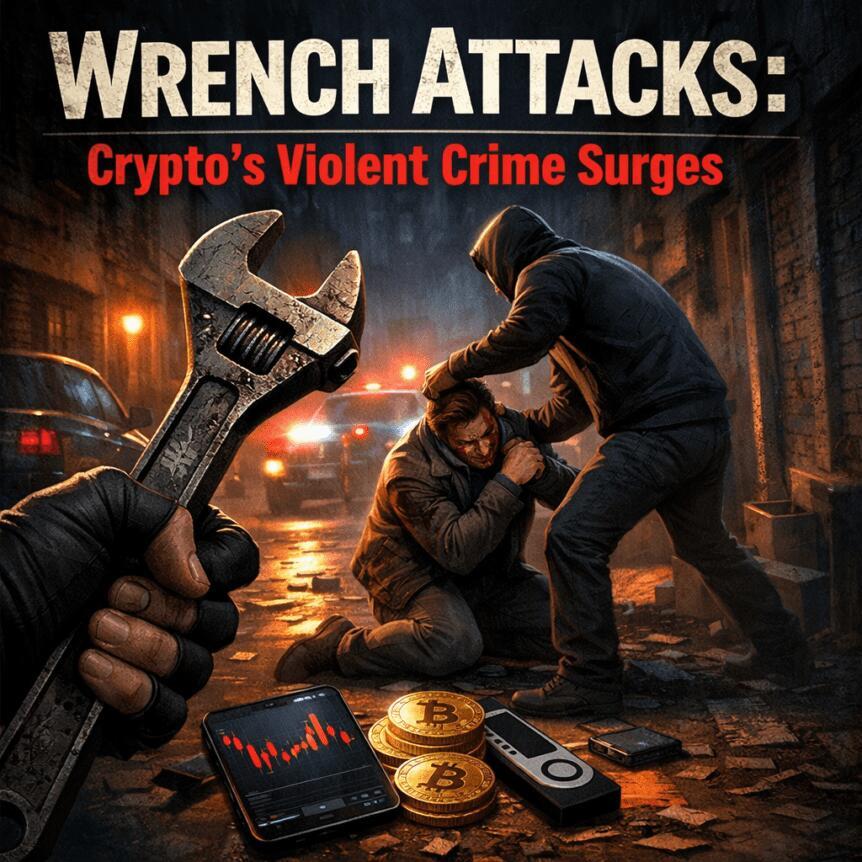
Wrench Attacks: Crypto's Violent Crime Surges
(MENAFN- Crypto Breaking) Introduction
Crypto assets are highly volatile. Your capital is at risk. Don't invest unless you're prepared to lose all the money you invest.
January 2025 saw French authorities freeing Ledger co-founder David Balland after kidnappers demanded a large ransom in cryptocurrency, a case that starkly illustrated how crypto crime can cross from screens into the streets. The incident underscores a troubling trend: coercive, real-world attacks aimed at gaining access to digital wealth. As crypto markets expand and wealth concentrates, attackers are increasingly resorting to violence and threats to bypass digital safeguards. That shift has prompted a broader rethink of risk management-from wallets and keys to personal safety and offline leverage.
Key Takeaways- Wrench attacks rely on coercion in the physical world to extract crypto access, not on breaking cryptography. Violence linked to crypto crime is rising in visibility, with incidents clustered around higher market wealth. Attack vectors include public-facing roles, data leaks, and the ease of converting stolen access into quick payouts. Mitigation centers on reducing exposure, limiting accessible balances, and treating impersonation as a credible threat.
Tickers mentioned: None
Sentiment: Neutral
Price impact: Neutral. No immediate price signal tied to the topic.
Trading idea (Not Financial Advice): Hold. While risk is rising in certain scenarios, broad market participation remains unaffected in the near term.
Market context: The rise in wrench-style pressure mirrors wider crypto-market volatility and the ongoing tension between on-chain wealth and off-chain risk.
What is a wrench attack?A wrench attack is a physical-world crime in which attackers use threats or violence to force a crypto holder to reveal credentials, unlock a device, or authorize a transfer. In essence, it is crypto theft by targeting the person, not the cryptography. The label drew its bite from an Xkcd comic, which joked that if encryption is sufficiently strong, criminals may skip breaking the math and instead rely on coercion-the infamous“$5 wrench” shortcut. The metaphor captures a shift from purely digital exploits to a direct threat model that converges online wealth with offline risk, forcing the security conversation beyond the browser.
Are wrench attacks really increasing or just getting more attention?The short answer is both: reported wrench attacks have risen, and the severity of incidents has grown in recent years. Haseeb Qureshi of Dragonfly, analyzing Jameson Lopp's incident log, asserts that the frequency of wrench attacks has increased and that outcomes have become more damaging as values involved climb. The data also show a price effect: as total crypto market capitalization rises, reported violence tends to rise, with a regression attributing about 45% of the variation in attack frequency to market capitalization.
Two caveats matter. First, Lopp's database is not comprehensive; it draws on public reports, meaning many cases that never reach headlines remain invisible. Second, academic research suggests systematic underreporting, including victims who stay quiet out of fear of revictimization. That context matters: measured per user, current risk may appear lower than in earlier cycles, even if headlines feel more alarming.
Why wrench attacks are among crypto's most violent crimesWrench attacks are driven by four dynamic forces: fast, irreversible payouts; rising concentrations of reachable wealth; easier real-world targeting; and data leaks that turn online identities into real-world risk.
Driver 1: The payout is fast, portable and hard to unwindCriminals can compel transfers that move value quickly and across borders, bypassing traditional laundering workflows. The velocity and finality of a direct coercion payout explain why some attackers find coercion more attractive than cyber exploits.
Driver 2: More people hold reachable wealthAs crypto markets rise, larger holdings become more tempting targets. Incident frequency tracks total market capitalization, suggesting wealth growth correlates with risk of violence.
Driver 3: Finding targets is easier than it looksPublic roles, meetups, peer-to-peer platforms and everyday oversharing provide attackers with real-world hooks. Cambridge researchers describe these as attacks that shift pressure from digital security to the holder's daily life.
Driver 4: Data exposure turns online identity into offline riskRecent incidents show how names, addresses and phone numbers can leak through third parties or insider abuse. Examples range from incidents involving support-agent bribery at Coinbase to Ledger -related data exposures, making it easier to link individuals to crypto activity in the real world.
How these attacks typically play outPattern-wise, wrench attacks resemble a crime script: target, approach, coercion, then rapid movement of funds after access is obtained. The initial contact can resemble ordinary street crime or more organized coercion, and victims are not always random. In some cases, wrench attacks intersect with domestic or interpersonal abuse, where crypto access becomes a tool of control.
Did you know? Roman Novak and Anna Novak were a Russian couple living in Dubai who disappeared in October 2025 after being lured to a meeting with supposed investors near Hatta, close to the Oman border. Investigators later treated the case as a kidnapping linked to attempts to force access to money, including cryptocurrency, making it one of the most widely cited real-world examples of a wrench attack with fatal consequences.
Who's most at risk?Wrench attacks rarely target random crypto users. They disproportionately affect individuals who are easy to identify, locate and perceived to hold large, accessible wealth, including founders, executives, public-facing influencers, OTC or P2P traders, and anyone whose online footprint ties real identity to significant crypto wealth.
Geography matters: Western Europe and parts of the Asia-Pacific region account for a sharp rise in reported incidents, while North America shows rising counts but comparatively safer relative to regional peers. Notably, attackers sometimes target relatives or partners, using family proximity when the wallet owner is difficult to reach.
How to lower your riskThe hard truth is that strong key management does not eliminate all risk. The goal is to make yourself a poor target and slow an attacker's progress. Three practical themes guide risk reduction:
- Lower your visibility: Avoid broadcasting holdings, disentangle real-world identity from crypto activity, and assume oversharing heightens risk. Lower your instant-access balance: Separate day-to-day spending from long-term storage and avoid single points of failure for larger amounts, using multi-party approvals or delays where feasible. Treat support impersonation as part of the same threat landscape: Leaked data can pressure victims into moving funds. Legitimate support will not request passwords, 2FA codes or transfers to a so-called safe address, per industry guidance.
If a threat materializes, safety comes first: secure personal safety and seek help, then address wallet security. Wrench-style attacks personify crypto crime's most delicate edge-where digital wealth becomes a personal security risk and the line between cyberspace and the street blurs in real time.
Crypto Investing Risk WarningCrypto assets are highly volatile. Your capital is at risk. Don't invest unless you're prepared to lose all the money you invest.

Legal Disclaimer:
MENAFN provides the
information “as is” without warranty of any kind. We do not accept
any responsibility or liability for the accuracy, content, images,
videos, licenses, completeness, legality, or reliability of the information
contained in this article. If you have any complaints or copyright
issues related to this article, kindly contact the provider above.
Most popular stories
Market Research

More Story








Comments
No comment