







403
Sorry!!
Error! We're sorry, but the page you were looking for doesn't exist.
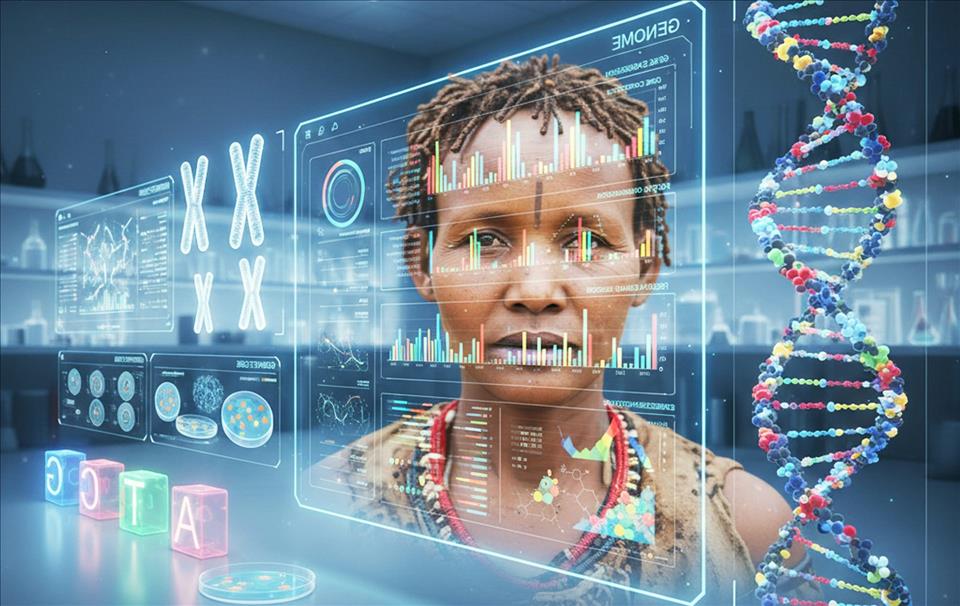
Becoming Human In Southern Africa: What Ancient Hunter-Gatherer Genomes Reveal
Author: hunter-gatherer
(MENAFN- The Conversation) New genetic research is shedding light on some of the earliest chapters of our human history. In one of the largest studies of its kind, scientists analysed DNA from 28 individuals who lived in southern Africa between 10,200 and a few hundred years ago. The study provides more evidence that hunter-gatherers from southern Africa were some of the earliest modern human groups, with a genetic ancestry tracing back to about 300,000 years ago. Marlize Lombard, an archaeologist whose research focuses on the development of the human mind, breaks down the key findings.Why did you study the DNA of ancient hunter-gatherers in southern Africa?

According to the genetic, palaeo-anthropological and archaeological evidence, modern humans – Homo sapiens – originated in Africa hundreds of thousands of years ago and then spread around the world. But the evolutionary process of exactly how, where and when this happened is debated.
Africa has the greatest human genetic diversity and the hunter-gatherers of southern Africa represent some of the oldest known genetic lineages. They can therefore reveal more about where and when we originated as a species.
After thousands of years of migration, modern African populations have a mixed genetic heritage. So their genomes are not very helpful for understanding our deep evolutionary history. For that, we need to look at genetic variation among individuals living before large-scale population movements on the continent.
In southern Africa, it means going back to before about 1,400-2,000 years ago. It also means that such rare ancient hunter-gatherer DNA can provide valuable information, not available in the DNA of living people.
What we specifically wanted to learn from the ancient southern African DNA was to which extent the biological and behavioural patterns we observe in the fossil and archaeological records were continuous and particular to the region.
For example, at a South African fossil-bearing site called Florisbad, we have a human skull dating to about 260,000 years ago that shows a possible transition from Homo heidelbergensis into Homo sapiens. And from about 100,000 years ago there was a rapid increase in technological innovations such as paint-making, glue-making and long-range weapon use.
We sequenced the DNA of 28 ancient individuals from what is now South Africa, all dating to the Holocene epoch that started about 11,700 years ago. DNA sequencing“reads” the order of the chemical base-pairs that make up an individual's DNA. This helps us to reconstruct a person's genome, or their complete set of genetic information. Among other things, it can tell us something about the individual's biological and behavioural characteristics.
Eight of the individuals used to live near the coast at Matjes River, in today's Western Cape province. Several others lived at inland sites across South Africa. We dated their remains with radiocarbon dating, finding that the oldest died about 10,200 years ago at Matjes River and the most recent died just 280 years ago in the Free State. (All DNA from archaeological contexts is scientifically known as ancient DNA.)
What did the DNA reveal?Our study shows that the genetic makeup of the southern African hunter-gatherer population didn't change much for 9,000 years across the whole of South Africa, not only in the southern Cape, even though their technologies and lifeways may have changed or differed during this time.
All ancient southern Africans dated to more than 1,400 years ago had some unique Homo sapiens genetic variations. The ancient DNA had genes associated with UV-light protection, skin diseases, and skin pigmentation. These could have been essential to life on southern Africa's grasslands and fynbos. Among the genetic variants that were common to ancient and modern humans were genes related to kidney function (potentially connected to improved water-retention) and immune-system related genes.
About 40% of the ancient southern African genes are associated with neurons, brain growth and the way that human brains process information today. Some of these gene variants may have been involved in the evolution of how humans pay attention today. Attention is a cognitive or mental trait that seems to have evolved differently in African Homo sapiens compared to the now extinct Neanderthals and Denisovans from Eurasia. It may have played a role in the successful spread of Homo sapiens out of Africa after about 60,000 years ago.
What does this tell us about human evolution and population migration?Our work shows that some biological adaptations for becoming modern humans were unique to southern African hunter-gatherers who lived in a relatively large, stable population for many thousands of years south of the Limpopo River.
Co-author and geneticist from Uppsala University in Sweden, Carina Schlebusch, commented that
Our findings contrast with linguistic, archaeological and some early genetic studies pointing to a shared ancestry or long-term interaction between different regions of Africa. Instead, it seems that southern Africa may have offered humans a climate and landscape refuge where hunter-gatherers thrived, adapting to a place rich in plant and animal resources for 200,000 years or more. During this time, we see no genetic evidence for incoming populations. Instead, sometime after about 100,000-70,000 years ago, small groups of southern African hunter-gatherers may have wandered northwards, carrying with them some of their genetic and technological characteristics.
According to population geneticist Mattias Jakobsson at Uppsala University,
Up to now, humans seemed to have developed their modern anatomical (physical) form before they developed modern behaviour and thinking. Learning more about ancient genes could help to close this gap, especially once more becomes known from genetic studies of other ancient African forager groups, and indigenous peoples elsewhere on the globe.
Institution:University of Johannesburg

Legal Disclaimer:
MENAFN provides the
information “as is” without warranty of any kind. We do not accept
any responsibility or liability for the accuracy, content, images,
videos, licenses, completeness, legality, or reliability of the information
contained in this article. If you have any complaints or copyright
issues related to this article, kindly contact the provider above.
Most popular stories
Market Research

More Story







Comments
No comment