




403
Sorry!!
Error! We're sorry, but the page you were looking for doesn't exist.
Active Clubs: How The Body Has Become A Battleground For The Far Right
Author: Frédérick Nadeau
(MENAFN- The Conversation) Photos of young men with bare chests and arms crossed standing in front of flags with runic or Celtic symbols are multiplying on social media. These images are not of ordinary sports clubs, but show a transnational far-right network called Active Clubs.
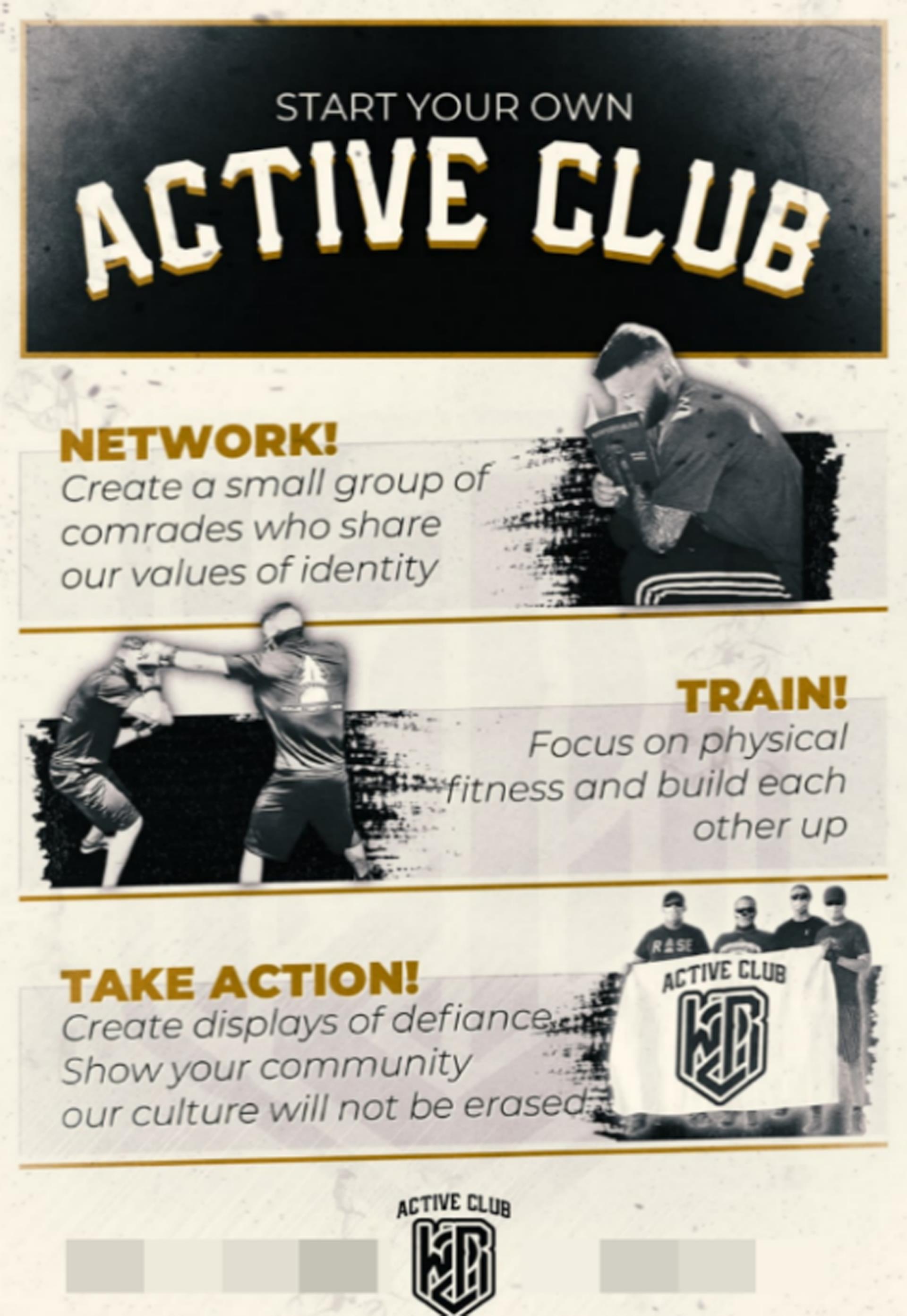
An invitation to start your own local club. The infographic was created by Will2Rise, a branch of the Rise Above Movement. (Source: Anti-Defamation League) Sport as breeding ground for indoctrination![]()
Italian far-right thinker Julius Evola promoted by Active Clubs. (Message from Gym XIV on the SoCal Active Club Telegram channel, June 2025, accessed on June 11, 2025), CC BY![Men fighting]()
Active Clubs want to give the far right a respectable face. (Telegram channel AC x OFFICIAL), CC BY Fascism with a friendly face![Men fighting]()
Active Clubs promote community action. (Published on the AC x OFFICIAL channel, accessed on 22 July 2025), CC BY![Men lined up holding a banner]()
Through Active Clubs, we are witnessing the transnationalization of white nationalism, write the authors. (Message spotted on the Telegram channel Nationlist-13, 21 April 2025, accessed 3 June 2025), CC BY Extremism taking root in everyday life

Hidden behind innocuous rhetoric of self-improvement and calls to become“the best version of yourself,” these groups actually promote a form of virile camaraderie infused with white nationalism and accelerationist ideology. Their core belief is that forging a strong and disciplined body is essential to prepare for an anticipated racial war and for what they describe as the“reconquest” of western civilization.
Our analysis is based on a body of 1,000 publications from Telegram channels linked to Active Clubs, as well as internal media resources within the movement. With our colleague Isaac Gnochinni, we recently published the results in the journal Amnis.
An invitation to start your own local club. The infographic was created by Will2Rise, a branch of the Rise Above Movement. (Source: Anti-Defamation League) Sport as breeding ground for indoctrination
Active Clubs originated in the United States, drawing inspiration from the Rise Above Movement, founded in 2017 by Californian neo-Nazi activist Robert Rundo. From exile in Romania, Rundo developed the idea of a network of local, decentralized clubs based on a simple principle: replacing large, hierarchical organizations with small autonomous cells that are harder to dismantle and where physical training becomes a vehicle for radicalization.
Chapters now exist in Canada, Europe and Australia. According to the American organization Global Project Against Hate and Extremism, their numbers have grown by 25 per cent since 2023, with 187 clubs in 27 countries.
Training together fosters bonds of solidarity rooted in shared hardships, discipline and loyalty, values that are central to fascist ideology. The muscular, resilient, combat-ready body becomes a marker of moral renewal and a symbol of an imagined racial order that must be restored.
Italian far-right thinker Julius Evola promoted by Active Clubs. (Message from Gym XIV on the SoCal Active Club Telegram channel, June 2025, accessed on June 11, 2025), CC BY
Influenced by accelerationist thinking - an ideology that seeks to provoke or hasten the collapse of liberal society to enable the“rebirth” of a white civilization - this worldview circulates in thousands of posts shared on encrypted messaging platforms like Telegram.
Videos, images and symbols combine to produce a unified visual culture of a globalized and visually appealing white nationalism.
Read more: A field guide to 'accelerationism': White supremacist groups using violence to spur race war and create social chaos
In Canada, some Active Club members have been linked to designated terrorist organizations like the AtomWaffen Division (AWD). After AWD propagandist Patrick Gordon MacDonald was convicted of terrorism charges earlier this year, several of the group's supporters turned to Active Clubs.
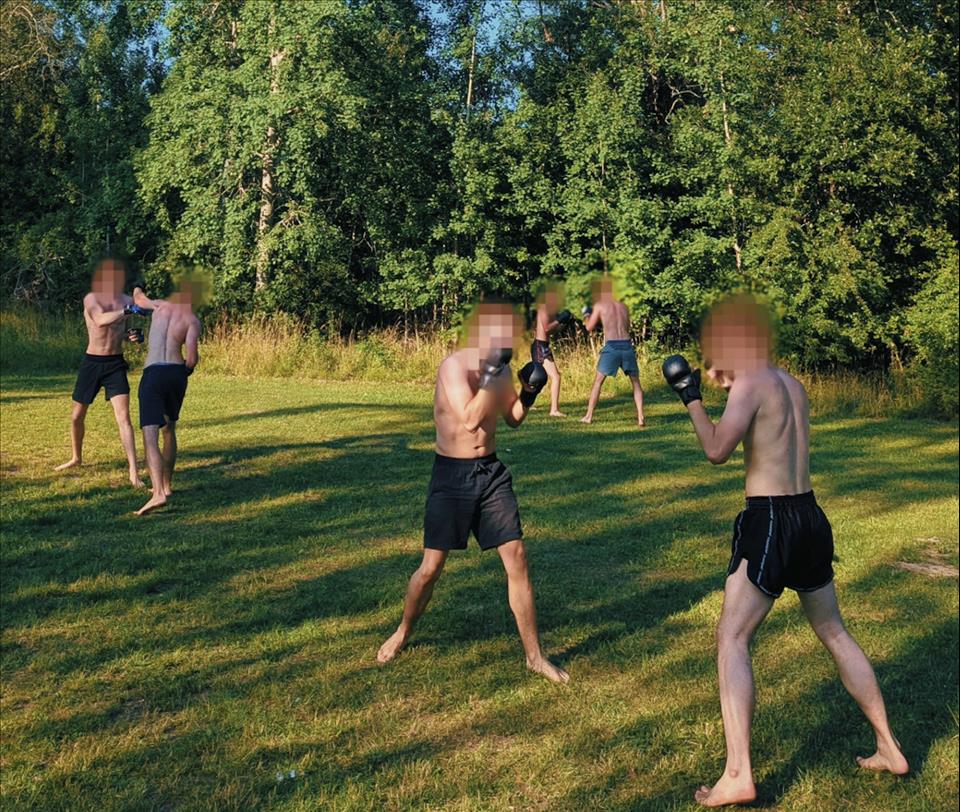
The body as an instrument of radicalizationActive Clubs' online content frequently features group workouts, forest hikes and outdoor boxing sessions. The messages circulating on Telegram emphasize rigour, virility and brotherhood. One channel puts it bluntly:
This illustrates what we have elsewhere described as an “esthetic mode of political engagement:” a form of embodied politics in which ideologies are lived and experienced through bodies, lifestyles and everyday habits. In this logic, politics begins as a relationship with yourself. Activists are encouraged to modify their diet, appearance, leisure activities and even intimate relationships in order to conform to the ideal promoted by the movement.
Such strategies give ideological commitments a tangible and emotional dimension. They make radicalism experiential: you don't merely believe in ideas; you inhabit them, feel them and perform them. This dynamic helps explain why Active Clubs can be particularly attractive to some young men seeking purpose, community and masculine role models.
Active Clubs want to give the far right a respectable face. (Telegram channel AC x OFFICIAL), CC BY Fascism with a friendly face
Unlike explicitly political organizations, Active Clubs operate in ordinary, everyday spaces. On social media, members showcase themselves training together, volunteering or cleaning public areas - activities that function as rituals of sociability while projecting the image of disciplined and respectable young men. This stands in stark contrast to the stereotypical figure of the skinhead or neo-Nazi often portrayed in popular culture. As the SoCal Active Club's Telegram channel puts it:
Active Clubs promote community action. (Published on the AC x OFFICIAL channel, accessed on 22 July 2025), CC BY
But behind the facade of sport and camaraderie, Active Clubs quietly politicize their members by instilling narratives of identity, hierarchy and moral or racial purity. Their posts routinely revive a dichotomy at the heart of fascist ideology: the divide between the“strong,” imagined as healthy, disciplined and virile, and the“weak,” dismissed as parasites or degenerates.
These images foster a sense of belonging rooted in the pride of being on the“right side” while excluding those deemed unworthy.
Read more: Grok, l'IA de Musk, est-elle au service du techno-fascisme?
Estheticized violence in the language of wellnessWhat makes Active Clubs particularly dangerous is their ability to shift political radicalization into the realm of everyday life, reframing it as a culture of well-being. By adopting the language of self-improvement, brotherhood and discipline, they don't reject violence: they estheticize it. Where neo-fascist or skinhead crews displayed overt brutality and a clearly marginal esthetic, Active Clubs recast violence as a moral virtue, presenting it as a sign of health, honour and loyalty.
This blurs boundaries, making radicalism attractive, even aspirational, by tapping into positive emotions to legitimize authoritarian ideals.
Drawing on the rhetoric and visual codes of wellness, fitness and performance culture, Active Clubs turn fascism into a lifestyle - not only something to believe in, but something to live.
Through Active Clubs, we are witnessing the transnationalization of white nationalism, write the authors. (Message spotted on the Telegram channel Nationlist-13, 21 April 2025, accessed 3 June 2025), CC BY Extremism taking root in everyday life
To understand these new forms of radicalization, it's no longer enough to study political discourse or party policies. We must pay attention to bodies, gestures and emotions. We must look closely at everyday life.
Active Clubs show that today's culture wars are also fought in gyms, on Instagram reels and through self-help podcasts. The message is simple: to change the world, you must first change yourself.
Read more: Masculinité et politique à l'ère du trumpisme
By giving radicalism the appearance of personal growth and camaraderie, Active Clubs help normalize the far right. They translate classic fascist tropes - hierarchy, purity, masculinity - into the neoliberal language of performance, well-being and health.
By merging bodily discipline with extremist narratives, they make fascism not only acceptable but desirable. In doing so, they contribute to the rise of a new form of white nationalism: less overtly political, more cultural and therefore more difficult for law enforcement - but also for parents, educators and civil society in general - to detect and challenge.
This article was originally published in French
Institution:Sciences Po

Legal Disclaimer:
MENAFN provides the
information “as is” without warranty of any kind. We do not accept
any responsibility or liability for the accuracy, content, images,
videos, licenses, completeness, legality, or reliability of the information
contained in this article. If you have any complaints or copyright
issues related to this article, kindly contact the provider above.
Most popular stories
Market Research

More Story




Comments
No comment