


HRCP Slams Lower Dir Police For 'Taliban-Inspired' Restrictions On Music And Women's Mobility


Lower Dir police have come under strong criticism from human rights organisations and activists after the district police officer (DPO) issued a controversial circular ordering action against loud music at weddings and prohibiting non-mahram women from sitting in the front seat of vehicles.
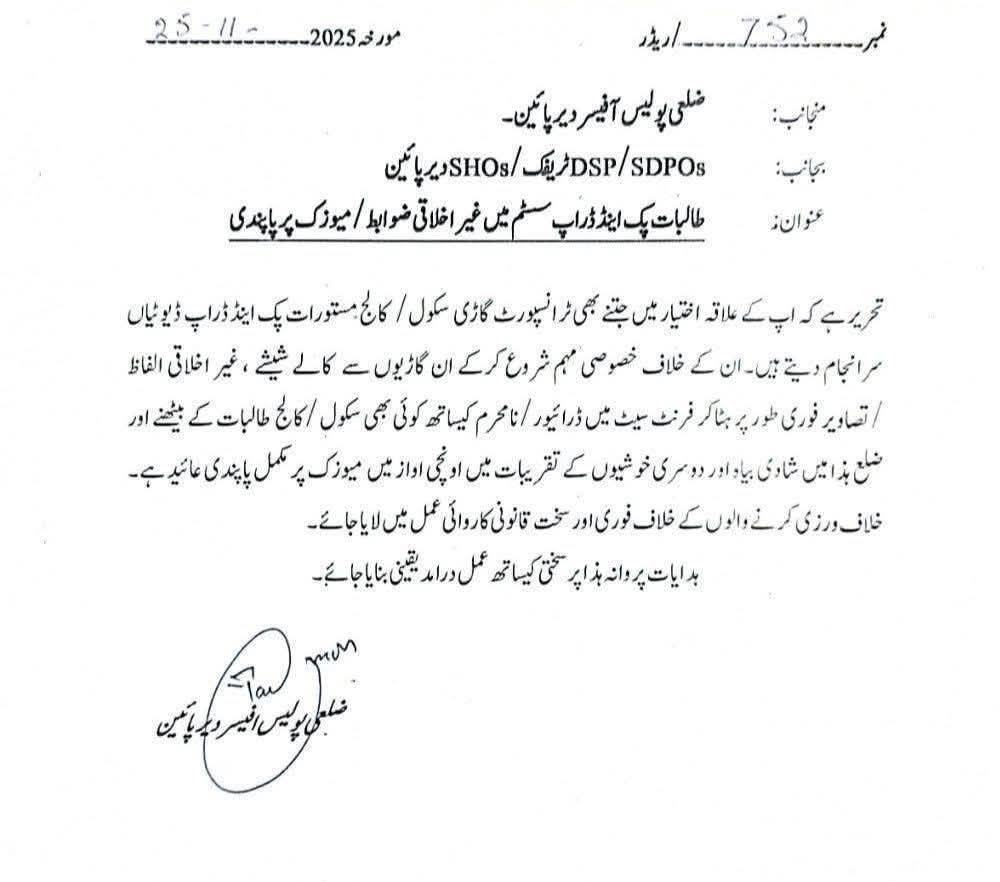
The circular, issued on 25 November by the DPO of Lower Dir (Dir Paeen), directed DSPs, SDPOs and SHOs to launch a special campaign against transport vehicles providing pick-and-drop services to women. The order instructed police to remove black-tinted windows,“immoral” stickers and images, and to strictly enforce a ban on school and college girls sitting in the front seat with male drivers.
The circular further declared that no marriage ceremonies or celebratory gatherings in the district would be allowed to play loud music.
Also Read: Abandoned Hospital Turns Into Stray Dog Haven as Child Dies Without Treatment in Upper South WaziristanPolice spokesperson Badshah Hussain confirmed the authenticity of the circular, saying it was meant only for Lower Dir police officials and was not intended for public circulation.“The DPO had directed that it must not be posted on social media, yet it has gone viral,” he said.
The leaked directive sparked immediate backlash. The Human Rights Commission of Pakistan (HRCP) declared the move a violation of fundamental freedoms.
Akbar Ali, HRCP's vice-chairperson for Khyber Pakhtunkhwa, told TNN that the DPO's instructions were“beyond the law” and would directly impact personal liberty.“We urge all subordinate officers to refrain from implementing illegal directives that could infringe upon individual freedoms,” he said.
He added that loud music alone is not an unlawful act and if noise is the concern, then all activities causing sound pollution should be addressed“without discrimination”.
This is not the first time police in the province have attempted to enforce moral restrictions. Earlier, an SHO named Abdul Ali had also issued similar orders publicly.
However, former Additional Inspector General of Police, Syed Akhtar Ali Shah, believes that while music is part of culture and protected under Pakistan's Constitution, some forms of“vulgar” music can affect the emotions of girls sitting in front seats, which is why such restrictions were introduced.“Around the world music is played freely, but care is taken not to disturb others,” he said.
When questioned why similar action is not taken against loud, provocative speeches blared through speakers at public intersections across KP, Shah admitted that the law must be enforced without bias.“Unfortunately, that does not happen here, which leads to chaos.”
Article 9 of the Constitution of Pakistan states that no person shall be deprived of life or liberty except in accordance with law.
Human rights activist and former senator Bushra Gohar strongly condemned the police directive, calling it a strategy influenced by“Taliban ideology”. She said policing should focus on maintaining public order, not enforcing morality.“This is an attack on the lives and freedoms of women and Pashtun society,” she said.
“These actions are part of a broader project to impose Taliban-like thinking, and the provincial government is equally complicit. We will never accept extremist measures being enforced in Khyber Pakhtunkhwa,” she added.

Legal Disclaimer:
MENAFN provides the
information “as is” without warranty of any kind. We do not accept
any responsibility or liability for the accuracy, content, images,
videos, licenses, completeness, legality, or reliability of the information
contained in this article. If you have any complaints or copyright
issues related to this article, kindly contact the provider above.


Comments
No comment