





403
Sorry!!
Error! We're sorry, but the page you were looking for doesn't exist.
Lawyers Question Trump's Authority To Impose H-1B Visa Fees, Vow To Fight Till The End
(MENAFN- Live Mint)
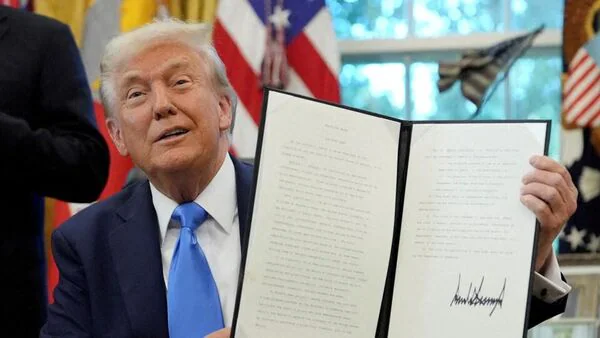
Three of the seven lawyers who filed a case challenging US President Donald Trump's executive order to raise H-1B visa fees to $100,000 last month questioned his authority to increase monetary requirements for such permits, suggesting that they would fight this case to the end.
“Our lawsuit asks the court to block the Executive Order from taking effect because it exceeds the authority granted to the President and would cause significant harm. Our legal system is designed to prevent exactly that kind of overreach," said Kalpana V. Peddibhotla, executive director of the South Asian American Justice Collaborative (SAAJCO), a San Jose-based non-profit legal organisation, in an emailed response to Mint.
This was the first major case filed against Trump's executive order seeking to limit the entry of foreigners in the country, and also a pushback to lawmakers in the US who have upped the ante against H-1B visa holders in the last two months.
Also Read | H1B visa holders not coming back to India: US-based Indian investor explains wh“We believe the law is crystal clear that does not allow any president to do what Trump has done here," said Charles H. Kuck, founder of Kuck Baxter LLC, an Atlanta-based law firm, in an emailed response to Ming. Kuck is also a law professor at Emory University School of Law, where he teaches advanced immigration law.
Peddibhotla said the order passed by Trump would harm the US economy.
“By imposing a $100,000 fee, it (the executive order) turns a lawful visa program into a pay-to-play system that benefits only the wealthiest employers and harms the broader U.S. economy. The language of fraud and job stealing has long been used to justify exclusion of immigrants from Latin America, Asia, and Africa, and it is now being directed at South Asians, particularly Indians, who make up the majority of H-1B professionals," said Peddibhotla.
According to the US Department of State, Asian countries are the primary beneficiaries of the H-1B visas. The top beneficiary was India, which received 150,647 visas in the previous fiscal year. China was a distant second, receiving 31,735 such visas.
Challenging Trump's orderOn 23 September, at least nine complainants, including employee unions from sectors such as healthcare, education, agriculture, automobile, and aerospace, filed a lawsuit through seven law firms in a California district court. They challenged Trump's order, requesting that the court deem the proclamation unlawful and have the H-1B visas processed in accordance with existing laws.
The law firms and non-profit organisations include Justice Action Centre, Democracy Forward Foundation, Kuck Baxter Llc, South Asian American Justice Collaborative, Joseph & Hall, P.C., Bless Litigation Llc, and Siskind Susser.
They represent the nine complainants, including Global Nurse Force, a California-based healthcare business that provides nurses to hospitals across the US, and various unions and religious bodies.
Also Read | Ex-Amazon employee reveals why Americans hate Indians taking jobs on H1B visa“The litigants in the H1-B are not who you would expect to find working together - the United Auto Workers and a nursing group have united as part of the group seeking relief against the Trump H1-B fee. It shows how opposition to Trump is creating unusual alliances," said Russell A. Stamets, partner at New Delhi-based law firm Circle of Counsels, in an emailed response to Mint.
However, Peddibhotla said,“It's too early to speculate about next steps, but we're prepared to pursue every legal avenue necessary to protect the people and communities affected by this policy. We're confident in the strength of our case and believe the law is on our side at every level of review."
Kuck added that they would appeal at a higher court if they were to lose this case,“as will the government when they lose."
In the US, parties dissatisfied with the district court's ruling can file appeals in one of the 13 circuit courts, known as the US Court of Appeals. If either party is still not content with the circuit courts' judgment, they can petition the Supreme Court to hear the case.
The Supreme Court reviews the petition and only grants a request if it believes that a significant legal issue must be resolved. If the petition is denied by the Supreme Court, the lower court's decision remains final and binding.
"Like the injunction granted against Trump's use of troops in Oregon, lower courts are mostly ruling against Trump but Trump is winning on appeal at a Supreme Court that has utterly surrendered its independence to Trump," said Stamets.
Mounting visaAccording to a Mint analysis, most H-1B visas are snapped up by information technology (IT) companies, with Indians being the majority of such visa holders. Seven of the 10 largest users of these visas are technology firms. According to data from the US Citizenship and Immigration Services, the top 10 users accounted for 36,737 visas, more than half of the total number of H-1B visas issued in 2024-25, as of June 30. The US government follows a fiscal calendar from October to September.
US policymakers have also increased scrutiny of such visa holders.
On 30 September, Tom Cotton, a Republican senator from Arkansas, introduced the Visa Cap Enforcement Bill in the US Senate, aiming to strip colleges, non-profits and research institutes of their long-standing exemption from annual H-1B visa limits.
Also Read | Indians Express Anger & Frustration Over Trump's H1B Visa Fee HikeAlmost a week prior, on 24 September, Republican senator Charles E. Grassley and Democratic senator Richard J. Durbin targeted several companies, including TCS and Cognizant, over their hiring practices.
Both senators wrote joint letters to K. Krithivasan and S. Ravi Kumar, chief executives of TCS and Cognizant, respectively, seeking responses on the claims of race-based discrimination and substituting American workers with low-cost H-1B employees.
Earlier the same month, Ohio senator Bernie Moreno proposed the Halting International Relocation of Employees (HIRE) Act to increase taxes on companies that hire offshore employees from their IT vendors.

Legal Disclaimer:
MENAFN provides the
information “as is” without warranty of any kind. We do not accept
any responsibility or liability for the accuracy, content, images,
videos, licenses, completeness, legality, or reliability of the information
contained in this article. If you have any complaints or copyright
issues related to this article, kindly contact the provider above.
Most popular stories
More Story







Comments
No comment