


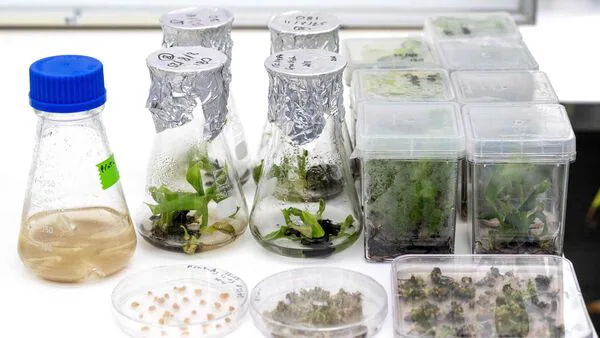
India's New Speed Breeding Centres To Deliver Improved Seeds Faster


India is planning to establish five modern seed breeding facilities across the country to encourage advanced seed research and develop high-yielding, disease-resistant varieties of crops, senior government officials said.
India already has two such facilities at Indian Council of Agricultural Research (ICAR) centres, and is expected to increase it to seven by the end of this fiscal year, the officials told Mint.
The seed breeding technology enables rapid crop development by creating controlled environmental conditions such as temperature, light intensity, and day length in a chamber, allowing processing of seeds in a shorter time compared to the conventional way.
Also Read | Govt unveils plan to combat counterfeit seed frauThe process of multiplying seeds from the original plant breeding material to the final seeds that are distributed to farmers is known as 'generation.' This can be used in crop varieties such as wheat, rice, cotton, soybean, millets, maize, and mustard.
A controlled atmosphere accelerates plant growth, allowing multiple generations each year instead of just one or two under natural conditions. This shortens the breeding cycle of a seed by 2-3 years, reducing it from the current six years.
The development assumes significance as the facilities would allow scientists to develop and release new varieties within a shorter period of time.
“The reduction in the breeding cycle will allow researchers to quickly develop a new variety. This advancement will expedite the development of high-yielding, disease-resistant, and quality crop varieties, making them available to farmers more quickly," Mangi Lal Jat, secretary, Department of Agricultural Research and Education (DARE), and director general, Indian Council of Agricultural Research (ICAR) told Mint.
Also Read | QR-coded packets, digital tracking to protect farmers from substandard seedThe proposed facilities will be developed at ICAR's institutes across the country, such as the Central Institute for Cotton Research (CICR), Nagpur; Indian Institute of Rice Research (IIRR), Hyderabad; Indian Agricultural Research Institute (IARI), New Delhi; Indian Institute of Agricultural Biotechnology (IIAB), Ranchi; and Indian Institute of Maize Research (IIMR), Ludhiana. While some facilities will be dedicated to a specific crop, others will support multiple crops.
Each centre would entail an investment of anywhere between ₹2 crore and ₹12 crore, depending on the area and facilities.
The facilities are expected to transform crop research by enabling the development of four crop generations per year, thereby significantly shortening breeding cycles. In traditional farming, a farmer or researcher can usually grow only 1 or 2 generations (or crop cycles) per year due to seasonal limits. However, by using controlled environments, researchers can produce four generations every year.
"With the help of technology, the breeding cycle will be reduced to two to three years from six years presently, which will ensure that genome-edited varieties or hybrid varieties reach the fields much earlier," said D.K. Yadav, deputy director general (crop science), ICAR, Delhi.
The research facilities at the Indian Institute of Mustard Research, Bharatpur, Rajasthan, and the Central Soil Salinity Research Institute (CSSRI), Karnal, Haryana, are already operational, with others set to start shortly, Yadav added.
Also Read | Can Indian scientists tame the weather with modification techTraditionally, it takes 8-10 years to develop a new crop variety and transfer it to the fields. Speed breeding centres can reduce this time by three to four years. This means farmers would get access to high-yielding and climate-resilient varieties much earlier, helping them improve productivity and income.
"By enabling multiple crop generations each year, these centres will fast-track the delivery of high-yielding, climate-resilient seed varieties. For farmers, this means quicker access to improved seeds that can withstand pests, diseases, and erratic weather, leading to better yields and more secure incomes," said Ajai Rana, chairman of the Federation of Seed Industry of India.
During 2014–2024, the National Agricultural Research System, including ICAR institutes and state/ and central agricultural universities developed 2,900 location-specific improved crop varieties and hybrids. These included 1,380 cereals, 412 oilseeds, 437 pulses, 376 fibre crops, 178 forage crops, 88 sugarcane varieties, and 29 other crops.
The agriculture and allied sector contributes approximately 16% to India's GDP and supports about 46.1% of the population. These seed breeding facilities are likely to increase productivity and improve farm incomes. This push comes at a time when climate change and erratic weather patterns are placing unprecedented stress on agriculture.

Legal Disclaimer:
MENAFN provides the
information “as is” without warranty of any kind. We do not accept
any responsibility or liability for the accuracy, content, images,
videos, licenses, completeness, legality, or reliability of the information
contained in this article. If you have any complaints or copyright
issues related to this article, kindly contact the provider above.


Comments
No comment