




403
Sorry!!
Error! We're sorry, but the page you were looking for doesn't exist.
Crane Market Size, Share, Growth & Forecast By 2033
(MENAFN- IMARC Group)
Market Overview:
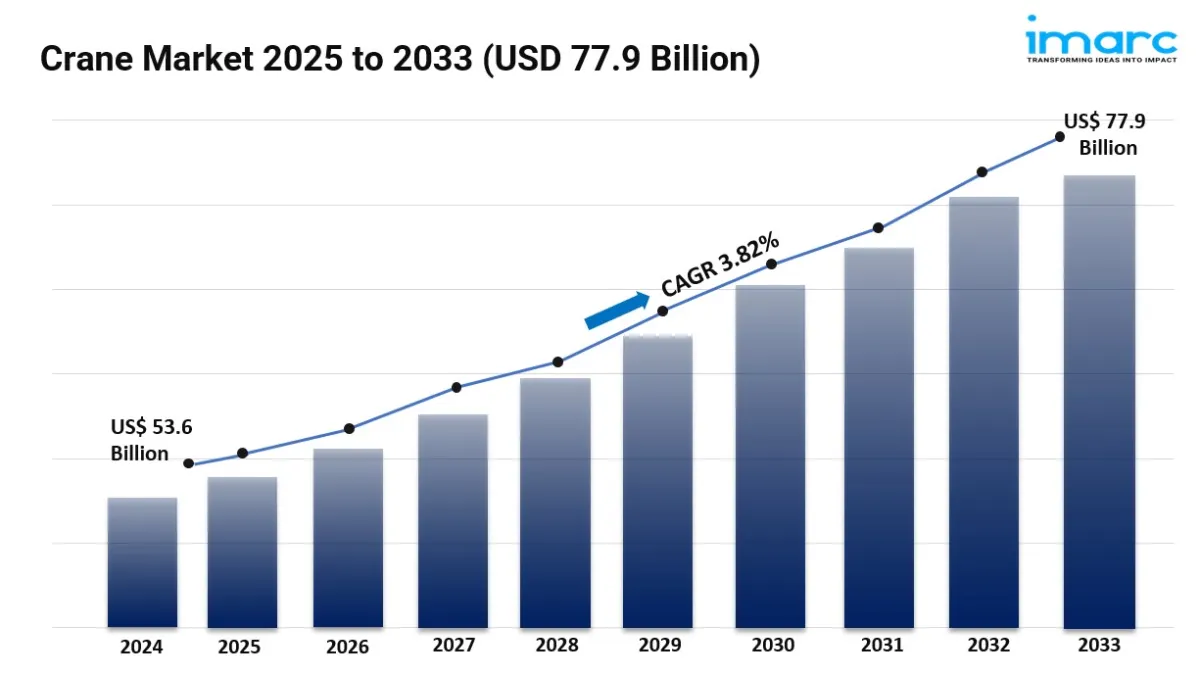
The crane market is experiencing rapid growth, driven by infrastructure development boom, expansion of renewable energy projects, and urbanization and industrial growth in emerging economies. According to IMARC Group's latest research publication,“ Crane Market Size, Share, Trends and Forecast by Product Type, Application, and Region, 2025-2033 “ , the global crane market size reached USD 53.6 Billion in 2024. Looking forward, IMARC Group expects the market to reach USD 77.9 Billion by 2033, exhibiting a growth rate (CAGR) of 3.82% during 2025-2033.
This detailed analysis primarily encompasses industry size, business trends, market share, key growth factors, and regional forecasts. The report offers a comprehensive overview and integrates research findings, market assessments, and data from different sources. It also includes pivotal market dynamics like drivers and challenges, while also highlighting growth opportunities, financial insights, technological improvements, emerging trends, and innovations. Besides this, the report provides regional market evaluation, along with a competitive landscape analysis.
Get Your Free“Crane Market” Sample PDF Report Now!
Our report includes:
-
Market Dynamics
Market Trends And Market Outlook
Competitive Analysis
Industry Segmentation
Strategic Recommendations
Growth Factors in the Crane Market
-
Infrastructure Development Boom
-
Expansion of Renewable Energy Projects
-
Urbanization and Industrial Growth in Emerging Economies
Key Trends in the Crane Market
-
Automation and Smart Crane Technology
-
Sustainability and Electric/Hybrid Cranes
-
Rise of Rental and Managed Service Models
Leading Companies Operating in the Global Crane Industry:
-
Broderson Manufacturing Corporation (Lanco International Inc.)
Hiab Corporation
IHI Corporation
Kobelco Construction Machinery Co. Ltd
Konecranes
Link-Belt Cranes (Sumitomo Heavy Industries Ltd.)
Tadano Ltd
Terex Corporation
The Liebherr Group
The Manitowoc Company Inc.
XCMG Group
Crane Market Report Segmentation:
Analysis by Product Type:
-
Mobile Cranes
Marine and Port Cranes
Fixed Cranes
Analysis by Application:
-
Construction and Infrastructure
Mining
Oil and Gas
Others
Regional Insights:
-
North America (United States, Canada)
Asia Pacific (China, Japan, India, South Korea, Australia, Indonesia, Others)
Europe (Germany, France, United Kingdom, Italy, Spain, Russia, Others)
Latin America (Brazil, Mexico, Others)
Middle East and Africa
Research Methodology:
The report employs a comprehensive research methodology, combining primary and secondary data sources to validate findings. It includes market assessments, surveys, expert opinions, and data triangulation techniques to ensure accuracy and reliability.
Note: If you require specific details, data, or insights that are not currently included in the scope of this report, we are happy to accommodate your request. As part of our customization service, we will gather and provide the additional information you need, tailored to your specific requirements. Please let us know your exact needs, and we will ensure the report is updated accordingly to meet your expectations.
About Us:
IMARC Group is a global management consulting firm that helps the world's most ambitious changemakers to create a lasting impact. The company provide a comprehensive suite of market entry and expansion services. IMARC offerings include thorough market assessment, feasibility studies, company incorporation assistance, factory setup support, regulatory approvals and licensing navigation, branding, marketing and sales strategies, competitive landscape and benchmarking analyses, pricing and cost research, and procurement research.
Contact Us:
IMARC Group
134 N 4th St. Brooklyn, NY 11249, USA
Email: sales[@]imarcgroup.com
Tel No:(D) +91-120-433-0800
United States: +1-201-971-6302

Legal Disclaimer:
MENAFN provides the
information “as is” without warranty of any kind. We do not accept
any responsibility or liability for the accuracy, content, images,
videos, licenses, completeness, legality, or reliability of the information
contained in this article. If you have any complaints or copyright
issues related to this article, kindly contact the provider above.
Most popular stories
Market Research

More Story








Comments
No comment