


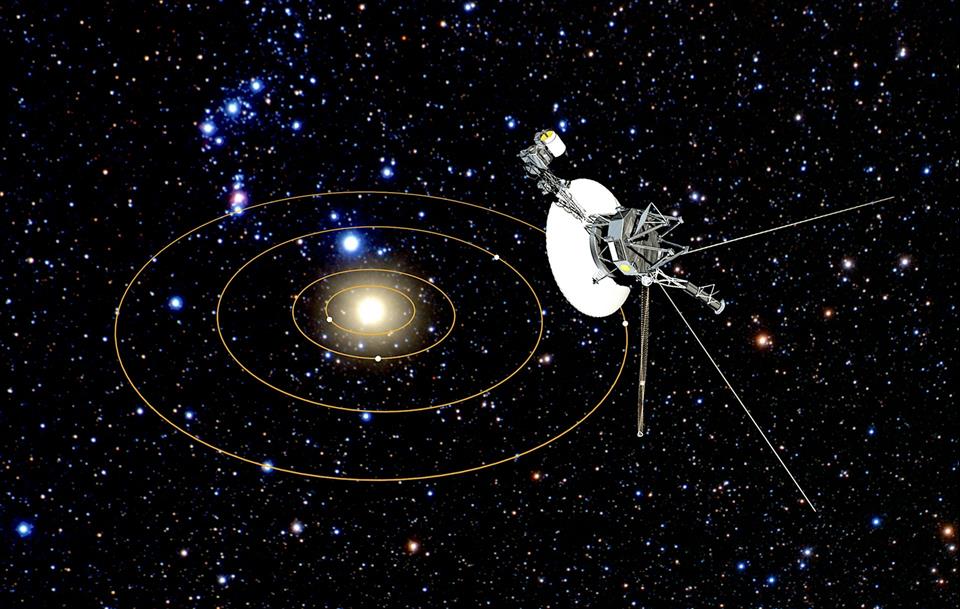
Nasa's Voyager 1 Probe, Launched In 1977, Reaches Distance Milestone Of One Light-Day From Earth


| Date | Event |
|---|---|
| Summer 1965 | Calculations reveal the rare planetary alignment |
| July 1, 1972 | Nasa officially approves the Voyager programme |
| August 20, 1977 | Voyager 2 launches from Kennedy Space Center, Florida |
| September 5, 1977 | Voyager 1 launches from Kennedy Space Center, Florida |
| March 5, 1979 | Voyager 1 makes its closest approach to Jupiter |
| November 12, 1980 | Voyager 1 carries out its flyby of Saturn and Titan |
| February 17, 1998 | The spacecraft becomes the furthest human-made object from Earth |
| August 25, 2012 | The probe enters interstellar space |
When I spoke to Professor Hunt recently, he explained that being the only team member from the UK was“an opportunity to open up planetary science in this country”.
The unique planetary alignment meant there was only a brief window to launch both Voyager spacecraft. Professor Hunt described this period as particularly intense, noting that there was“no time for tea breaks”.
Historic discoveriesAfter 18 months of spaceflight, Voyager 1 reached Jupiter in 1979. Professor Hunt noted:“that's when the fun started”. Voyager 1 studied the complex dynamics of the huge storm in Jupiter's atmosphere known as the Great Red Spot. The spacecraft also detected aurorae and lightning, as well as discovering active volcanoes on Jupiter's moon Io.
After gathering data on the Jovian system, Voyager 1 continued on, reaching Saturn in November 1980. The spacecraft revealed previously unseen structures in the planet's majestic rings, including wedge-shaped features in Saturn's B ring which scientists dubbed“spokes”.
It also resolved craters on the Saturnian moons Enceladus and Mimas, and a thick nitrogen atmosphere on the large moon Titan.
Recalling this period, Garry Hunt told me:“We honestly didn't know what those funny marks were in the rings, the spokes”. He added that the largest crater on Mimas made it look“like the Death Star from Star Wars”.
Perhaps the most famous image from the mission was taken nine years later, inearly 1990. Carl Sagan had been lobbying for nearly a decade for Voyager 1 to takeone last photograph of our home planet before its cameras were permanently powereddown. Professor Hunt explained that“we wanted to take the family portrait”.
The photograph, which became known as the Pale Blue Dot, revealed planet Earth, as Sagan described, as“a mote of dust suspended in a sunbeam”. Hunt described the image to me as“perhaps one of the most important pictures ever taken”.
Interstellar spaceAfter 35 years of spaceflight, Voyager 1 crossed the boundary of the heliosphere. This is a region of electrically charged particles – plasma – that surrounds the Sun and the planets. When it passed this threshold, Voyager 1 became the first spacecraft made by humans to enter interstellar space.
My colleague Dr Chris Chen, reader in space plasma physics, at Queen Mary University of London, describes the heliosphere as a“bubble of plasma”. He explained that Voyager 1 made some surprising discoveries when it traversed this boundary.
Rather than finding the expected change in magnetic field direction, Voyager 1 detected a magnetic field that remained broadly aligned with the field inside the heliosphere. Instead, the spacecraft found a dramatic reduction in the number of solar cosmic rays, which suggests that the dynamics of space plasma marks the true boundary of interstellar space.
After nearly half a century of spaceflight, Voyager 1 is still operational, and still providing valuable scientific data. As well as extraordinary observations and discoveries about the largest planets in our solar system, Voyager 1's Pale Blue Dot photograph has become one of the classic images of space exploration.
At the height of the mission, Professor Hunt recalled working eighteen-hour days:“We were pathfinders, it was tough”. Reflecting on the Voyager programme, herecalled that“everything we touched, everything we did, was historic”. Nearly half a century after its launch, Voyager 1 continues its journey into interstellarspace.
It is now so distant from Earth that signals travelling at the speed of light takea full day to reach it, and another day for a response to return. This extraordinary milestone provides an opportunity to appreciate the unique perspective that Voyager 1 has given us on our own place in the solar system.


Legal Disclaimer:
MENAFN provides the
information “as is” without warranty of any kind. We do not accept any
responsibility or liability for the accuracy, content, images, videos,
licenses, completeness, legality, or reliability of the information
contained in this article. If you have any complaints or copyright issues
related to this article, kindly contact the provider above.


Comments
No comment