


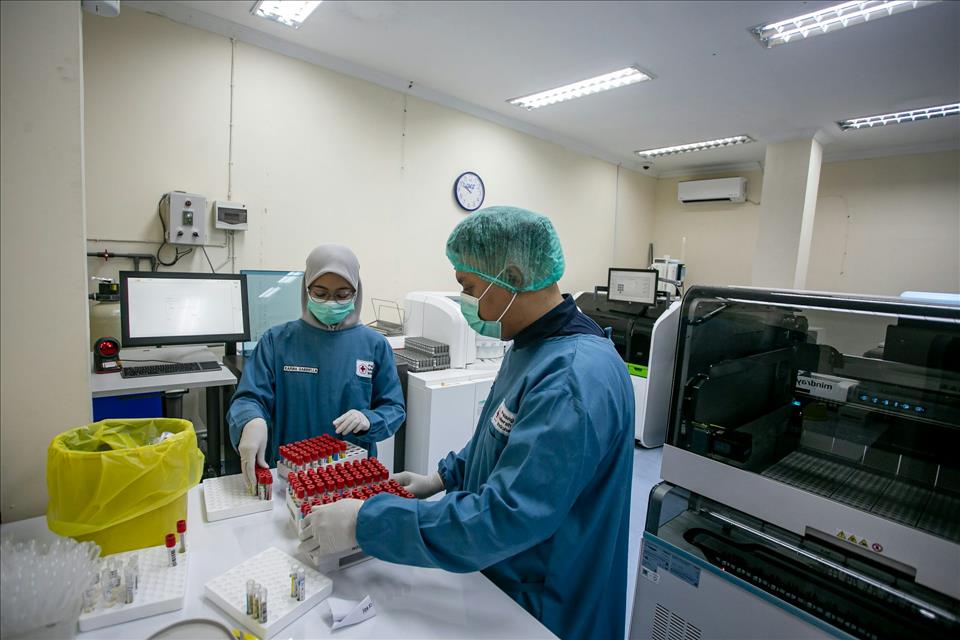
Can Indonesian Researchers Ever Win A Nobel? Not Without Overhauling The Research Ecosystem


The reality is that there are no shortcuts to a Nobel. Breakthroughs recognised by the committee almost always stem from foundational work done decades earlier - often when it is impossible to foresee the practical payoffs.
Take the 2026 Nobel Prize in Physiology or Medicine awarded to Peter Hegemann, Georg Nagel and Karl Deisseroth for pioneering optogenetics - a breakthrough technique that uses light to control nerve cell activity.
Read more: Bagaimana alga mengantarkan ilmuwan pada Nobel Kedokteran dan cara baru memahami otak
Interestingly, the road to optogenetics began with research that seemed to have nothing to do with medicine. Hegemann was initially investigating how the single-celled green alga Chlamydomonas swims towards light. His collaboration with Nagel eventually led to the discovery of channelrhodopsin - a light-sensitive protein that acts as an ion channel.
By 2005, Deisseroth's team showed that channelrhodopsin could be harnessed to control neuronal firing with light. What began as a humble inquiry into pond algae laid the groundwork for optogenetics - now an indispensable tool for mapping and manipulating the brain.
This trajectory illustrates the road to the prestigious award: Nobel-worthy breakthroughs emerge from ecosystems patient enough to let basic research mature before demanding immediate benefits.
But can Indonesia's research ecosystem nurture that kind of long game?
It all comes down to funding. Again.The most glaring bottleneck in Indonesia's research ecosystem is funding. The country's R&D spending remains low, lagging far behind its ASEAN peers.
Data from the National Research and Innovation Agency (BRIN) paint a sobering picture: in 2024, Indonesia's total R&D expenditure stood at around US$2.8 billion - a meagre 0.23% of gross domestic product (GDP). Higher education shouldered 71.02% of that spending, while the private sector contributed a negligible 14.96%.
Neighbours tell a different story: the private sector drove 51.37% of R&D in Malaysia (2022) and roughly 74% in Thailand (2021). The lesson is structural: a nation's scientific muscle depends not just on how much it spends, but on who funds it.
Read more: Lemahnya sistem pendanaan riset di Indonesia semakin terasa di tengah pandemi: berikut pengalaman para dosen
How should public research funds be accounted for?Researchers must naturally account for every public fund they spend: explaining what they investigate, how funds are allocated and what discoveries emerge. Yet not all grant systems in Indonesia define“results” the same way - and rigid metrics can easily distort scientific work.
Take Indonesia's 2025 Research and Community Service Guidelines. Under the Regular Fundamental Research scheme (PFR), grantees are mandated to publish at least one paper in a reputable international journal every single year.
Research benchmarks are indeed necessary. But when success hinges on short-term milestones - like annual publication quotas - scientists are almost guaranteed to play it safe, pursuing predictable findings over ambitious, high-risk discoveries.
Take Katalin Karikó and Drew Weissman, who jointly won the 2023 Nobel Prize in Physiology or Medicine for work that began more than two decades earlier.
In 2005, the pair made a critical breakthrough: modifying mRNA's nucleosides could suppress harmful inflammatory responses to synthetic mRNA. After years of funding rejections, skepticism and painstaking refinement, that fundamental discovery unlocked the mRNA vaccines and therapies that ultimately saved millions of lives during the COVID-19 pandemic.
Read more: Hadiah Nobel bidang kedokteran diberikan kepada pionir mRNA – bagaimana penemuan mereka berperan penting dalam pengembangan vaksin COVID
By comparison, Japan's Grants-in-Aid for Scientific Research program, known as KAKENHI, still demands strict accountability: recipients must report on expenditure, track ongoing milestones, and submit comprehensive final evaluations.
KAKENHI explicitly urges researchers to disseminate their findings globally - via peer-reviewed journals, international partnerships, and academic conferences. Crucially, the guidelines avoid treating rigid publication targets as make-or-break funding criteria.
Lessons from Asia's research ecosystemsIn 2025, China boosted its R&D spending to roughly 2.8% of GDP. Its investment in basic research surged by 13.3% year-on-year – comfortably outstripping its 8.2% overall growth in R&D expenditure.
Meanwhile, Singapore committed S$S37 billion (around US$28.77 billion) to its Research, Innovation and Enterprise 2030 (RIE2030) plan. The blueprint balances market-driven applications with solid backing for open-ended fundamental science and homegrown scientific talent.
Both countries operate under distinct economic realities and strategic priorities. Yet they share a common thread: fundamental science remains an indispensable pillar of their national policy.
Boosting Indonesia's research budget is crucial, but cash alone will not fix the system without deeper industry involvement and long-term backing for university laboratories. Accountability matters, too – but evaluation frameworks must be flexible enough to give unorthodox, exploratory ideas room to breathe.
Read more: Ribuan riset dan paten Indonesia terjebak di“jurang maut” karena tak dipakai industri
After all, scientific inquiry is inherently unpredictable. Hypotheses fall flat, experiments fail and dead ends are part of the process. A project that yields no marketable innovation within five years may still unearth foundational knowledge that sparks a breakthrough decades later.
Grant systems must therefore make room for rigorous science whose outcomes cannot be mapped in advance. Such work still demands robust evaluation – just not through the same narrow, transactional metrics applied to off-the-shelf product development.
The Nobel is a byproduct, not the destinationIndonesia does not need a glitzy roadmap to a Nobel Prize; it needs a dependable research ecosystem. That means reliable funding, smarter resource allocation, sensible evaluation metrics and real avenues for international collaboration.
Read more: Bukan (hanya) soal anggaran. Bagaimana dana riset dibelanjakan juga penting
Every nation dreams of its own Nobel laureate, and Indonesia is no exception. But the medal itself cannot be the end goal.
For Indonesia, the real debate is not a false choice between applied projects with immediate payoffs and curiosity-driven basic science. The challenge is designing an ecosystem flexible enough to nurture both, knowing full well that groundbreaking research runs on its own clock.
What matters far more is fostering a research ecosystem that empowers scientists to pursue bold, open-ended questions – even when the tangible payoffs are years or decades down the line.


Legal Disclaimer:
MENAFN provides the
information “as is” without warranty of any kind. We do not accept any
responsibility or liability for the accuracy, content, images, videos,
licenses, completeness, legality, or reliability of the information
contained in this article. If you have any complaints or copyright issues
related to this article, kindly contact the provider above.


Comments
No comment