


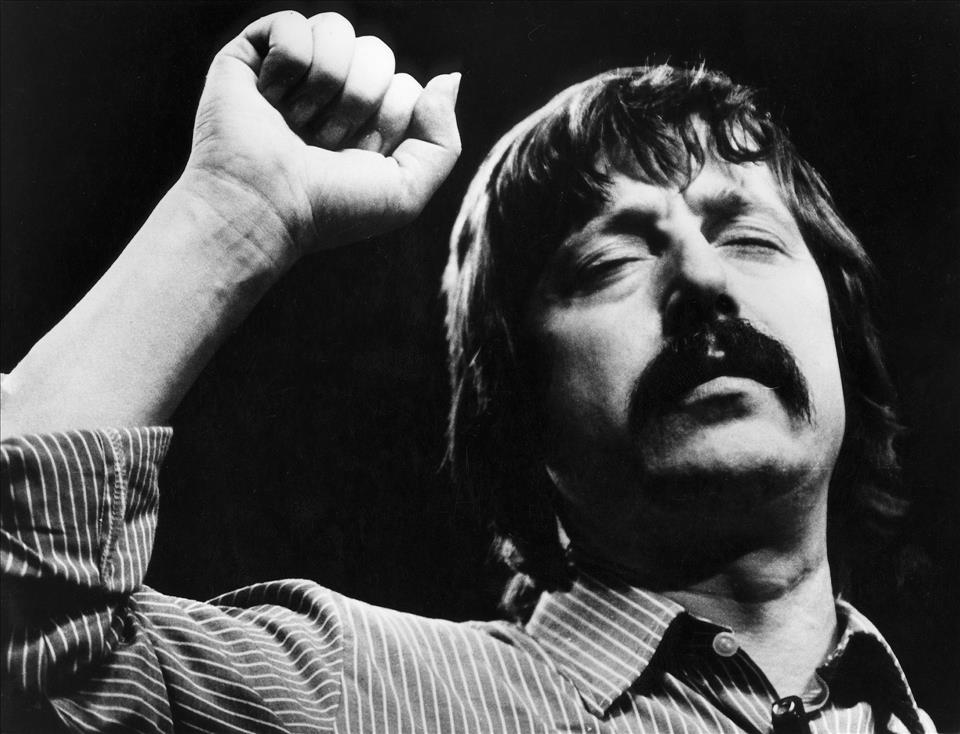
East Germany Exiled Singer Wolf Biermann. They Only Made His Message Louder


Far from quashing Biermann's voice, this act of political exile amplified it, and cemented his place in history, underscored by a new documentary about his life story.
It is a lesson others should have done more to heed. Earlier this year, US billionaire Robert Kraft and other stadium owners banned Macklemore from their venues over pro-Palestinian remarks the singer made during his support slot on Ed Sheeran's tour.
But in trying to silence the rapper, Kraft and his cohort unintentionally amplified his message.
The story of Biermann can tell us much about how attempts to quash the political expression of musicians have spectacularly backfired.
From East German darling to dissidentBiermann, born in 1936, became a prominent figure within East German left-wing dissident artists and intellectuals in the late 1960s. But he wasn't always an outsider.
As the West German immigrant son of a Jewish communist killed in Auschwitz, and a mentee of Bertolt Brecht, Biermann was initially the darling of the East German press, and held a candidate membership of the Socialist Unity Party (SED).
When his lyrics became critical of the SED, however, the Stasi (secret police) began a campaign of harassment that escalated over more than a decade. It included performance bans, sabotage, intimidation, round-the-clock surveillance, bugging, reports from more than 200 Stasi informants, and even a veiled death threat.
Yet this persecution amplified Biermann's voice and gave him an international platform.
The making of an international symbolWestern governments adopted Biermann as a potent symbol in the cultural Cold War. He acquired famous fans, including Joan Baez and Allen Ginsberg.
Numerous organisations awarded him prizes. CBS gave him a record deal, and West Berlin radio stations frequently broadcast his music into East Germany.
These broadcasts made some remarkable converts. Gerulf Pannach, a young songwriter and then Stasi informant, first heard Biermann's music while working as a border guard. He befriended the singer, renounced the Stasi and began writing his own critical lyrics.
Pannach convinced Christian Kunert, the keyboardist of the beloved rock band Renft, to take an anti-state position in 1974.
Kunert, in turn, introduced writer and social psychologist Jürgen Fuchs – who would go on to become a prominent East German dissident – to Pannach and Biermann. He also converted his Renft band mate Thomas“Monster” Schoppe to the cause.
Closer to home, Biermann's former stepdaughter, young rock singer and future queen of punk Nina Hagen, introduced her bandmates to Biermann.
The consequences of dissentBiermann's inner circle was, for a time, paradoxically protected by their fame as dissidents. Aided by Western media, they flouted state controls in ways average East Germans wouldn't dare. While the state maintained tight surveillance of Biermann's circle, they seemed hesitant to arrest them.
But those more loosely associated with Biermann often found themselves caught in the crossfire of multiple Stasi operations to harass and crush dissidents.
This included band members of Renft, who helped Pannach bypass his performance ban and perform Biermann's songs, and publicly denounced East German border policy.
As a result, members of Renft were repeatedly summoned and questioned by the authorities. Then the band was banned. In September 1975, a local licensing board told Renft they“no longer exist”.
Taboo themes in Pannach's lyrics were the pretext for the ban, but declassified Stasi documents suggest the state ultimately targeted them as proxies for Biermann.
The regime accidentally elevated a popular East German rock band to anti-state legends.
A further attempt to neutralise Renft through conscription and a tax investigation converted the band's thus far apolitical founder, Klaus Jentzsch, into a gifted anti-state organiser. With Biermann's help, he coordinated a transnational multi-media campaign.
Biermann's exileEventually, the East German state made its move against Biermann.
In November 1976, Biermann was unexpectedly granted permission to tour West Germany. Shortly after his packed opening concert in Cologne, the Politbüro stripped the singer of his East German citizenship.
Although state media hadn't mentioned Biermann since 1968, the regime inexplicably publicised its decision.
If this staged confrontation was designed to root out Biermann's supporters, it backfired. A protest petition gathered over 100 signatures from East German cultural elites in only three days. The decision sparked global outrage.
A cautionary taleThe state's crackdown forced dozens of artists into exile, to no appreciable political gain. East German rock and pop music remained just as prolific, and arguably just as critical.
At each stage, attempts to limit the reach of music made by dissident artists instead extended it – and turned the artists themselves into causes célèbres.
Today, this chapter of history is a cautionary tale. Those who intend to silence or restrict musicians' reach would do well to note it.


Legal Disclaimer:
MENAFN provides the
information “as is” without warranty of any kind. We do not accept any
responsibility or liability for the accuracy, content, images, videos,
licenses, completeness, legality, or reliability of the information
contained in this article. If you have any complaints or copyright issues
related to this article, kindly contact the provider above.


Comments
No comment