


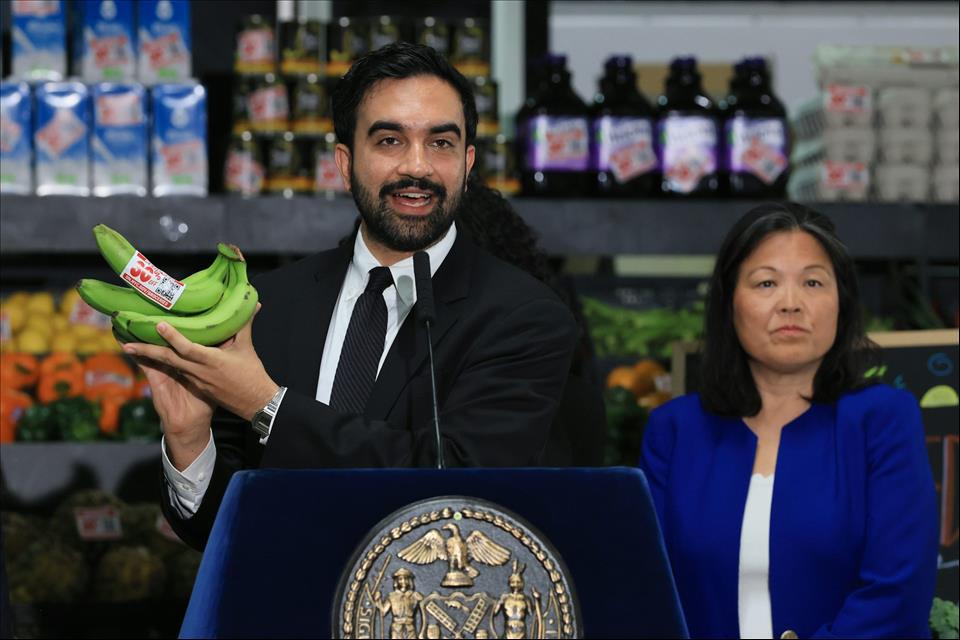
Debate In New York City Over City-Run Groceries Is Not Just About Food, But Something Bigger


Five stores, one in each borough, are unlikely to substantially change grocery prices in a city with nearly 1,000 supermarkets and more than 8 million inhabitants. But each could make a meaningful difference to the grocery bills of local shoppers by selling essentials at below-market prices.
Even with just five planned stores set to open in lower-income neighborhoods, the initiative has ignited fierce opposition from independent grocers, supermarket trade associations and a coalition representing immigrant-owned food businesses.
What explains this pushback?
As a food policy scholar, I believe this opposition is about more than the immediate economic impact of five stores. It is about the precedent they could establish. Mamdani's initiative challenges an entrenched expectation that the government should leave the provision of consumer goods to private enterprise even as it encourages businesses to invest in certain locations, regulates their activities and helps low-income shoppers through various food assistance programs.
The reality is more complicated. For at least a century, New York's food economy has not operated independently of government. In fact, public policies and investments have long shaped where supermarkets open, which businesses can operate with a profit, and how residents obtain food.
It's just that they have done so in ways consumers often don't see.
That is why the five grocery stores carry a broader significance, in my view. They offer a different model of public investment that makes the government much more visible in providing an essential service – and more accountable for its results. New Yorkers will get an opportunity to judge that contribution directly.
If the stores succeed, they may change not just what people expect to pay for groceries, but what they expect their city government to provide.
How the plan will workNew York City has committed US$70 million to develop these stores, which will be open to all.
While they will be managed by private operators, the city will provide rent-free space, prioritize publicly owned sites and ensure that essential foods are priced 30% below typical retail prices.
In this respect, the stores offer a“public option” – a government-provided good or service that exists alongside private alternatives, like public schools and city hospitals.
Municipal grocery stores would offer New Yorkers a similar choice alongside private retailers. But as a public option, they would create a visible alternative against which shoppers can judge privately owned stores, setting a benchmark for food prices and service quality. They would also demonstrate how public investment can be used to make an essential good more affordable.
At his May announcement, Mamdani described the proposed Bronx store and its surrounding development as“physical proof of our conviction that government can be a force for good.”
A fresh form of interventionGovernment-supported food retailing has a long history in New York City despite opposition by existing businesses.
In 1934, Mayor Fiorello La Guardia's administration began selling discounted milk to low-income families, but the initiative drew complaints from grocers about unfair competition. Independent merchants similarly protested the city's efforts to subsidize a new Pathmark supermarket in East Harlem in the 1990s, warning that it would put local grocers out of business.
A more recent example is the city's Food Retail Expansion to Support Health program, known as FRESH. Since 2009, it has offered supermarket developers and operators long-term tax breaks and zoning incentives to build or expand dozens of stores in underserved neighborhoods.
These incentives have helped increase grocery retail space, but shoppers don't see the public support behind them.
FRESH is just one example of an approach toward supermarket financing that gained momentum in the 1990s, when governments sought to address social problems by encouraging private investment. Food insecurity was blamed on a scarcity of neighborhood supermarkets, not on prices being beyond reach for local shoppers.
Subsidizing new stores promised better nutrition and economic development without confronting poverty or inequality, and FRESH reflects that approach. Participating supermarkets must devote space to perishable foods, but they're not required to offer affordable prices. That may be one reason why researchers have found that adding supermarkets to low-income neighborhoods, by itself, doesn't substantially improve residents' diets.
This hidden government role is hardly confined to grocery stores. Much of what government does for Americans is delivered indirectly, through tax credits, subsidies and private institutions. Because the public contribution is obscured, people often give credit to private markets for the benefits provided by public policy, from student loans to healthcare.
This invisibility is a consequence of policy design and influences how citizens understand government, a phenomenon that political scientist Suzanne Mettler described as“the submerged state.”
Bringing the state into the openMunicipal grocery stores depart from the traditional model in two important ways.
First, they make affordability an explicit condition of public investment rather than the outcome of increased retail competition. Second, they make government's contribution visible. For example, the stores will share distinct branding so shoppers know who's responsible for the affordable food.
If the stores deliver reliable savings, shoppers may begin to see affordable food as something government can help provide, not an outcome determined entirely by private markets. When public benefits are obscured, people are more likely to underestimate government's contribution to their lives. Visible programs, like a physical store in the neighborhood, make that contribution easier to notice and evaluate.
Visibility also creates accountability. A customer at a private supermarket that received a tax break to expand isn't likely to tie the store's prices or food quality to government policy. At a municipal grocery store, with clear branding, the connection is unmistakable.
To be sure, critics' concerns deserve serious attention. Many independent grocery stores are owned by immigrant entrepreneurs operating on thin margins. Groups representing bodegas and independent supermarkets warn that a publicly subsidized competitor could draw away their customers. Some may lose business.
Yet East Harlem's Pathmark demonstrates that new supermarkets and smaller retailers can coexist. Between 2000 and 2015, the number of small grocery stores and bodegas in the neighborhood increased from 100 to 126, while supermarkets rose from 10 to 18. That said, those figures don't establish Pathmark's effects on individual businesses.
The municipal stores' impact on nearby retailers remains an open question. But the task for New York City is to ensure that private operators deliver excellent service and real savings, and that their commercial interests don't undermine the public mission. It will also need to provide good working conditions and track effects on nearby businesses.
Ultimately, public ownership doesn't guarantee success. But it makes government's responsibility for the outcome impossible to miss.


Legal Disclaimer:
MENAFN provides the
information “as is” without warranty of any kind. We do not accept any
responsibility or liability for the accuracy, content, images, videos,
licenses, completeness, legality, or reliability of the information
contained in this article. If you have any complaints or copyright issues
related to this article, kindly contact the provider above.


Comments
No comment