


Being Heumaan Is No 'Inspirational Cripple' Tale. It's A Story Of Ordinary People Taking On Impossible Odds


As a wheelchair user, I am extremely grateful to the disabled advocates of the previous generation who made the world so much more accessible for me to live in. So I can't pretend to offer an objective review of Being Heumann.
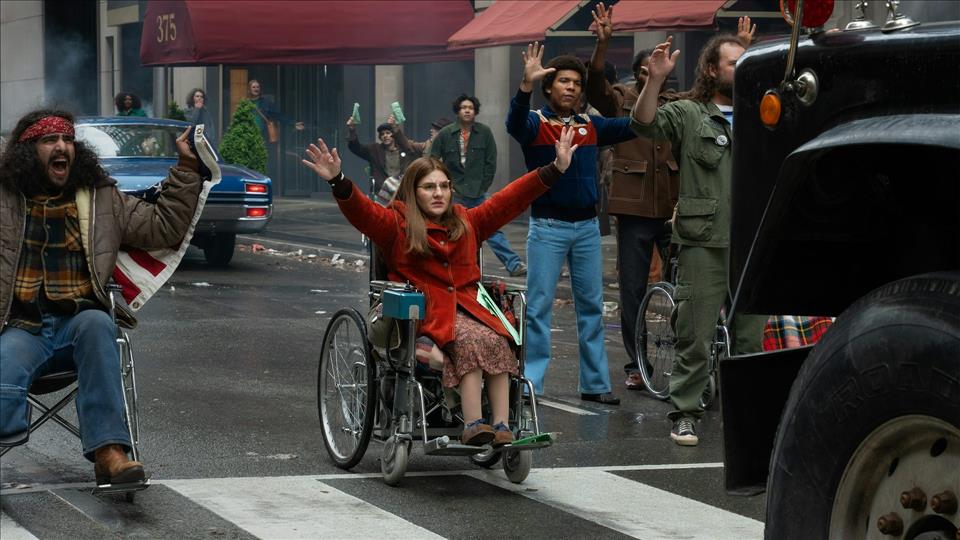
The film tells the story of the late disability rights activist Judy Heumann (Ruth Madeley) and her diverse cast of crip comrades. They occupied San Francisco's federal building for nearly a month in 1977, demanding the government finally implement Section 504 of the Rehabilitation Act – a significant disability rights legislation passed four years earlier.
Being seen with dignityI cried from the first scene, as Heumann wheels her chair onto a busy city street because the footpath lacks curb cuts, enduring the abuse of motorists whose journeys she interrupted. Madeley powerfully conveys the determined activist's frustration, fear, and defiance. She is brilliant throughout the film.
She is also part of an unusually large cast of disabled actors playing disabled characters.
This is not just a matter of disability justice. Important though it is to see disabled actors taking the lead onscreen, and to know a non-disabled actor won't potentially win an Academy Award for playing a pitiable cripple – what really matters is the actors are believable in their roles.
Subtle differences matter. Non-disabled actors rarely look comfortable in a wheelchair. It's hard to put your finger on why – but disabled people know it when we see it. More importantly, disabled actors understand how to avoid familiar disability tropes of the tragic, piteous, or boringly inspirational cripple.
Director and co-writer Siân Heder deserves recognition here. Building on her wonderful 2021 film CODA (Children of Deaf Adults), she once again provides a deep insight into the lives of disabled people – their dignity, strength and humanity.
Heder is aided by a powerful story drawn from Judy Heumann's memoir. There's also the good fortune of Heumann's surname lending itself perfectly to the film's title, in a wonderfully apt expression of what her protest was ultimately about: disabled people resisting a dehumanising world, and insisting on their right to belong.
Struggle, along with tenderness and joyJudy is no saint. As Judy's friends tell her in the film, she's often an asshole. And the truth of social change is that sometimes, perhaps too often, we need assholes like Judy.
A month-long sit-in would be challenging enough for anyone, let alone people whose bodies require particular care, equipment and assistance.
Not everyone can stay for the duration – but those who leave remain part of the struggle. There are tensions and disagreements between disabled people with different needs and perspectives.
The disabled community has every reason to love this film. But I hope it reaches a much, much wider audience. It certainly deserves to. And lest you're tempted to dismiss the film as an angry, woke political narrative – it's not. It is packed with joy and tenderness.
There's humour, too, because all bodies can be funny, and disabled people know how to laugh at the particular absurdities of their lives.
Complex characters and their comradesThe film revels in its 1970s setting, with its clunky old wheelchairs, young disabled people smoking weed, having sex, arguing and falling in love. In other words, being people.
We also get to see how disabled people find ways to work the system. One repeated suggestion to Judy when she's speaking to the media is that she should“show some cleavage and cry”. And why not? She's sexy and knows it.
I only wish we'd had more time for these intimate moments – to explore the relationships, tensions, and messy compromises that give collective action its human depth. Political change is never as straightforward as it looks on screen I'm quibbling here.
A shoutout, too, to the non-disabled allies highlighted in the film. Disabled people didn't make the world inaccessible, and we can't fix it on our own.
Being Heumann shows the contribution of the Black Panthers and the wider civil rights movement, the journalists who listened and took disabled people seriously, the few politicians willing to act, and the care workers and supporters who helped sustain the occupation.
Care work can often be seen as low-status work, and dependence as a sign of weakness. Here, both are portrayed with dignity.
A reminder of hope in a hopeless timeI think anyone watching the film will be inspired: not just the typical inspiration porn of seeing cripples get about their day, but inspired to participate in social change.
They will be fired-up to see that seemingly insignificant people can bring about immense social change when they are determined, committed, resourceful, resilient, and collaborate with others.
It's a message desperately needed in a world where so many of us feel invisible and powerless against billionaires, politicians and media moguls relentlessly undermining action on climate change, LGBTQI+ rights, gender equality, and, yes, disability rights.
Judy Heumann and her crip radicals helped changed the world. But there's still a hell of a long way to go.
Being Heumann is available on Apple TV from today.


Legal Disclaimer:
MENAFN provides the
information “as is” without warranty of any kind. We do not accept any
responsibility or liability for the accuracy, content, images, videos,
licenses, completeness, legality, or reliability of the information
contained in this article. If you have any complaints or copyright issues
related to this article, kindly contact the provider above.


Comments
No comment