




403
Sorry!!
Error! We're sorry, but the page you were looking for doesn't exist.
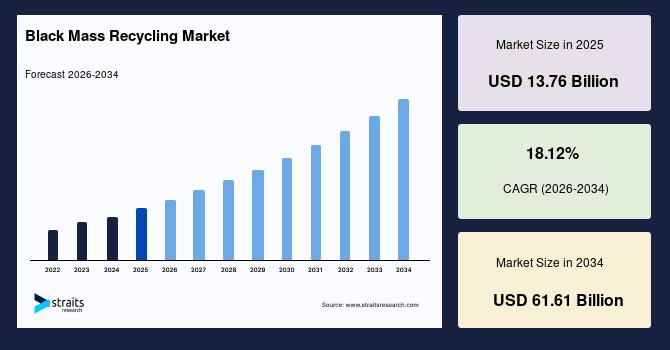
Black Mass Recycling Market Size, Share, Growth, Analysis, 2034
| Market Metric | Details & Data (2025-2034) |
|---|---|
| 2025 Market Valuation | USD 13.76 Billion |
| Estimated 2026 Value | USD 16.25 Billion |
| Projected 2034 Value | USD 61.61 Billion |
| CAGR (2026-2034) | 18.12% |
| Study Period | 2022-2034 |
| Dominant Region | Asia-Pacific |
| Fastest Growing Region | North America |
| Key Market Players | Li-Cycle Holdings Corp., Umicore N.V., Redwood Materials, Inc., Glencore plc, Fortum Oyj |
Download Free Sample Report to Get Detailed Insights.
Black Mass Recycling Market Growth Factor Environmental Concerns & RegulationThe increasing environmental impact of spent lithium-ion batteries is prompting stringent regulatory actions, significantly driving the global market. Governments worldwide are prioritizing battery waste management to mitigate pollution and resource depletion.
-
For instance, in March 2025, the European Commission officially classified black mass as hazardous waste to be treated under the EU Waste Shipment Regulation and the Basel Convention. This reclassification bans its export to non-OECD countries, aiming to retain critical metals like lithium and cobalt within Europe and support the circular economy. The new hazardous waste code (19 14 02) comes into effect in November 2026, ensuring uniform treatment across EU member states.
Such regulations not only safeguard environmental and public health but also encourage domestic recycling investments, creating a more resilient, traceable, and sustainable battery materials supply chain.
Market Restraint High Processing Costs and Technological BarriersOne of the primary restraints in the global market is the high processing cost associated with extracting valuable metals from used lithium-ion batteries. The recycling process, particularly hydrometallurgical and pyrometallurgical methods, requires advanced technologies, specialized equipment, and significant energy input, making operations economically challenging.
Additionally, handling these mass, containing hazardous and reactive components, demands strict safety protocols, skilled labor, and environmental compliance, further inflating costs. Many developing regions lack the necessary infrastructure, leading to limited adoption. Moreover, variability in battery chemistries and contamination issues complicate material recovery, making standardization difficult. These technical and financial barriers hinder the large-scale commercialization of black mass recycling globally.
Market Opportunity Development of Regional Recycling HubsThe rising volume of end-of-life lithium-ion batteries and the growing demand for battery metals are driving the establishment of regional black mass recycling hubs. These localized facilities reduce logistical challenges, enhance supply chain resilience, and support the circular economy.
-
For instance, in April 2025, Redwood Materials, founded by former Tesla CTO JB Straubel, announced a major scale-up in Nevada. The company currently recycles over 70% of North America's lithium-ion batteries and aims to produce 100 GWh of cathode-active material annually by 2026, positioning itself as a leading North American recycling hub.
Such initiatives are crucial in reducing reliance on imported raw materials, cutting emissions from mining activities, and securing domestic supply chains. Similar models are being explored in Europe and Asia, driven by favorable policies and investment in clean energy infrastructure.
Regional AnalysisAsia Pacific holds a dominant position in the market due to its significant EV manufacturing base and growing battery consumption. Rapid industrialization and rising awareness of battery waste management are prompting governments to incentivize recycling initiatives. The region benefits from an established supply chain for lithium-ion battery components and a maturing recycling ecosystem. Technological advancements and cost-effective labor are facilitating the large-scale deployment of recycling plants, while increasing investments in clean energy and battery sustainability are further fueling market expansion.
-
China's market is witnessing robust growth driven by its leadership in EV production and battery manufacturing. Leading firms like GEM Co. and Brunp Recycling (a CATL subsidiary) are investing heavily in hydrometallurgical recycling facilities. China's "Dual Carbon" policy aims to achieve carbon neutrality, accelerating investments in sustainable battery disposal. Government mandates on end-of-life battery traceability further support the circular economy and black mass recovery ecosystem.
India's black mass recycling industry is gradually emerging as EV adoption grows and battery imports increase. Companies like Attero Recycling and LOHUM are pioneering lithium-ion battery recycling through environmentally friendly processes. The Indian government's Battery Waste Management Rules (2022) mandate extended producer responsibility (EPR), fostering recycling infrastructure. With initiatives like FAME-II and domestic battery production plans, India is setting the foundation for scalable black mass recovery solutions.
North America's market is expanding due to rising investments in EV battery production and a robust shift toward electrification in transportation. Regulatory support for sustainable waste management and tax incentives for battery recyclers are creating a favorable ecosystem. Strong R&D initiatives are fostering the development of advanced recycling technologies, especially hydrometallurgical methods. Additionally, the presence of several large-scale battery manufacturing facilities is accelerating the demand for localized recycling infrastructure, supporting the creation of a closed-loop supply chain for critical battery materials.
-
The U.S. market is witnessing rapid growth fueled by federal funding and EV expansion. Redwood Materials, founded by a former Tesla executive, operates one of the largest black mass recycling plants in Nevada. In 2022, the U.S. Department of Energy awarded $2 billion to battery recycling projects under the Bipartisan Infrastructure Law, accelerating the development of closed-loop systems for recovering lithium, cobalt, and other valuable battery metals.
Canada's black mass recycling sectort is gaining traction due to the government's push for battery recycling and circular economy goals. In 2023, Li-Cycle, a Toronto-based company, expanded its Ontario facility to recover lithium, nickel, and cobalt from EV batteries. With Canada aiming to be a global battery materials hub, domestic recycling initiatives are aligning with its EV strategy to reduce dependency on imported raw materials.
Europe is witnessing notable growth in the global market, driven by stringent environmental regulations and circular economy policies. The region's aggressive decarbonization targets and mandates for battery recycling under extended producer responsibility (EPR) frameworks are boosting infrastructure development. Public-private collaborations are encouraging innovations in green recycling technologies. Moreover, a growing number of end-of-life EV batteries and a strong governmental push toward resource independence are accelerating the recycling demand. Europe's integrated approach to battery value chain localization is also promoting the establishment of regional recycling hubs.
-
Germany's black mass recycling industry is gaining traction due to the country's strong EV manufacturing base and circular economy initiatives. Companies like Duesenfeld and BASF are developing advanced hydrometallurgical recycling processes. Germany's Battery Act (BattG) mandates battery collection and recovery, encouraging industrial-scale black mass recovery. The government's support through the Battery Passport initiative further strengthens material traceability and sustainable battery lifecycle management.
The UK black mass recycling market is expanding amid rising EV sales and policy-driven recycling mandates. Britishvolt and Recyclus Group have launched projects targeting lithium-ion battery recycling. The UK's "Battery Strategy" aligns with net-zero goals and supports domestic supply chains for critical minerals like lithium and cobalt. Government funding under the Faraday Battery Challenge accelerates innovation, making black mass recycling a strategic focus for battery sustainability and circular resource use.
The lithium-ion batteries segment holds a significant share in this market due to their widespread use in electric vehicles, smartphones, and energy storage systems. With the surge in EV adoption, the volume of spent lithium-ion batteries is rapidly increasing. These batteries contain high-value metals such as lithium, cobalt, and nickel, making them highly attractive for recovery. Their dominance is further supported by strong regulatory frameworks and technological advancements in battery chemistry and recycling efficiency.
Battery Source InsightsAutomotive batteries represent the dominant segment in the global market, driven by the exponential growth of electric vehicles worldwide. EV batteries have a relatively short lifecycle and contain substantial quantities of valuable metals, making them a prime source for black mass generation. Government mandates on EV battery recycling and end-of-life regulations are accelerating the development of recycling infrastructure. As EV adoption expands, automotive batteries will continue to generate the largest share of the market.
Recycling Process InsightsThe hydrometallurgical process is gaining traction in the global market due to its high metal recovery efficiency and lower environmental impact. This method involves leaching valuable metals using aqueous solutions, allowing for selective and precise extraction of materials like lithium, nickel, and cobalt. It is increasingly preferred over pyrometallurgical methods due to lower emissions and operational costs. The scalability and adaptability of hydrometallurgy make it ideal for commercial recycling facilities focusing on sustainability and profitability.
Recovered Metals InsightsNickel is a key metal recovered from black mass, valued for its role in enhancing the energy density and performance of lithium-ion batteries. The increasing demand for nickel-rich cathode chemistries, especially in EVs, is fueling its recovery from spent batteries. Recycled nickel offers a sustainable alternative to primary mining, reducing environmental impacts and supply chain risks. Its high market value and strong industrial demand make nickel one of the most critical and economically viable metals in this market.
Company Market ShareCompanies in the global market are focusing on expanding their processing capacities, developing efficient recovery technologies, and forming strategic partnerships with battery manufacturers and automakers. They are investing in R&D to enhance metal extraction rates while lowering environmental impact and operational costs. Additionally, players are securing supply agreements for spent batteries and establishing regional recycling facilities to strengthen their position in the growing circular battery economy.
Ecobat Technologies Ltd.Ecobat Technologies Ltd. (part of the global Ecobat Group) is a major battery recycling leader, processing over 120 million used batteries annually via 27 facilities across Europe and North America. Headquartered in Texas and tracing roots back to 1938, Ecobat has recently commissioned three lithium-ion recycling plants in Germany, Arizona, and England, capable of producing black mass at 10,000 t/year, with plans to scale to 25,000 t. Their closed loop approach spans collection, dismantling, crushing, and advanced hydrometallurgical recovery.
-
In April 2025, Ecobat announced that it had commissioned three lithium-ion battery recycling facilities in the past year: Hettstedt (Germany, Q4 2023), Casa Grande (Arizona, April 2024), and Darlaston (England, November 2024). The combined capacity is around 10,000 t/year of batteries, focusing on black mass extraction to recover lithium, cobalt, nickel, manganese, and graphite, with plans to expand to 25,000 t/year.
-
Li-Cycle Holdings Corp.
Umicore N.V.
Redwood Materials, Inc.
Glencore plc
Fortum Oyj
American Battery Technology Company (ABTC)
Ecobat Technologies Ltd.
BASF SE
RecycLiCo Battery Materials Inc.
Neometals Ltd.
Primobius GmbH
-
June 2025- LG Energy Solution and Toyota Tsusho launched Green Metals Battery Innovations, LLC in Winston‐Salem, North Carolina. This new JV builds a black mass pre‐processing plant to dismantle and shred EV battery scrap, targeting 13,500 t/year (≈40,000 batteries). Operations begin in 2026, aiming for a closed‐loop supply chain for nickel, cobalt, and lithium.
June 2025- BASF has activated one of Europe's largest black mass production plants in Schwarzheide, Germany. It processes up to 15,000 tons of end-of-life lithium-ion batteries annually (≈40,000 EV batteries), converting them into black mass for downstream chemical recovery of lithium, nickel, cobalt, and manganese. This facility marks a key step toward a fully integrated, circular battery materials ecosystem in Europe.
April 2025- American Battery Technology Co. (ABTC) has transitioned its Nevada lithium‐ion battery recycling facility to continuous 24/7 operations, doubling quarterly recycled-material output in Q1 2025 compared to the previous quarter. It now produces and sells commercial volumes of low‐impurity black mass and byproducts, securing recurring OEM battery shipments and strong pricing momentum.
| Report Metric | Details |
|---|---|
| Market Size in 2025 | USD 13.76 Billion |
| Market Size in 2026 | USD 16.25 Billion |
| Market Size in 2034 | USD 61.61 Billion |
| CAGR | 18.12% (2026-2034) |
| Base Year for Estimation | 2025 |
| Historical Data | 2022-2024 |
| Forecast Period | 2026-2034 |
| Report Coverage | Revenue Forecast, Competitive Landscape, Growth Factors, Environment & Regulatory Landscape and Trends |
| Segments Covered | By Battery Type, By Battery Source, By Recycling Process, By Recovered Metals |
| Geographies Covered | North America, Europe, APAC, Middle East and Africa, LATAM |
| Countries Covered | US, Canada, UK, Germany, France, Spain, Italy, Russia, Nordic, Benelux, China, Korea, Japan, India, Australia, Taiwan, South East Asia, UAE, Turkey, Saudi Arabia, South Africa, Egypt, Nigeria, Brazil, Mexico, Argentina, Chile, Colombia |
Download Free Sample Report to Get Detailed Insights.
Black Mass Recycling Market Segments By Battery Type-
Lithium-Ion Batteries
Nickel-Based Batteries
-
Automotive Batteries
Consumer Electronics
Industrial Batteries
Others
-
Hydrometallurgical Process
Pyrometallurgical Process
-
Nickel
Cobalt
Lithium
Copper
Others
-
North America
Europe
APAC
Middle East and Africa
LATAM

Legal Disclaimer:
MENAFN provides the
information “as is” without warranty of any kind. We do not accept
any responsibility or liability for the accuracy, content, images,
videos, licenses, completeness, legality, or reliability of the information
contained in this article. If you have any complaints or copyright
issues related to this article, kindly contact the provider above.
Most popular stories
Market Research

More Story








Comments
No comment