




403
Sorry!!
Error! We're sorry, but the page you were looking for doesn't exist.
Cell Signaling Market Size, Global Trends, Growth & Forecasts Industry Reports 2033
| Market Metric | Details & Data (2025-2034) |
|---|---|
| 2025 Market Valuation | USD 6.12 Billion |
| Estimated 2026 Value | USD 6.58 Billion |
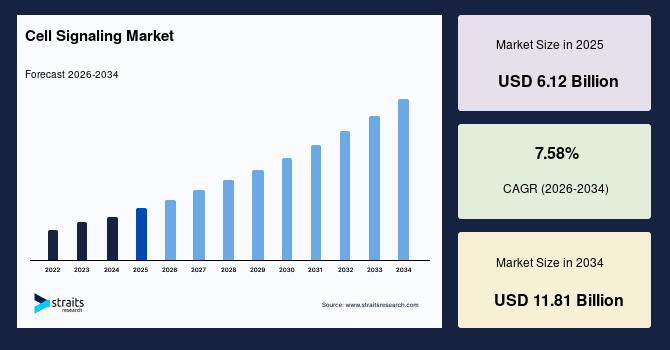
| Projected 2034 Value | USD 11.81 Billion |
| CAGR (2026-2034) | 7.58% |
| Study Period | 2022-2034 |
| Dominant Region | North America |
| Fastest Growing Region | Asia Pacific |
| Key Market Players | Thermo Fisher Scientific, Inc., QIAGEN, BD, Bio-Rad Laboratories Inc., Bio-Techne |
Download Free Sample Report to Get Detailed Insights.
Cell Signaling Market Growth Factors Regulatory Approvals for Cell Signaling Product LaunchesRegulatory approvals play a crucial role in the commercialization of cell signaling-based therapeutics, ensuring compliance with safety, efficacy, and global health standards. Accelerated approvals of targeted therapies and companion diagnostics drive further investment in precision medicine and oncology research.
-
For instance, in December 2022, the FDA approved adagrasib (Krazati) with accelerated approval for KRAS G12C-mutated NSCLC, a major milestone in targeted therapies based on cell signaling pathways. The KRYSTAL-1 trials showed a 43% objective response rate (ORR) with a median duration of response (DOR) of 8.5 months, reflecting the effectiveness of RAS GTPase inhibitors.
Such regulatory support drives the market for cell signaling with the growing need for companion diagnostics, targeted inhibitors, and precision oncology solutions.
Market Restraining Factors High Costs of R&d in the Cell SignalingThe high cost of research and development is a significant barrier to growth in the cell signaling market, driven by the substantial financial investment required for developing advanced assays, reagents, and therapeutics. Extensive preclinical and clinical trials, coupled with stringent regulatory approval processes, further escalate expenses, making it difficult for small biotech firms and startups to compete. This limits innovation and slows market penetration. Additionally, the high price of cell signaling products restricts access for academic researchers and clinical institutions with limited budgets, ultimately hindering advancements in drug discovery, personalized medicine, and targeted therapy development.
Market Opportunity Advancements in Proteomics and GenomicsAdvancements in proteomics and genomics are unlocking new growth opportunities in the market for cell signaling as next-generation omics technologies enhance biomarker discovery, precision medicine, and targeted drug development. The ability to map intricate signaling pathways at an unprecedented resolution is transforming disease research, leading to faster identification of therapeutic targets and more effective drug screening.
-
In October 2024, Proteintech Genomics introduced theMultiPro Human Discovery Panel, enabling researchers to profile 325 proteins alongside whole transcriptome analysis in single cells. Built on 10x Genomics' Chromium technology, this cost-effective innovation is expanding access to high-resolution multiomic analysis, driving breakthroughs in oncology, immunology, and cell biology.
As demand grows for personalized therapeutics and precision diagnostics, integrating intracellular and surface protein profiling presents a major market opportunity.
Regional InsightsNorth America holds the dominant position in the global cell signaling market, driven by significant investments in biotechnology and pharmaceutical research, a well-established healthcare infrastructure, and the presence of key market players. Substantial funding from government agencies like the National Institutes of Health (NIH) and non-profit organizations accelerates advancements in cell signaling technologies. Moreover, the region witnesses a high uptake of clinical trials and diagnostic research, particularly in oncology, neurology, and immunology. The rising prevalence of chronic diseases, coupled with the adoption of precision medicine, further fuels market expansion.
U.s. Cell Signaling Market TrendsThe U.S. market is dominating due to its advanced research infrastructure and high prevalence of chronic diseases like cancer. In January 2024, the National Cancer Institute estimated 2,001,140 new cancer cases in the U.S., driving demand for cutting-edge cell signaling technologies. Increasing investments in precision medicine, biotechnology innovations, and robust clinical research further fuel market expansion, positioning the U.S. as a global leader in this sector.
Asia-Pacific is poised to record the fastest CAGR, driven by increasing government support for life sciences research, rapid growth in biotechnology and pharmaceutical sectors, and the widespread adoption of advanced signaling technologies in clinical diagnostics. Countries like China, Japan, and India are heavily investing in biomedical research, expanding healthcare infrastructure, and addressing the rising burden of cancer and infectious diseases. Moreover, the region benefits from increasing collaborations between global biotech firms and local research institutions, facilitating innovation and technology transfer.
China's cell signaling market is expanding due to strong government funding in biotech research and a booming pharmaceutical sector. As part of its 14th Five-Year Plan (2021-2025), China allocated 5 billion yuan to the China Brain Project, supporting neural circuit research and brain-inspired AI technologies. This initiative enhances cell signaling studies, particularly in neurological disorders, cognitive function, and synaptic signaling pathways, driving China's leadership in neuroscience and biomedical advancements.
India's cell signaling industry is growing rapidly, supported by government initiatives, a developing biotech sector, and new product launches. In July 2024, REPROCELL's Indian subsidiary, Bioserve India, introduced advanced stem cell products to drive regenerative medicine and therapeutic discoveries. With a global biorepository of over 600,000 biospecimens and specialized cell culture technologies, this initiative strengthens research on cellular mechanisms and signal transduction, boosting India's presence in the global cell signaling industry.
Europe's Cell Signaling Market TrendsGermany is a key player in Europe's cell signaling market, benefiting from regulatory advancements, government initiatives, and private-sector investments. In April 2024, Merck announced a €300 million investment in an Advanced Research Center in Darmstadt, focusing on antibodies, mRNA applications, and biotechnological production. This initiative accelerates innovations in cancer, autoimmune disease, and gene therapy research, strengthening Germany's role in cell signaling technologies.
France is advancing in the market through neuroscience, pharmaceutical research, and government-backed life sciences programs. The France 2030 initiative, a €54 billion investment program, accelerates digital health, precision medicine, and biotechnology advancements. By funding research in cellular mechanisms, disease modeling, and targeted therapies, the initiative fosters innovation in cell signaling applications, enhancing France's role in cutting-edge biomedical research and therapeutic development.
Type InsightsEndocrine signaling leads the global market due to its crucial role in regulating metabolism, growth, and immune response. This process involves hormone release into the bloodstream, enabling long-distance cellular communication. Rising cases of endocrine-related disorders, such as diabetes, thyroid dysfunction, and hormonal imbalances, are driving demand for advanced research and diagnostic applications. Moreover, technological advancements in hormone assays and receptor-targeted therapies are expanding the scope of endocrine signaling studies, reinforcing its dominance in the market.
Product InsightsThe instruments segment dominates the market for cell signaling by providing high-precision analysis, automation, and real-time cellular monitoring. These tools are essential for studying signal transduction pathways with accuracy. In August 2024, DeNovix introduced the CellDrop FLi Automated Cell Counter, incorporating machine-learning algorithms and dual-channel fluorescence for viability analysis. Instruments like flow cytometers, microfluidic platforms, and biosensors are advancing research by enabling quantitative assessments of signaling dynamics, boosting their adoption in laboratories worldwide.
Technology InsightsMicroscopy remains the leading technology in the global market, offering high-resolution visualization of protein interactions and cellular structures. Advanced techniques like confocal, fluorescence, and super-resolution microscopy allow researchers to explore intricate signaling pathways at a subcellular level. In October 2024, Bruker introduced the OptoVolt module, a high-speed multiphoton microscopy solution for neural imaging at over 1000 frames per second. This innovation enhances real-time observation of neural signal transmission, significantly advancing neuroscience and biomedical research.
Pathway InsightsThe AKT signaling pathway dominates the market due to its pivotal role in regulating cell survival, metabolism, and proliferation. Widely studied in cancer research, drug development, and regenerative medicine, this pathway has become a prime target for therapeutic interventions. Increasing investments in targeted cancer therapies have led to the development of AKT inhibitors, driving demand for cell signaling tools. Moreover, its involvement in neurobiology and immunology has fueled research into novel biomarkers and precision medicine applications.
Company Market ShareKey players in the cell signaling industry are actively adopting strategic business approaches such as collaborations, product approvals, acquisitions, and innovative product launches to strengthen their market presence. Companies are increasingly partnering with research institutions and biotech firms to drive innovation, accelerate drug discovery, and enhance cell signaling applications in precision medicine.
Bio-Techne: An Emerging Player in the Global Cell Signaling MarketBio-Techne is a leading life sciences and diagnostics company headquartered in Minneapolis, Minnesota, catering to the biotechnology, pharmaceutical, and academic research sectors. The company specializes in protein analysis, antibodies, and cell and gene therapy tools, providing high-quality reagents, assay platforms, and innovative solutions for biomedical research.
Recent Developments by Bio-Techne:-
In February 2023, Bio-Techne partnered with Cell Signaling Technology (CST) to validate CST antibodies for use on the Simple Western platform, enabling automated, reproducible, and quantitative immunoassays for cell signaling research. This collaboration enhances protein detection workflows, improving accuracy and efficiency in analyzing signaling pathways.
-
Thermo Fisher Scientific, Inc.
QIAGEN
BD
Bio-Rad Laboratories Inc.
Bio-Techne
Cell Signaling Technology Inc.
Danaher
Merck KGaA
PerkinElmer Inc.
Promega Corporation
Miltenyi Biotec
Abcam Limited.
Cell Biolabs, Inc.
MEDICAL & BIOLOGICAL LABORATORIES CO., LTD.
Abeomics
-
March 2025 – AstraZeneca announced the acquisition of Belgian biotech firm EsoBiotec for up to $1 billion. EsoBiotec specializes in in-vivo CAR-T cell therapies, which aim to enhance the immune system's ability to target cancer and treat autoimmune diseases through simple injections, potentially transforming cell therapy accessibility and cost-effectiveness.
As per our analyst, the market is set for remarkable growth, driven by advancements in cancer research, immunotherapy, and targeted drug development. The increasing prevalence of chronic diseases, including cancer, autoimmune disorders, and neurological conditions, is fueling demand for precise signaling pathway modulators. Moreover, the growing focus on immuno-oncology and precision medicine is accelerating the adoption of cutting-edge technologies in this space.
Pharmaceutical and biotech companies are expanding their validated antibody portfolios to support research on kinase inhibitors, cytokine pathways, and DNA damage response (DDR) mechanisms, further strengthening market expansion. Despite the immense growth potential, challenges persist. The complexity of signaling pathways and cross-talk between multiple cellular mechanisms create hurdles in drug development and biomarker identification.
Moreover, the high costs associated with advanced research tools and stringent regulatory frameworks can slow innovation. However, continued investment in cancer therapeutics, proteomics, and spatial biology, coupled with breakthroughs in single-cell analysis and AI-driven drug discovery, is expected to overcome these barriers, ensuring sustained growth for the global cell signaling market.
Report Scope| Report Metric | Details |
|---|---|
| Market Size in 2025 | USD 6.12 Billion |
| Market Size in 2026 | USD 6.58 Billion |
| Market Size in 2034 | USD 11.81 Billion |
| CAGR | 7.58% (2026-2034) |
| Base Year for Estimation | 2025 |
| Historical Data | 2022-2024 |
| Forecast Period | 2026-2034 |
| Report Coverage | Revenue Forecast, Competitive Landscape, Growth Factors, Environment & Regulatory Landscape and Trends |
| Segments Covered | By Type, By Product, By Technology, By Pathway |
| Geographies Covered | North America, Europe, APAC, Middle East and Africa, LATAM |
| Countries Covered | US, Canada, UK, Germany, France, Spain, Italy, Russia, Nordic, Benelux, China, Korea, Japan, India, Australia, Taiwan, South East Asia, UAE, Turkey, Saudi Arabia, South Africa, Egypt, Nigeria, Brazil, Mexico, Argentina, Chile, Colombia |
Download Free Sample Report to Get Detailed Insights.
Cell Signaling Market Segments By Type-
Endocrine Signaling
Paracrine Signaling
Autocrine Signaling
Others
-
Consumables
Instruments
-
Flow Cytometry
Microscopy
Western Blotting
ELISA
Others
-
AKT Signaling Pathway
AMPK Signaling Pathway
ErbB/HER Signaling Pathway
Others
-
North America
Europe
APAC
Middle East and Africa
LATAM

Legal Disclaimer:
MENAFN provides the
information “as is” without warranty of any kind. We do not accept
any responsibility or liability for the accuracy, content, images,
videos, licenses, completeness, legality, or reliability of the information
contained in this article. If you have any complaints or copyright
issues related to this article, kindly contact the provider above.
Most popular stories
Market Research

More Story








Comments
No comment