




403
Sorry!!
Error! We're sorry, but the page you were looking for doesn't exist.
Global Organoids And Spheroids Market Share And Forecast To 2033
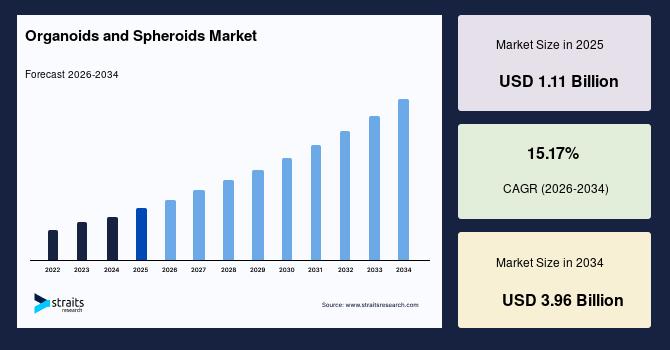
| Market Metric | Details & Data (2025-2034) |
|---|---|
| 2025 Market Valuation | USD 1.11 Billion |
| Estimated 2026 Value | USD 1.28 Billion |
| Projected 2034 Value | USD 3.96 Billion |
| CAGR (2026-2034) | 15.17% |
| Study Period | 2022-2034 |
| Dominant Region | North America |
| Fastest Growing Region | Asia Pacific |
| Key Market Players | 3D Biomatrix (The U.S.), 3D Biotek LLC (The U.S.), AMS Biotechnology (Europe) Limited (U.K.), ATCC (The U.S.), Cellesce Ltd. |
Download Free Sample Report to Get Detailed Insights.
Market Dynamics Technological Developments and Innovations in 3d Spheroid Technology to Drive the Market GrowthTechnological interventions, as well as the latest innovations, coupled with 3D model technologies, drive the market growth. For instance, the Cultrex Organoid Progenitor Cells launched by AMS Biotechnology (AMSBIO) can be optimized using different sets of extracellular matrices, facilitating the researchers to direct the cellular activities by controlling the culture micro-environment. Thus, spheroids produced by this technique are used for the modeling of cell invasion from tumor spheroids.
Researchers have further developed a 3D tri-culture model by adding vascular cells and human mesenchymal stem cells (hMSCs) to these spheroids. These efforts have led to the development of a predictive in-vitro model as the tri-cultures exhibit drug response and tumor morphology similar to xenografts. Such studies have propelled the adoption of spheroids and organoids in drug testing and clinical trials.
Rapid acceptance and utilization of spheroid and organoid culture in government-based research bodies, as well as institutional projects, is expected to drive the academic and research institutes segment. One such example is researchers from the Stanley Center for Psychiatric Research (Broad Institute) and Harvard University that created enhanced human brain organoids in June 2019 to strengthen neurological disorder research.
Regional Analysis North America to Hold the Lion's Share in the Organoids and Spheroids MarketThe rapid rise in the implementation of organoid-based research models in the biotechnology sector of the U.S. and Canada drives the regional market growth. These 3D culture technologies have helped the researchers to overcome restraints faced by 2D cell culture platforms, as 3D spheroids offer a microenvironment that can mimic the properties of human tissue structures. Moreover, the presence of numerous state and federal funding organizations in this region that are motivated to fund such projects is also expected to drive the demand for organoids and spheroids culture systems. For instance, a February 2020 study conducted by the American Association for the Study of Liver Diseases (AASLD) regarding the usage of organoid medicine in hepatology was supported by the AASLD Foundation (Pinnacle Research Award), North American Society of Gastroenterology Hepatology and Nutrition Foundation, and Cincinnati Children's Research Foundation (Procter Scholar Award).
Segmental Analysis Spheroids Segment to Dominate the Market Based on Rising Its Rising Demand in Cancer ResearchIn the past few years, spheroid cultures have been witnessing ever-growing demand in the field of drug discovery, toxicology, and cancer research. This is attributed to the fact that spheroids have a similar development pattern as of tumors, and they can be cultured to produce a huge volume of cells with consistent dimensions. They can also be analyzed and counted by the use of a variety of instruments and techniques.
The multicellular tumor spheroids (MCTS) segment, on the other hand, dominates the spheroid segment as it is the most commonly adopted spheroid model for cell culture. In April 2020, a study conducted by researchers of the University of Pittsburgh showed the utilization of MCTS in preclinical cancer drug studies. The study concluded that the utilization of MCTS in oncology drug screening regimes can lead to a better assessment of drug response and give accurate insights.
organoids Segment is Expected to Grow with the Highest CagrOrganoids can potentially be used as in-vitro models for drug discovery. With developments in the organoids segment, the market is expected to garner higher revenue during the forecast period. For instance, MatTek Corporation cultured 3D organotypic structures for the production and commercialization of in-vitro human tissue models. The company has commercialized a diverse product portfolio of bronchial airway (EpiAirway), skin (EpiDerm, EpiDermFT), vaginal (EpiVaginal), and ocular (EpiOcular) epithelium.
The intestinal organoids segment holds the largest share in the organoid segment on account of the increasing availability of commercial model systems and intestinal epithelium analysis methods. In addition, intestinal organoids find applications in the field of cell biology, modeling of diseases, and production and screening of drugs.
biology Segment to Dominate the Market during the Forecast PeriodThe biology segment dominates the market during the forecast period. Organoid biology provides a great opportunity to test the basics of human developmental biology, learned through classical methods. In the study of the tissue homeostasis process, lineage determination, and embryonic growth, organoids derived from Induced Pluripotent Stem Cells (iPSCs), and Embryonic Stem Cells (ESCs) have proven to be beneficial. This is because the characteristics of the developmental stages they go through are preserved by organoids. Therefore, these models have been used for the study of the stomach, pancreas, and brain developmental biology.
Collaboration and Strategic Partnerships to Drive the Biotechnology and Pharmaceutical Companies SegmentThe biotechnology and pharmaceutical companies segment accounted for the largest market share. Future therapeutic applications of organoids and spheroids have motivated pharmaceutical startups to adopt these products. In addition, the surging use of organoids and spheroids by pharmaceutical entities in preclinical drug discovery is expected to propel segment growth. Further, the collaborations and strategic alliances between key players provide an impetus to the market growth. In October 2019, Hubrecht Organoid Technology (HUB) collaborated with MIMETAS to commercialize Organoids-on-a-Chip technology.
List of Key and Emerging Players in Organoids and Spheroids Market-
3D Biomatrix (The U.S.)
3D Biotek LLC (The U.S.)
AMS Biotechnology (Europe) Limited (U.K.)
ATCC (The U.S.)
Cellesce Ltd.
Corning Incorporated (The U.S.)
Greiner Bio-One (The U.S.)
Hubrecht Organoid Technology (HUB) (the Netherlands)
Kuraray (Japan)
Lonza (Japan)
Merck KGaA (The U.S.)
Thermo Fisher Scientific, Inc. (The U.S.)
-
In 2020, researchers developed mini lungs using 3D cultured models to study the mechanism of the entry of SARS-CoV-2 and its spread in tissues. Organoids have also been employed to study the defense mechanism of tissues against SARS-CoV-2
SCIVAX Corporation developed the Nano Culture Plate (NCP) and Nano Culture Dish (NCD). Spheroids grown on NCP can be used for live imaging under both fluorescence and bright-field microscopes.
| Report Metric | Details |
|---|---|
| Market Size in 2025 | USD 1.11 Billion |
| Market Size in 2026 | USD 1.28 Billion |
| Market Size in 2034 | USD 3.96 Billion |
| CAGR | 15.17% (2026-2034) |
| Base Year for Estimation | 2025 |
| Historical Data | 2022-2024 |
| Forecast Period | 2026-2034 |
| Report Coverage | Revenue Forecast, Competitive Landscape, Growth Factors, Environment & Regulatory Landscape and Trends |
| Segments Covered | By Type, By Spheroids, By Application, By End-user |
| Geographies Covered | North America, Europe, APAC, Middle East and Africa, LATAM |
| Countries Covered | US, Canada, UK, Germany, France, Spain, Italy, Russia, Nordic, Benelux, China, Korea, Japan, India, Australia, Taiwan, South East Asia, UAE, Turkey, Saudi Arabia, South Africa, Egypt, Nigeria, Brazil, Mexico, Argentina, Chile, Colombia |
Download Free Sample Report to Get Detailed Insights.
Organoids and Spheroids Market Segments By Type-
Organoids
Neural Organoids
Hepatic Organoids
Intestinal Organoids
-
Multicellular Tumor Spheroids (MCTS)
Neurospheres
Mammospheres
Hepatospheres
Embryoid bodies
-
Developmental Biology
Personalized Medicine
Regenerative Medicine
Disease Pathology Studies
Drug Toxicity and Efficacy Testing
-
Biotechnology and Pharmaceutical Industries
Academic and Research Institutes
Hospitals and Diagnostic Centers
-
North America
Europe
APAC
Middle East and Africa
LATAM

Legal Disclaimer:
MENAFN provides the
information “as is” without warranty of any kind. We do not accept
any responsibility or liability for the accuracy, content, images,
videos, licenses, completeness, legality, or reliability of the information
contained in this article. If you have any complaints or copyright
issues related to this article, kindly contact the provider above.
Most popular stories
Market Research

More Story








Comments
No comment