




403
Sorry!!
Error! We're sorry, but the page you were looking for doesn't exist.
DNA Methylation Market Size, Top Share, Demand Industry Report, 2033
| Market Metric | Details & Data (2025-2034) |
|---|---|
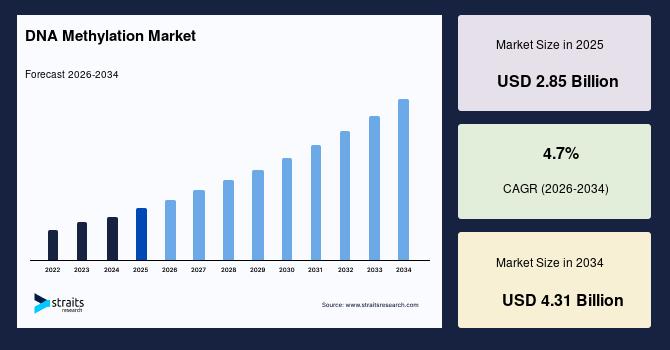
| 2025 Market Valuation | USD 2.85 Billion |
| Estimated 2026 Value | USD 2.98 Billion |
| Projected 2034 Value | USD 4.31 Billion |
| CAGR (2026-2034) | 4.7% |
| Study Period | 2022-2034 |
| Dominant Region | North America |
| Fastest Growing Region | Asia Pacific |
| Key Market Players | New England Biolabs, Sysmex Corporation, Abcam Limited, F. Hoffmann-La Roche Ltd, Watchmaker Genomics |
Download Free Sample Report to Get Detailed Insights.
Market Growth Factors Rising Prevalence of Chronic DiseasesThe increasing incidence of chronic diseases such as cancer, diabetes, and cardiovascular disorders is driving demand for DNA methylation-based diagnostics and therapies. Epigenetic modifications play a crucial role in disease onset and progression, making DNA methylation biomarkers valuable for early detection and precision medicine.
-
For instance, the Centers for Disease Control and Prevention (CDC) reports that six in ten Americans have at least one chronic disease, and four in ten have two or more, many of which are linked to poor nutrition and lifestyle factors. This growing disease burden is driving demand for advanced diagnostic tools, including DNA methylation-based biomarkers, which enable early detection and personalized treatment strategies.
The prevalence of chronic diseases continues to rise, which highlights the urgent need for innovative approaches, such as DNA methylation-based solutions, to address the growing burden of chronic diseases.
Increase in Government and Private Funding for Epigenetics ResearchGrowing investments from governments and private organizations are driving advancements in DNA methylation-based diagnostics and therapies. Funding supports cancer epigenetics, precision medicine, and the commercialization of methylation-based tests, accelerating research and clinical adoption.
-
For instance, in February 2025, TruDiagnostic, an epigenetic testing and research company, announced the TruDiscovery Grant, offering $400,000 in funding for researchers and organizations pioneering advancements in DNA methylation, longevity science, and diagnostic innovation.
Such initiative highlights the growing investment in epigenetics research, fostering innovation in precision medicine and biomarker development, ultimately accelerating the clinical adoption of DNA methylation-based diagnostics and therapies.
Market Restraining Factor High Costs of Dna Methylation Sequencing TechnologiesAdvanced techniques such as whole-genome bisulfite sequencing (WGBS), reduced representation bisulfite sequencing (RRBS), and methylation arrays require expensive reagents, specialized equipment, and sophisticated bioinformatics analysis. These financial constraints limit accessibility, particularly for smaller research institutions and healthcare providers in developing regions with restricted budgets.
Moreover, the cost of integrating DNA methylation-based diagnostics into routine clinical practice remains high, slowing commercialization and market expansion. Addressing affordability through cost-effective sequencing platforms and funding support is crucial for wider adoption and technological advancement.
Market Opportunity Expansion in Liquid Biopsy-Based Early Cancer ScreeningThe growing adoption of methylation-based liquid biopsy tests is transforming early cancer detection by offering a non-invasive, highly accurate alternative to traditional screening methods. These tests analyze circulating tumor DNA (ctDNA) to identify specific methylation patterns associated with cancer, enabling earlier diagnosis, risk assessment, and personalized treatment strategies. Increasing regulatory approvals, research advancements, and investment inflows are accelerating market growth and clinical adoption.
-
For instance, in March 2024, a study published in the National Library of Medicine highlighted the potential of DNA methylation biomarkers in liquid biopsy for colorectal cancer (CRC) screening. The research emphasized CRC as a leading cause of cancer-related deaths and underscored the limitations of traditional detection methods, concluding that methylation biomarkers in ctDNA significantly improve diagnostic accuracy and patient outcomes.
Such advancements create substantial market opportunities, driven by growing collaborations, technological innovations, and expanding accessibility of cost-effective, non-invasive cancer diagnostics.
Regional AnalysisNorth America holds a leading position in the global DNA methylation market, driven by substantial investments in epigenetics research, strong government funding, and a well-established biotechnology and pharmaceutical sector. The region benefits from the presence of key market players such as Illumina Inc., Thermo Fisher Scientific Inc., Zymo Research, and Pacific Biosciences, which offer cutting-edge methylation sequencing platforms and bioinformatics solutions.
Moreover, the rising prevalence of cancer and neurological disorders has fueled the demand for liquid biopsy tests and non-invasive diagnostics, which rely on DNA methylation biomarkers for early disease detection. Regulatory support, such as funding from the National Institutes of Health (NIH) and initiatives like the Cancer Moonshot Program, continue to strengthen research and clinical applications in the region.
-
The U.S. market remains a global leader, fueled by robust investment in research and development. A prime example is a 2023 study from the University of Michigan's Institute for Social Research, which explored DNA methylation's role in predicting aging and disease outcomes. This highlights how methylation patterns can serve as biomarkers for assessing health risks, particularly in aging populations, driving growth in epigenetics and personalized medicine.
Asia-Pacific is poised to register the fastest CAGR, driven by increasing awareness of epigenetics in disease diagnostics, rising cancer prevalence, and expanding research initiatives. Countries such as China, India, and Japan are heavily investing in precision medicine, genomic research, and cost-effective DNA methylation technologies, fostering market growth. Moreover, the presence of emerging biotech firms and partnerships with global players is driving advancements in epigenetic drug development and biomarker-based diagnostics.
-
India, with its vast population, is experiencing rapid growth in the DNA methylation market, driven by the launch of innovative kits by key players. For instance, in December 2024, Reliance Industries, in collaboration with Strand Life Sciences, introduced CancerSpot, a non-invasive blood test for early cancer detection. This innovative test utilizes advanced methylation profiling technology to identify tumor DNA fragments in the blood, enabling early and accurate cancer screening.
Japan is witnessing significant growth in its market, driven by advancements in cancer research, precision medicine, and aging-related epigenetics. The rising elderly population and increasing prevalence of neurological disorders are fuelling demand for methylation-based diagnostics. Government initiatives supporting genomics research and collaborations between biotech firms and academic institutions are further accelerating innovation.
Belgium is gaining momentum in the DNA methylation industry, driven by groundbreaking research and investments in epigenetics. A key development came in January 2025, when researchers from Université libre de Bruxelles discovered a transformative connection between DNA and RNA methylation. Their findings have reshaped the understanding of gene regulation and epitranscriptomics, opening new pathways for targeted therapies, enhancing the country's position in global epigenetics research and cancer treatment innovations.
UK Market TrendsThe UK DNA methylation industry is strengthening through strategic collaborations. Notably, Oxford Nanopore Technologies partnered with the UK Biobank in November 2024 to create the world's first large-scale epigenetic dataset. This project, involving sequencing 50,000 samples, aims to unlock insights into disease mechanisms and improve patient outcomes, making the dataset a critical resource for advancing genomics research and the development of epigenetic-based therapies.
Product InsightsThe kits & reagents segment led with a 42.6% share in 2024, driven by their key role in cancer and neurological diagnostics, primarily due to its essential role in research, diagnostics, and clinical applications. These products are widely used in bisulfite sequencing, methylation-specific PCR, and microarray-based methylation analysis, enabling researchers to study epigenetic modifications with high precision. The rising demand for methylation analysis in cancer diagnostics, neurodegenerative diseases, and personalized medicine further fuels growth, driving increased adoption of specialized kits and reagents.
Technology InsightsSequencing technology leads the global market, driven by its high accuracy, scalability, and ability to analyze genome-wide methylation patterns. Next-generation sequencing (NGS) has revolutionized methylation analysis by offering high-throughput, cost-effective solutions for detecting epigenetic changes. Researchers and clinicians increasingly rely on sequencing-based methylation analysis for biomarker discovery, disease diagnostics, and precision medicine applications, particularly in oncology and neurogenetics.
Application InsightsThe diagnostics segment holds the largest revenue share in the global market, driven by the growing demand for non-invasive, biomarker-based tests. Methylation-based liquid biopsy tests are revolutionizing early cancer detection, disease monitoring, and risk assessment, providing more accurate and accessible diagnostic solutions. Moreover, methylation biomarkers are gaining traction in neurological and autoimmune disease diagnostics, offering insights into disease progression and therapeutic responses.
End-User InsightsBiotechnology and pharmaceutical companies account for the largest share, owing to their substantial investments in epigenetics research, biomarker discovery, and drug development. These companies are actively exploring methylation-based therapies, precision oncology, and companion diagnostics, expanding the clinical applications of DNA methylation. The rise of collaborations between pharma companies and research institutions, along with increasing funding for epigenetic drug development and diagnostics, is further driving market growth.
Company Market ShareMajor companies related to the DNA methylation industry are investing heavily in research and development to enhance their product portfolios and expand their market reach. They are also focusing on mergers and partnerships to leverage complementary technologies, enter new markets, and strengthen their competitive position.
Singlera Genomics Inc.: An Emerging Player in the Global Dna Methylation MarketSinglera Genomics Inc. is a leading biotechnology company specializing in non-invasive genetic diagnostics, with a strong focus on DNA methylation technologies. The company develops cutting-edge molecular diagnostic solutions designed for early cancer detection, enabling timely intervention and personalized treatment strategies.
Singlera's innovative platforms leverage DNA methylation biomarkers to identify tumor-related genetic changes in blood samples, facilitating non-invasive liquid biopsy tests.
Recent Developments by Singlera Genomics Inc.:-
In April 2022, Singlera Genomics Inc. partnered with Astellas Pharma Inc. to develop methylation-based tools using the mTitan platform. This platform detects rare circulating cell-free DNA methylation signals and has previously identified cancer signals up to four years before symptoms appear.
-
New England Biolabs
Sysmex Corporation
Abcam Limited
F. Hoffmann-La Roche Ltd
Watchmaker Genomics
Thermo-Fisher Scientific Inc.
Agilent Technologies Inc.
Bio-Rad Laboratories, Inc.
Exact Sciences Corporation
QIAGEN
Active Motif, Inc.
Illumina Inc
TruDiagnostic
EpigenTek Group Inc
Singlera Genomics Inc.
-
May 2025: Illumina is currently engaged in legal disputes with Element Biosciences. Element has filed lawsuits in federal courts in California and Delaware, alleging that Illumina is monopolizing the next-generation DNA sequencing market and infringing on its patents. Illumina has denied the claims, asserting that Element is attempting to exploit its innovations without appropriate compensation. This legal situation may have implications for market competition and intellectual property dynamics within the DNA sequencing and methylation space.
July 2025: Bio-Rad Laboratories has expanded its Droplet Digital PCR (ddPCR) offerings through a strategic acquisition and platform rollout. The enhanced portfolio now includes over 400,000 assays, positioning Bio-Rad as a leader in digital PCR products for life science research and diagnostic applications.
As per our analyst, the global DNA methylation market is poised for robust growth, fueled by the increasing adoption of epigenetics in precision medicine, cancer diagnostics, and neurological research. Advances in liquid biopsy-based methylation assays, AI-powered bioinformatics, and next-generation sequencing (NGS) technologies are enhancing disease detection, enabling more accurate diagnoses, and improving therapeutic strategies.
However, despite the optimistic outlook, the market faces several challenges. High costs associated with advanced sequencing technologies and liquid biopsy tests remain a barrier to widespread adoption, particularly in emerging markets. Moreover, there is a need for standardization in methylation-based diagnostic methods to ensure consistent and reliable results across clinical applications.
Nevertheless, these challenges are not insurmountable. Continued technological advancements, along with increased collaboration between biotech firms, academic institutions, and government bodies, are expected to overcome these obstacles, paving the way for sustained growth in the market.
Report Scope| Report Metric | Details |
|---|---|
| Market Size in 2025 | USD 2.85 Billion |
| Market Size in 2026 | USD 2.98 Billion |
| Market Size in 2034 | USD 4.31 Billion |
| CAGR | 4.7% (2026-2034) |
| Base Year for Estimation | 2025 |
| Historical Data | 2022-2024 |
| Forecast Period | 2026-2034 |
| Report Coverage | Revenue Forecast, Competitive Landscape, Growth Factors, Environment & Regulatory Landscape and Trends |
| Segments Covered | By Product, By Technology, By Applications, By End-User |
| Geographies Covered | North America, Europe, APAC, Middle East and Africa, LATAM |
| Countries Covered | US, Canada, UK, Germany, France, Spain, Italy, Russia, Nordic, Benelux, China, Korea, Japan, India, Australia, Taiwan, South East Asia, UAE, Turkey, Saudi Arabia, South Africa, Egypt, Nigeria, Brazil, Mexico, Argentina, Chile, Colombia |
Download Free Sample Report to Get Detailed Insights.
DNA Methylation Market Segments By Product-
Enzymes
Consumables
Kits & Reagents
Instruments & Software
-
Microarray
Sequencing
Polymerase Chain Reaction (PCR)
Others
-
Diagnostics
Clinical Research
Others
-
Hospitals
Diagnostics Laboratories
Biotechnology and Pharmaceuticals Companies
Research & Academic Institutions
-
North America
Europe
APAC
Middle East and Africa
LATAM

Legal Disclaimer:
MENAFN provides the
information “as is” without warranty of any kind. We do not accept
any responsibility or liability for the accuracy, content, images,
videos, licenses, completeness, legality, or reliability of the information
contained in this article. If you have any complaints or copyright
issues related to this article, kindly contact the provider above.
Most popular stories
Market Research

More Story








Comments
No comment