

Freight Forwarding Market Size, Share & Growth Report By 2033


| Market Metric | Details & Data (2025-2034) |
|---|---|
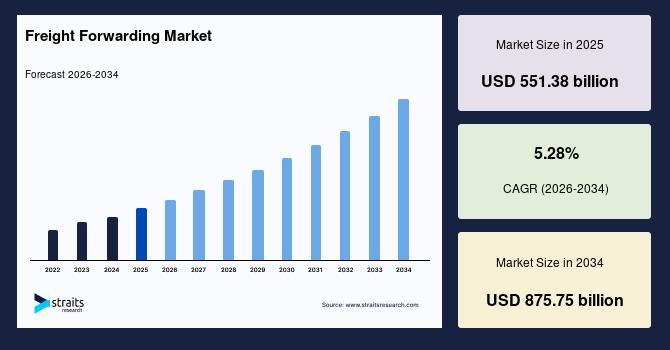
| 2025 Market Valuation | USD 551.38 billion |
| Estimated 2026 Value | USD 580.47 Billion |
| Projected 2034 Value | USD 875.75 billion |
| CAGR (2026-2034) | 5.28% |
| Study Period | 2022-2034 |
| Dominant Region | Asia Pacific |
| Fastest Growing Region | Middle East & Africa |
| Key Market Players | DHL Global Forwarding, Kuehne + Nagel, DB Schenker, DSV Panalpina, Expeditors International |
Download Free Sample Report to Get Detailed Insights.
Market Drivers Growth of Global E-commerceThe rapid expansion of cross-border e-commerce has driven parcel volumes and integrated delivery needs. Freight forwarders are expanding parcel forwarding and fulfillment networks to serve online retailers and omnichannel businesses.
Supply Chain Resilience InvestmentsBusinesses are diversifying routing, nearshoring production, and building inventory buffers. This shift has increased demand for forwarders with flexible capacity, carrier networks, and scenario-based routing to mitigate disruptions.
Market Restraint Fragmented Pricing and Margin PressureFreight pricing remains highly volatile due to fluctuating air and ocean rates, competitive pressure, and customer focus on spot pricing. This commoditization limits pricing power for smaller forwarders and squeezes profit margins across the industry.
Market Opportunities Value-Added Logistics & 3PL IntegrationForwarders offering customs brokerage, warehousing, trade compliance, and fulfillment are evolving into end-to-end logistics providers. This integrated service model increases client retention and recurring revenue streams.
Data Services and Supply Chain AnalyticsLeveraging shipment data for predictive ETAs, capacity forecasting, and dynamic pricing allows forwarders to transition from transactional logistics to consultative partnerships, strengthening customer loyalty.
Regional InsightsNorth America accounted for 22.8% of the global freight forwarding market in 2024 and is projected to grow at a CAGR of 5.0% through 2033. The region's growth is driven by reshoring initiatives, port automation, and rapid adoption of digital logistics solutions. Companies are investing in smarter freight platforms and multimodal integration to strengthen resilience against supply chain disruptions.
The United States remains the dominant national market, supported by strong e-commerce logistics infrastructure, advanced warehousing networks, and high import–export volumes. Federal investments in logistics modernization and transportation efficiency further position the U.S. as a global leader in freight forwarding and digital supply chain integration.
Europe Market InsightsEurope held 21.5% of the market in 2024, expanding at a CAGR of 5.3% (2025–2033). Growth across the region is underpinned by intra-EU trade, cross-border logistics harmonization, and green transport policies promoting sustainable freight movement. Increasing adoption of rail freight and multimodal solutions is improving efficiency and reducing emissions.
Germany leads the European market, benefitting from its strong manufacturing and automotive export base. Its logistics sector emphasizes precision, regulatory compliance, and automation, driving investments in digital freight management systems and energy-efficient transport infrastructure.
Asia Pacific Market InsightsAsia Pacific dominated the global market with a 33.1% share in 2024 and is projected to grow at a CAGR of 5.6% through 2033. The region's leadership stems from robust export manufacturing, expanding e-commerce logistics, and rising intra-Asia trade corridors. Governments are prioritizing logistics infrastructure, smart ports, and trade digitization to enhance connectivity and efficiency.
China remains the largest contributor to regional growth, supported by massive container shipping volumes, manufacturing exports, and digital freight adoption among SMEs. Emerging markets like India, Vietnam, and Indonesia are witnessing rapid development of e-commerce-driven freight services and growing foreign investment in logistics parks and fulfillment centers.
Middle East & Africa Market InsightsThe Middle East & Africa accounted for 9.4% of the global freight forwarding market in 2024 and is projected to be the fastest-growing region, with a CAGR of 6.4%. Growth is primarily supported by strategic logistics hubs, free trade zones, and infrastructure investments in ports, airports, and road networks.
The United Arab Emirates anchors regional expansion, with Dubai serving as a key transshipment and e-commerce gateway connecting Asia, Europe, and Africa. Investments in air cargo capacity, digital customs clearance, and smart trade corridors are strengthening the UAE's role as a global logistics powerhouse.
Latin America Market InsightsLatin America represented 13.2% of the freight forwarding market in 2024, expanding at a CAGR of 4.7% (2025–2033). Market growth is supported by infrastructure upgrades, regional trade agreements, and the rise of pharmaceutical and industrial exports. Governments are increasingly investing in port modernization and customs automation to enhance trade competitiveness.
Brazil is the leading national market, driven by strong commodity exports, pharmaceutical cold-chain logistics, and growing manufacturing activity. Initiatives promoting regional supply chain integration and foreign investment continue to improve the region's logistics efficiency and capacity utilization.
Service Type InsightsOcean freight forwarding dominated the market with a 44.5% share in 2024, owing to its cost-effectiveness and the expansion of global maritime trade. As international trade volumes rise, ocean forwarding remains the backbone of bulk goods transport, particularly across Asia–Europe and Trans-Pacific routes.
E-commerce parcel forwarding is the fastest-growing service, projected to grow at a CAGR of 8.3%. The boom in cross-border e-commerce, coupled with the need for faster last-mile solutions, is prompting forwarders to invest in automated fulfillment, parcel tracking, and customs-friendly digital documentation.
Mode of Transport InsightsMultimodal transport solutions are gaining prominence as shippers seek flexibility, resilience, and cost optimization. The integration of air, ocean, rail, and road modes allows for faster and more reliable deliveries across regions.
Single-mode transport, while still widely used for specific routes, is gradually giving way to multimodal strategies as sustainability and efficiency take precedence in supply chain planning.
The retail and e-commerce sector led the market with a 38.7% share in 2024, supported by global online sales growth, direct-to-consumer logistics models, and increased reliance on third-party logistics providers.
The healthcare and pharmaceutical segment is the fastest-growing end-use, projected to expand at a 7.1% CAGR. Demand for temperature-controlled logistics, compliance-driven shipping, and rapid delivery networks has strengthened forwarder participation in pharma supply chains.
Customer Type InsightsLarge enterprises accounted for the majority of freight forwarding revenue in 2024, leveraging long-term contracts and global logistics partnerships to ensure consistent capacity and reliability.
However, Small and Medium Enterprises (SMEs) represent the fastest-growing customer base, with a 6.8% CAGR, driven by digital freight platforms that offer instant pricing, flexible capacity, and simplified customs processes, enabling SMEs to access global markets more efficiently.
Solution InsightsCustoms brokerage and documentation remain essential, forming the foundation of global forwarding services. Growing digitalization is simplifying clearance and reducing delays. Warehousing and fulfillment solutions are expanding rapidly, registering a 6.9% CAGR, as e-commerce and just-in-time manufacturing demand proximity storage and value-added services. Value-added services such as insurance, packaging, and cargo tracking enhance customer experience and increase retention. Meanwhile, technology and data analytics are emerging as strategic differentiators-enabling predictive shipment tracking, route optimization, and cost forecasting for enhanced operational efficiency.
Competitive LandscapeThe global freight forwarding market is fragmented, with competition among major integrators and regional specialists. DHL Global Forwarding led the market in 2024, expanding its digital freight capabilities and securing global carrier contracts.
List of Key and Emerging Players in Freight Forwarding Market-
DHL Global Forwarding
Kuehne + Nagel
DB Schenker
DSV Panalpina
Expeditors International
CEVA Logistics
UPS Supply Chain Solutions
SDV / Bolloré Logistics
Sinotrans
Geodis
Agility Logistics
FourKites (platform partner)
Flexport
Matson Logistics
ZIM Integrated Shipping
-
November 2024 – Kuehne + Nagel: Launched a sustainable air freight product with carbon footprint reporting and offset options for shippers.
January 2025 – DHL Global Forwarding: Expanded ocean capacity agreements with major carriers and rolled out an enhanced digital booking portal for SMEs.
March 2025 – DB Schenker: Opened a new automated fulfillment center in Central Europe to support e-commerce cross-dock and same-day processing.
May 2025 – DSV Panalpina: Acquired a regional cold-chain specialist to strengthen pharmaceutical logistics capabilities in LATAM.
July 2025 – Flexport: Partnered with a major TMS provider to integrate predictive ETA and capacity forecasting into its client dashboard.
| Report Metric | Details |
|---|---|
| Market Size in 2025 | USD 551.38 billion |
| Market Size in 2026 | USD 580.47 Billion |
| Market Size in 2034 | USD 875.75 billion |
| CAGR | 5.28% (2026-2034) |
| Base Year for Estimation | 2025 |
| Historical Data | 2022-2024 |
| Forecast Period | 2026-2034 |
| Report Coverage | Revenue Forecast, Competitive Landscape, Growth Factors, Environment & Regulatory Landscape and Trends |
| Segments Covered | By Service Type, By Mode of Transport, By End-Use Industry, By Customer Type, By Solution |
| Geographies Covered | North America, Europe, APAC, Middle East and Africa, LATAM |
| Countries Covered | US, Canada, UK, Germany, France, Spain, Italy, Russia, Nordic, Benelux, China, Korea, Japan, India, Australia, Taiwan, South East Asia, UAE, Turkey, Saudi Arabia, South Africa, Egypt, Nigeria, Brazil, Mexico, Argentina, Chile, Colombia |
Download Free Sample Report to Get Detailed Insights.
Freight Forwarding Market Segments By Service Type-
Ocean Freight Forwarding
Air Freight Forwarding
Road Freight Forwarding
Rail Freight Forwarding
E-commerce Parcel Forwarding
-
Multimodal
Single-mode (Air/Ocean/Road/Rail)
-
Retail & E-commerce
Automotive
Healthcare & Pharmaceuticals
Electronics
Industrial & Manufacturing
-
Large Enterprises
Small & Medium Enterprises (SMEs)
-
Customs Brokerage & Documentation
Warehousing & Fulfillment
Value-Added Services (Insurance, Packaging)
Technology & Data Analytics
-
North America
Europe
APAC
Middle East and Africa
LATAM

Legal Disclaimer:
MENAFN provides the
information “as is” without warranty of any kind. We do not accept any
responsibility or liability for the accuracy, content, images, videos,
licenses, completeness, legality, or reliability of the information
contained in this article. If you have any complaints or copyright issues
related to this article, kindly contact the provider above.
Comments
No comment