




403
Sorry!!
Error! We're sorry, but the page you were looking for doesn't exist.
Queue Management System Market Size, Growth, Trends Forecast 2033
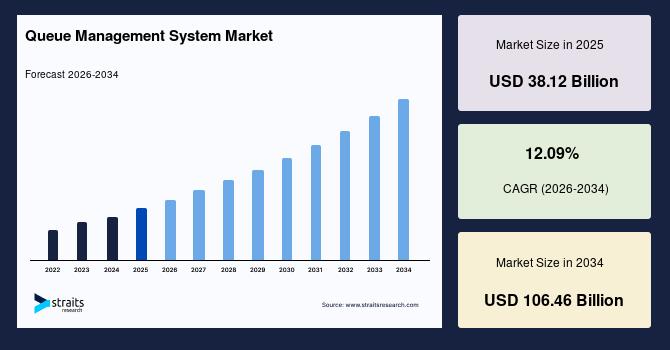
| Market Metric | Details & Data (2025-2034) |
|---|---|
| 2025 Market Valuation | USD 38.12 Billion |
| Estimated 2026 Value | USD 42.73 Billion |
| Projected 2034 Value | USD 106.46 Billion |
| CAGR (2026-2034) | 12.09% |
| Study Period | 2022-2034 |
| Dominant Region | North America |
| Fastest Growing Region | Asia Pacific |
| Key Market Players | AURIONPRO (India), Wavetec (UAE), Xtreme Media Pvt. Ltd. (India), Qmatic (Sweden), VirtuaQ (US) |
Download Free Sample Report to Get Detailed Insights.
Queue Management System Market Driving Factors Customer Experience EnhancementImproving the customer experience is a fundamental motivator in the market. Organizations in various industries use QMS to decrease wait times, improve service delivery, and create a more favorable customer experience. One of the key ways QMS improves customer experience is by minimizing wait times. According to a Lavi Industries survey, 86% of consumers are prepared to wait up to 5 minutes, while just 19% are willing to wait more than 10 minutes. Implementing an effective QMS assists organizations in keeping wait times below acceptable boundaries. Shorter wait times result in higher customer satisfaction. According to a TimeTrade survey, 73% of shoppers are more inclined to purchase if they obtain support fast. QMS adds to speedier service, which improves customer views.
Furthermore, QMS enables organizations to allocate resources based on real-time demand, ensuring personnel can help clients as soon as possible. This results in more effective service delivery and a more pleasant client trip. According to a Deloitte poll, 62% of organizations see customer experience given by contact centers as a competitive difference. Furthermore, according to the Aspect Consumer Experience Index, 76% of customers believe customer service is the genuine litmus test for how much a firm appreciates them. As a result, the queue management system market trend is projected to change throughout the forecast period.
Restraining Factors Cost of ImplementationAcquiring hardware, software licenses, and any needed customization or interface with existing systems are all common upfront expenditures when implementing a Queue Management System (QMS). There are also continuing maintenance and operating charges. For certain organizations, particularly smaller enterprises with limited finances, the financial burden associated with QMS adoption might be a substantial obstacle. The perceived return on investment (ROI) must be sufficient to justify broad adoption's initial and continuing costs.
The organization must invest in self-service kiosks, digital displays, backend software, and interface with current point-of-sale systems to establish a full QMS. The initial cost may include hardware purchases, software licensing, and staff training. The total cost for a chain with several sites might be significant. According to research, the cost of deploying a QMS in a hospital context varies from USD 50,000 to USD 200,000, depending on the system's size and complexity. This price includes hardware, software, and training. Furthermore, according to Capterra, a software discovery and reviews site, the typical cost of queue management software may vary from USD 500 to USD 5,000 per month, depending on the system's capabilities and scalability. While the long-term advantages of better customer experience and operational efficiency are significant, organizations must carefully weigh the costs and benefits to decide if adoption is feasible.
Market Opportunity Rising Demand in HealthcareThe healthcare industry is rapidly recognizing the importance of QMS in enhancing patient experience, optimizing processes, and guaranteeing effective resource utilization. The need to handle difficulties such as lengthy wait times, appointment scheduling complexity, and the requirement to preserve social distance, particularly in the COVID-19 epidemic, has spurred demand for QMS solutions in healthcare. Implementing QMS in healthcare settings may result in shorter patient wait times, more efficient appointment scheduling, and higher patient satisfaction. Patient flow optimization benefits healthcare providers by improving resource allocation and operational efficiency.
A case study published in the Journal of the American College of Radiology examined how a QMS was implemented in a radiology department. The research found a significant decrease in patient wait times, greater staff productivity and enhanced patient satisfaction. The Healthcare Information and Management Systems Society (HIMSS) also emphasizes using technology, especially QMS, to optimize patient flow and enhance access to treatment. Better patient outcomes and resource utilization result from efficient queue management.
Regional Analysis North America Dominates the Global MarketNorth America is the most significant global queue management system market shareholder and is estimated to grow at a CAGR of 6.0% over the forecast period. The growing use of queue management systems in the healthcare, aviation, and retail sectors is driving market growth in North America. Across the area, investment in the healthcare sector to embrace sophisticated technology is constantly increasing. According to JAHANI AND ASSOCIATES LLC, the effect of the COVID-19 pandemic will stimulate capital market activity in the healthcare industry in the United States in 2022. The healthcare business has received a USD 110 billion investment to develop technologies to enhance healthcare services.
Furthermore, about 45% of transactions in the healthcare business were merger and acquisition (M&A) transactions carried out by corporations to enhance current technologies. The development of the healthcare business due to a rise in the number of people visiting hospitals is boosting the market across the area. The market in Canada and Mexico is also gaining popularity as the number of system suppliers and end customers grows. As a result of the causes above, the market in North America is expanding.
Europe is the Fastest-Growing RegionEurope is anticipated to exhibit a CAGR of 6.1% over the forecast period. For the sake of this study, Europe has been split into the United Kingdom, Germany, France, Spain, Italy, and the rest of Europe. According to market insights on queue management systems, the United Kingdom is expected to have the largest market share, followed by Germany and France. The rising need to give a better customer experience for services is one of the factors driving the region's market expansion.
Asia-Pacific is predicted to develop rapidly during the projection period. Increased investment in R&D funds, both governmental and commercial, in this area. As many Asian nations undergo increasing urbanization, the need for effective queue management systems in congested metropolitan areas, public transit hubs, and government service centers is expected to rise. According to the United Nations, the Asia-Pacific region has some of the world's fastest-growing metropolitan regions, with cities housing a significant population share.
Segmental AnalysisThe global queue management system market is segmented based on offering, deployment model, mode, queue type, enterprise size, application, industry vertical, and region.
By OfferingSolution accounts for the largest share of the market. The solution segment often refers to the core product or technology that answers the customer's primary difficulties or demands. In Queue Management Systems (QMS) context, the Solution may comprise self-service kiosks, digital displays, backend software, and analytics tools that assist effective queue management. In 2022, the solution category led the queue management system market share growth, and this dominance is likely to continue. The growing need for queue management solutions in industries like BFSI, healthcare, and others propels the solution sector forward.
By Deployment ModelCloud commands the significant growth of the market. The Queue Management System is hosted on the infrastructure of a third-party cloud service provider in the cloud. The program is accessible online, and data is saved on the cloud provider's servers.
By Deployment ModelVirtual Queuing generates the most revenue in the market. Virtual queuing, often known as digital queuing, uses technology to enable people to join a wait without physically standing in line. This method uses digital technologies like mobile applications, websites, or kiosks to let clients check in, acquire a virtual ticket, and wait for their turn without physically being present at the service location.
Queue types can be divided into structured queues, unstructured queues, kiosk queues, and mobile queues.
Structured Queue holds the major market share. A structured queue is a method of managing consumers in a linear or sequential sequence that is well-defined and organized. Customers use a preset course or lanes, and service stops are labeled systematically. Structured queues allow organizations to properly distribute resources based on consumer demand and queue priority levels.
By Enterprise SizeLarge enterprises are significant contributors to the market. Large businesses are organizations with a large scope of activities, enormous resources, and a large staff. These are often international firms or businesses with a large market reach. Large businesses often have complicated operations, several divisions, and various services or goods. Large organizations led the worldwide queue management market share in 2022, and this trend is likely to continue throughout the forecast period due to an increase in queue management system software used to integrate it with their current inventory.
By ApplicationThe market can be further bifurcated by application into Reporting and Analytics, Real-Time Monitoring, Appointment Management, Customer Service, Query Handling, and In-Store Management.
Real-Time Monitoring occupies the maximum share of the market. The capacity of Real-Time Monitoring to give organizations real-time data regarding queue performance, consumer behavior, and resource utilization has contributed to its prominence. Real-time monitoring guarantees that organizations can react quickly to swings in demand, manage resources effectively, and maintain a consistent customer experience. It entails real-time monitoring of queue statuses, service points, and client flow.
By Industry VerticalThe market is further broken down into BFSI, retail and consumer goods, healthcare and life sciences, government and public sector, IT and telecom, travel and hospitality, and energy and utilities.
Retail and consumer goods influenced the market growth. Retailers use QMS to control lineups during peak shopping hours, optimize in-store customer flow, and improve the overall shopping experience. Due to the large customer numbers and frequent interactions, queue management is critical in retail and consumer products organizations. Regulating customer flow, minimizing wait times, and improving the shopping experience is crucial. Queue management systems may be used in retail environments, such as checkout counters, customer service desks, pick-up and return sections, and waiting spaces for in-store events or services.
List of Key and Emerging Players in Queue Management System Market-
AURIONPRO (India)
Wavetec (UAE)
Xtreme Media Pvt. Ltd. (India)
Qmatic (Sweden)
VirtuaQ (US)
QLess, Inc. (US)
Databyte (Australia)
Qudini (UK)
Tensator (UK)
SEDCO (UAE)
KareXpert Technologies Pvt Ltd. (India)
CampusQ (Australia)
Advantech Co., Ltd. (Taiwan)
XIPHIAS Software Technologies (India)
-
October 2023- Trident College selected Wavetec as a Virtual Queuing Partner to improve students' on-campus experience.
August 2023- LED Configurator by Xtreme Media is a powerful tool for virtually customizing LED video walls.
| Report Metric | Details |
|---|---|
| Market Size in 2025 | USD 38.12 Billion |
| Market Size in 2026 | USD 42.73 Billion |
| Market Size in 2034 | USD 106.46 Billion |
| CAGR | 12.09% (2026-2034) |
| Base Year for Estimation | 2025 |
| Historical Data | 2022-2024 |
| Forecast Period | 2026-2034 |
| Report Coverage | Revenue Forecast, Competitive Landscape, Growth Factors, Environment & Regulatory Landscape and Trends |
| Segments Covered | By Offering, By Deployment Model, By Queue Type, By Enterprise Size, By Application, By Industry Vertical |
| Geographies Covered | North America, Europe, APAC, Middle East and Africa, LATAM |
| Countries Covered | US, Canada, UK, Germany, France, Spain, Italy, Russia, Nordic, Benelux, China, Korea, Japan, India, Australia, Singapore, Taiwan, South East Asia, UAE, Turkey, Saudi Arabia, South Africa, Egypt, Nigeria, Brazil, Mexico, Argentina, Chile, Colombia |
Download Free Sample Report to Get Detailed Insights.
Queue Management System Market Segments By Offering-
Solution
-
Hardware
Software
-
Professional Service
Managed Service
-
On-Premise
Cloud
By Mode
Virtual Queuing
Non-Virtual Queuing
-
Structured Queue
Unstructured Queue
Kiosk Queue
Mobile Queue
-
Large Enterprises
SMEs
-
Reporting and Analytics
Real-Time Monitoring
Appointment Management
Customer Service
Query Handling
In-Store Management
Others
-
BFSI
Retail and Consumer Goods
Healthcare and Life Sciences
Government and Public Sector
IT and Telecom
Travel and Hospitality
Energy and Utilities
Others
-
North America
Europe
APAC
Middle East and Africa
LATAM

Legal Disclaimer:
MENAFN provides the
information “as is” without warranty of any kind. We do not accept
any responsibility or liability for the accuracy, content, images,
videos, licenses, completeness, legality, or reliability of the information
contained in this article. If you have any complaints or copyright
issues related to this article, kindly contact the provider above.
Most popular stories
Market Research

More Story








Comments
No comment