




403
Sorry!!
Error! We're sorry, but the page you were looking for doesn't exist.
Friction Stir Welding Market Size, Share & Growth Report By 2033
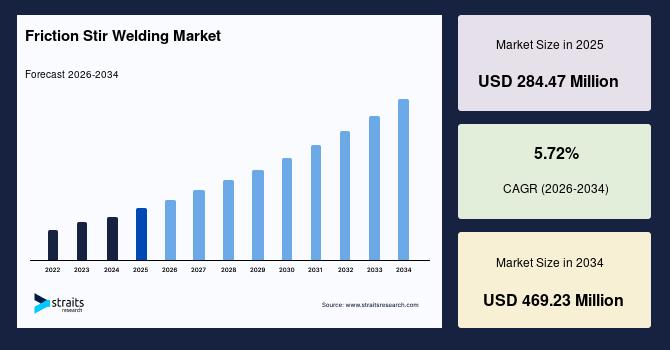
| Market Metric | Details & Data (2025-2034) |
|---|---|
| 2025 Market Valuation | USD 284.47 Million |
| Estimated 2026 Value | USD 300.74 Million |
| Projected 2034 Value | USD 469.23 Million |
| CAGR (2026-2034) | 5.72% |
| Study Period | 2022-2034 |
| Dominant Region | North America |
| Fastest Growing Region | Asia Pacific |
| Key Market Players | Achi Industries Co., Ltd., Beijing FSW Technology Co., Ltd., Bharat Heavy Electricals Limited (BHEL), ESAB (Colfax Corporation), ETA Technology Pvt. Ltd. |
Download Free Sample Report to Get Detailed Insights.
Global Friction Stir Welding Market Driver Rising Need for Cost-Efficient, High-Quality Welding ProcessesThe global friction stir welding (FSW) market is being strongly driven by the rising need for cost-efficient, high-quality welding processes across industries. Manufacturers are increasingly seeking technologies that not only enhance structural strength but also reduce production costs and improve sustainability.
-
For example, in June 2025, KUKA announced a follow-up order from a major U.S. automaker to deliver 12 additional FSW production cells for electric vehicle battery case manufacturing. The automaker expanded its adoption after initial deployments proved successful in delivering defect-free joints, reducing material waste, and lowering inspection costs.
Such developments highlight how FSW is emerging as a solution, offering both economic and technical advantages that align with industry demands for efficiency and precision.
Market Restraint High Initial Investment and Equipment CostAdvanced FSW machines require specialized tools, robust infrastructure, and precise control systems, which make them significantly more expensive than conventional welding technologies. This high capital requirement often limits adoption among small- and medium-sized manufacturers, particularly in cost-sensitive industries.
Moreover, maintenance and tool replacement further add to operational expenses, making the technology less attractive for businesses with limited budgets. As a result, despite its technical advantages, the widespread deployment of FSW is slowed down by financial barriers.
Market Opportunity Technological AdvancementsContinuous technological progress is opening new opportunities in the global friction stir welding market, especially as industries demand faster, smarter, and more cost-efficient solutions. Advanced systems are being developed to enhance welding precision, improve energy efficiency, and integrate seamlessly with automated production lines.
-
For instance, in April 2025, Bodor launched its ECO Series handheld laser welding machine, which delivers full-rated power and higher welding speeds while reducing labor costs by up to 50%. The system is also designed for automation-ready environments, highlighting how innovation is transforming welding processes.
Such developments reflect the market's shift toward high-performance, adaptable welding technologies that cater to evolving needs in automotive, aerospace, and energy sectors.
Regional Analysis North America: Dominant RegionNorth America holds a dominant position due to advanced manufacturing infrastructure, strong aerospace and automotive industries, and significant R&D investments. The region benefits from early adoption of automated FSW systems and integration with Industry 4.0 technologies. High demand for lightweight vehicle components, EV battery trays, and aerospace-grade structures is driving market growth. Moreover, leading companies and research institutions are continuously developing innovative FSW solutions to improve productivity, joint quality, and energy efficiency, reinforcing North America's leadership in the global FSW landscape.
The United States friction stir welding market is primarily focused on aerospace, defense, and automotive sectors. Key applications include aircraft fuselage panels, rocket fuel tanks, EV chassis, and aluminum body frames. The country is also investing in automated and robotic FSW systems to enhance production efficiency and reduce labor dependency. Moreover, collaborations between universities and industry players are advancing tool design and process optimization.
Canada's friction stir welding market is expanding in the aerospace, automotive, and railway sectors. Efforts are concentrated on lightweight aluminum components, EV infrastructure, and shipbuilding applications. Research institutions in Canada are actively working on hybrid FSW technologies and portable systems for on-site applications, enhancing flexibility and reducing production costs. The country's adoption of CNC-integrated and automated systems ensures high-quality welds and improved throughput.
Asia-Pacific: Significantly Growing RegionAsia-Pacific is emerging as a fast-growing market for FSW, driven by rapid industrialization, rising automotive production, and expanding aerospace sectors. Countries in the region are increasingly adopting advanced welding systems to improve manufacturing efficiency and product quality. Growth in EV production, shipbuilding, and railway infrastructure is further boosting demand. Investments in R&D and collaborations with global FSW technology providers are accelerating technological adoption. With rising awareness of lightweight and durable materials, the Asia-Pacific market is set for significant expansion.
China's friction stir welding market focuses heavily on automotive and aerospace applications, particularly EV battery trays, aluminum chassis, and aircraft fuselage components. The country is investing in automated and CNC-integrated FSW systems to boost efficiency and meet high production volumes. Domestic companies are also working on dissimilar material welding, enabling stronger and lighter components.
India's friction stir welding market is centered on automotive, aerospace, and railway sectors, with increasing adoption for aluminum and steel components. Companies are exploring automated and portable FSW systems to enhance production efficiency and quality. The country is also investing in R&D for welding dissimilar materials and advanced tool designs to meet evolving industry standards. Government initiatives supporting EV manufacturing and infrastructure projects are further driving demand.
Equipment Type InsightsFixed FSW equipment, such as vertical milling machines and CNC-based welders, dominates the market due to their ability to deliver precision, consistency, and scalability in high-volume production. These systems are extensively used in automotive and aerospace applications where weld quality is critical. Their integration with advanced automation technologies further strengthens their role in achieving faster cycle times, reduced rework, and superior joint performance compared to portable or robotic alternatives.
Material Type InsightsSteel and stainless steel remain the dominant materials in friction stir welding because of their widespread use in automotive, aerospace, and construction industries. Their superior strength, durability, and corrosion resistance make them suitable for critical structural applications. Growing demand for lightweight yet strong materials in electric vehicles and infrastructure projects is fueling adoption. With continuous improvements in tool design and process control, FSW of steel alloys is expanding into new applications, ensuring high-quality, defect-free joints in demanding environments.
Automation Level InsightsFully automated and CNC-integrated systems dominate due to their capability to support mass production with minimal human intervention. These systems ensure consistent quality, faster throughput, and lower operational costs, making them ideal for large-scale automotive and aerospace manufacturing. Their compatibility with Industry 4.0 technologies, such as real-time monitoring and predictive maintenance, further enhances efficiency. As industries increasingly prioritize precision and digitalization, the adoption of fully automated FSW systems is expected to accelerate.
End-Use Industry InsightsThe automotive and transportation sector leads the FSW market, driven by the rising demand for electric vehicles and lightweight components. Applications such as EV battery trays, aluminum chassis, and body frames rely heavily on FSW for creating strong, defect-free joints without compromising structural integrity. Automakers are leveraging FSW to enhance crashworthiness, reduce vehicle weight, and improve efficiency. With the global shift toward sustainable mobility, the need for FSW in automotive production continues to expand rapidly, making it the dominant end-use industry.
Company Market ShareThe global friction stir welding market is highly competitive, with key players focusing on innovation, automation, and process optimization to strengthen their market position. Companies are investing in developing advanced CNC-integrated and robotic FSW systems, as well as portable solutions for on-site applications. Efforts are also directed toward expanding material compatibility, including aluminum, steel, and dissimilar alloys, while improving weld quality and reducing cycle times.
TWI Ltd (The Welding Institute)TWI Ltd (The Welding Institute), established in 1946, is a globally recognized leader in welding and joining technologies, including friction stir welding. The UK-based institute specializes in research, development, and industrial application of advanced welding solutions across aerospace, automotive, energy, and defense sectors. TWI also provides training, consultancy, and certification, driving innovation and industry standards worldwide.
-
The Welding Institute (TWI) is hosting its Annual Members' Day on October 15, 2025, at its headquarters in Granta Park, Cambridge. The event is focused on addressing critical challenges in welding, including the shortage of skilled welders in the UK. Discussions are supposed to be centered on enhancing weld quality, improving training programs, and establishing clear career pathways in welding engineering.
-
Achi Industries Co., Ltd.
Beijing FSW Technology Co., Ltd.
Bharat Heavy Electricals Limited (BHEL)
ESAB (Colfax Corporation)
ETA Technology Pvt. Ltd.
Fronius International GmbH
Gatwick Technologies
General Tool Company
Grenzebach Maschinenbau GmbH
HFW Solutions
Hitachi High-Tech Corporation
IWES GmbH
KUKA Systems GmbH
Mazak Corporation
MTI (Manufacturing Technology Inc.)
PaR Systems, LLC
Stirtec GmbH
Thyssenkrupp AG
TWI Ltd (The Welding Institute)
VBC Group
-
March 2025 - TWI Ltd, in collaboration with Stirweld, organized a joint event at TWI's Cambridge facility to highlight the integration of TWI's advanced tank welding expertise with Stirweld's retractable pin Friction Stir Welding (FSW) technology. Held under the UK's Aerospace Technology Institute (ATI) MASTER project, the event included live welding demonstrations and presentations from leading organizations, including GKN Aerospace.
| Report Metric | Details |
|---|---|
| Market Size in 2025 | USD 284.47 Million |
| Market Size in 2026 | USD 300.74 Million |
| Market Size in 2034 | USD 469.23 Million |
| CAGR | 5.72% (2026-2034) |
| Base Year for Estimation | 2025 |
| Historical Data | 2022-2024 |
| Forecast Period | 2026-2034 |
| Report Coverage | Revenue Forecast, Competitive Landscape, Growth Factors, Environment & Regulatory Landscape and Trends |
| Segments Covered | By Equipment Type, By Material Type, By Automation Level, By End Use Industry |
| Geographies Covered | North America, Europe, APAC, Middle East and Africa, LATAM |
| Countries Covered | US, Canada, UK, Germany, France, Spain, Italy, Russia, Nordic, Benelux, China, Korea, Japan, India, Australia, Taiwan, South East Asia, UAE, Turkey, Saudi Arabia, South Africa, Egypt, Nigeria, Brazil, Mexico, Argentina, Chile, Colombia |
Download Free Sample Report to Get Detailed Insights.
Friction Stir Welding Market Segments By Equipment Type-
Fixed FSW Equipment (Stationary Machines)
Vertical milling machines
CNC-based welders
-
Portable FSW Equipment
-
Robotic FSW Systems
Gantry/Track-Based Systems
Retrofit Kits for Conventional CNC Machines
-
Aluminum Alloys
Aerospace-grade, automotive-grade aluminum
-
Magnesium Alloys
Copper & Copper Alloys
Steel & Stainless Steel
Titanium Alloys
Dissimilar Material Combinations (e.g., Al-Cu, Al-Mg)
-
Manual / Semi-Automated FSW Machines
Fully Automated & CNC-Integrated Systems
Integration with Industry 4.0 & Digital Twin Technology
-
Automotive & Transportation
EV battery trays, chassis, aluminum body frames
-
Aerospace & Defense
-
Shipbuilding
-
Railway
Construction & Infrastructure
Energy (e.g., solar panel frames, LNG tanks)
Electronics (e.g., heat sinks, casings)
-
North America
Europe
APAC
Middle East and Africa
LATAM

Legal Disclaimer:
MENAFN provides the
information “as is” without warranty of any kind. We do not accept
any responsibility or liability for the accuracy, content, images,
videos, licenses, completeness, legality, or reliability of the information
contained in this article. If you have any complaints or copyright
issues related to this article, kindly contact the provider above.
Most popular stories
Market Research

More Story








Comments
No comment