




403
Sorry!!
Error! We're sorry, but the page you were looking for doesn't exist.
Vegetable Seed Market Size, Demand & Growth, Forecast By 2033
| Market Metric | Details & Data (2025-2034) |
|---|---|
| 2025 Market Valuation | USD 75.79 Billion |
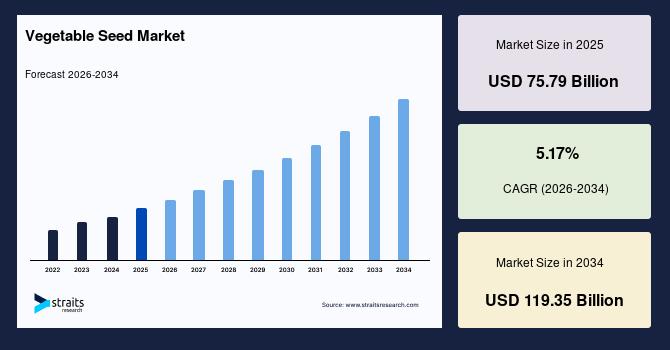
| Estimated 2026 Value | USD 79.71 Billion |
| Projected 2034 Value | USD 119.35 Billion |
| CAGR (2026-2034) | 5.17% |
| Study Period | 2022-2034 |
| Dominant Region | North America |
| Fastest Growing Region | Asia Pacific |
| Key Market Players | Bayer Crop Science, Syngenta, BASF Vegetable Seeds, Rijk Zwaan, Enza Zaden |
Download Free Sample Report to Get Detailed Insights.
Vegetable Seed Market Growth Factors Government Support and Agricultural PoliciesGovernment support and agricultural policies drive the global market. Countries invest in research, subsidies, and infrastructure to enhance seed quality and productivity.
-
For instance, in February 2025, India's Finance Minister Nirmala Sitharaman announced a six-year program to boost pulse production, reduce import dependency, and ensure food security. This initiative includes procuring crops like pigeon peas and red lentils at guaranteed prices.
Additionally, the Union Budget for 2025–26 proposes a significant increase in agricultural funding, with allocations reaching approximately $20 billion. Such initiatives encourage seed innovation, improve farmer access to high-yield varieties, and promote sustainable farming practices, strengthening the global market.
Restraining Factors High Development Costs and Regulatory ChallengesDespite the positive outlook, the vegetable seed market faces challenges related to the high costs of developing new seed varieties and stringent regulatory frameworks. Research and development in seed technology require substantial investment, particularly when incorporating advanced biotechnological methods. These costs can be a barrier for smaller companies and may limit the availability of improved seed varieties to farmers.
Additionally, regulatory approvals for genetically modified seeds vary across regions and can be time-consuming and costly. For example, while a GMO seed variety might be approved in one country, it could face restrictions or bans in another, leading to market fragmentation. These regulatory hurdles can delay the introduction of innovative seed products and affect the market's overall growth.
Market Opportunities Sustainable and Organic Seed DevelopmentThe growing consumer preference for organic and sustainably produced food presents a significant opportunity for the market. Developing seed varieties that cater to organic farming practices can tap into this expanding market segment. Companies investing in producing organic seeds, free from genetic modification and synthetic treatments, will likely benefit from the increasing demand for organic vegetables.
-
For example, Organic Seed Alliance's OSPREY Project, launched in September 2024, aims to advance organic seed production practices and expand the availability of high-quality organic seeds. This research initiative seeks to improve seed production economics and yields, supporting the growing demand for organic agriculture.
By focusing on sustainable seed development and innovative packaging solutions, companies can meet consumer demands and contribute to environmental conservation, securing a competitive edge in the market.
Regional Insights North America: Dominant Region with A Substantial Market ShareNorth America leads the global market, accounting for approximately 38% of global revenue in 2024. The region benefits from advanced agricultural technology, widespread adoption of hybrid seeds, and substantial investments in sustainable farming practices. The U.S. and Canada have a well-established seed industry supported by regulatory bodies like the USDA and Agriculture and Agri-Food Canada. The increasing demand for high-yield and disease-resistant vegetable seeds has driven extensive regional research and development.
Additionally, the growing preference for organic produce has encouraged companies to expand their organic seed offerings. The introduction of genetically improved varieties tailored for resistance against common diseases and climate resilience has further boosted the market.
Asia-Pacific: Fastest-Growing RegionThe Asia-Pacific region is experiencing rapid growth in the global market, driven by increasing vegetable consumption, population expansion, and technological advancements in seed production. China, India, and Japan lead the market, with India emerging as a significant hub for vegetable seed exports. Government initiatives in the region are crucial in supporting the adoption of hybrid and biofortified seeds.
Furthermore, the region's booming agriculture sector benefits from rising investments in research and development by both public and private entities. Countries like China and India are implementing policies to enhance seed quality and boost domestic production to reduce import dependency.
Country Insights-
United States - The U.S. remains dominant in the global market due to advanced agricultural technologies, strong research institutions, and high adoption of genetically modified (GM) and hybrid seeds. The USDA has invested heavily in research to enhance crop resilience to climate change. Companies such as Bayer Crop Science and Seminis Seeds also focus on developing high-yielding, disease-resistant vegetable seed varieties, catering to commercial farmers and small-scale growers.
Germany - Germany is a key player in Europe's vegetable seed market, driven by a strong focus on organic farming and seed innovation. The country leads in non-GMO and hybrid vegetable seed development, with companies like KWS Saat AG investing in sustainable seed solutions. Additionally, collaborations between agricultural universities and biotech firms foster innovation in plant breeding techniques.
China - China holds a significant share of the global market due to its large agricultural sector and government policies promoting food security. The Chinese Academy of Agricultural Sciences (CAAS) has actively developed high-yield and climate-resistant vegetable seeds. Additionally, seed companies like Longping High-Tech are expanding their R&D facilities, focusing on hybrid seed technologies.
India - India's vegetable seed market is growing rapidly, and it is supported by strong government initiatives and rising demand for high-yielding seed varieties. Private companies such as Advanta Seeds and Nunhems India are actively developing drought-resistant and early-maturity vegetable seeds to cater to the growing population. The government has also introduced tax incentives for seed producers to boost domestic production and reduce reliance on imports.
Netherlands- The Netherlands is a global leader in vegetable seed research and innovation, with a strong presence of companies like Rijk Zwaan and Enza Zaden. The country exports high-quality vegetable seeds worldwide, supported by cutting-edge greenhouse farming techniques. The Netherlands also launched grants to help startups specializing in vertical farming and precision seed technologies. Using controlled-environment agriculture in the Netherlands has significantly improved seed quality and production efficiency.
Brazil- Brazil is an emerging player in the global market, with a strong focus on hybrid seed production and sustainable agriculture. Companies like Syngenta Brazil are developing heat-resistant seed strains to combat climate change-related challenges, ensuring better productivity in tropical regions. Brazil's growing emphasis on sustainable agriculture has led to adopting regenerative farming practices, further strengthening its vegetable seed industry.
Hybrid seeds hold the largest market share due to their higher yield potential, disease resistance, and improved quality traits. Farmers increasingly adopt hybrid seeds to maximize productivity and ensure consistent output, particularly in regions with variable climatic conditions. Hybrid vegetable seeds account for a massive global market share due to their enhanced adaptability and resistance to pests. Major players such as Bayer CropScience, Syngenta, and East-West Seed heavily invest in hybrid seed development.
By Crop TypeTomato seeds are the most in-demand crop type within the vegetable seed market, driven by the high consumption of tomatoes worldwide. The Food and Agriculture Organization (FAO) states that global tomato production reached over 190 million metric tons in 2024, with a significant portion grown using high-yield hybrid seeds. Companies like BASF, Rijk Zwaan, and Enza Zaden have launched multiple tomato seed varieties tailored to different climatic conditions. Rijk Zwaan's“Tropical Sun” variety offers improved drought tolerance, making it ideal for regions with unpredictable rainfall.
By TraitsDisease-resistant vegetable seeds are gaining momentum as farmers prioritize crop protection against viruses, fungi, and bacterial infections. The increasing prevalence of plant diseases, such as downy mildew in lettuce and late blight in potatoes, has spurred demand for resistant seed varieties. Companies like Bejo Zaden and Sakata Seed Corporation have focused on developing seeds that are resistant to common diseases. Bejo launched a Fusarium-resistant carrot variety in 2024 to address growing concerns in the European market.
By Distribution ChannelDirect sales channel leads the market share. Direct sales from seed manufacturers to large-scale farmers and agribusinesses dominate the market due to the need for customized seed solutions and bulk purchasing. Companies like Limagrain and Corteva Agriscience use direct sales models to provide farmers with advisory services on seed selection and cultivation techniques. The increasing penetration of e-commerce platforms has also influenced distribution trends, with online seed marketplaces witnessing a rise in sales.
Company Market ShareThe global market is characterized by several key players contributing significantly to its development and growth. These organizations are instrumental in advancing agricultural biotechnology, developing high-yielding and disease-resistant seed varieties, and supporting sustainable farming practices.
Bayer AG: A leading force in the vegetable seed industry
Bayer AG, a German multinational pharmaceutical and life sciences company, holds a substantial position in the global market. Through its division, Bayer Crop Science, the company delivers innovative agricultural solutions, including developing genetically modified (GM) seeds to enhance crop yields and resilience.
Recent Developments
-
In October 2024, Bayer projected that its genetically modified Intacta2 Xtend soybean seeds would cover approximately 30% of Brazil's soybean cultivation area for the 2024/25 season. This marked a significant increase from the previous season, reflecting GM technology's growing acceptance and integration among Brazilian farmers.
-
Bayer Crop Science
Syngenta
BASF Vegetable Seeds
Rijk Zwaan
Enza Zaden
Sakata Seed Corporation
East-West Seed
Limagrain
Advanta Seeds
Takii & Co., Ltd.
Mahindra Agri Solutions
Bejo Zaden
-
December 2024- The U.S. Department of Agriculture (USDA) has announced a USD 2 billion initiative, the Marketing Assistance for Specialty Crops (MASC) program, designed to support specialty crop producers in managing costs and expanding markets. This program is particularly significant for producers of fruits, vegetables, tree nuts, and other specialty crops, offering financial assistance to help stabilize the sector.
January 2025- Syngenta Vegetable and Apricus Seeds signed a global licensing agreement to give Syngenta exclusive access to the best Apricus germplasm and breeding pipeline for watermelon, melon, and squash.
As per our analyst, the global vegetable seed market is witnessing substantial growth, driven by increasing demand for high-yield and climate-resilient seed varieties. Advancements in biotechnology, coupled with strong government initiatives worldwide, are shaping the market's trajectory. While North America and Europe dominate research and innovation, Asia-Pacific is rapidly expanding due to growing food demand and technological advancements in seed breeding.
One of the significant trends is the rising demand for hybrid and genetically modified (GM) vegetable seeds, which offer higher yields and resistance to pests and diseases. In contrast, the European market is witnessing an increased preference for organic and non-GMO seeds, driven by stringent regulations and consumer demand for clean-label food products.
Despite promising growth, the market faces restraints, including regulatory hurdles in GM seed approvals and concerns over biodiversity loss. Additionally, price fluctuations in raw materials for seed production pose challenges for manufacturers. However, the growing investments in R&D, especially in precision breeding technologies and AI-driven seed development, provide substantial growth opportunities for industry players.
Overall, strategic collaborations between governments, research institutions, and private companies will continue to drive innovation and expansion in the vegetable seed industry, ensuring long-term sustainability and food security worldwide.
Report Scope| Report Metric | Details |
|---|---|
| Market Size in 2025 | USD 75.79 Billion |
| Market Size in 2026 | USD 79.71 Billion |
| Market Size in 2034 | USD 119.35 Billion |
| CAGR | 5.17% (2026-2034) |
| Base Year for Estimation | 2025 |
| Historical Data | 2022-2024 |
| Forecast Period | 2026-2034 |
| Report Coverage | Revenue Forecast, Competitive Landscape, Growth Factors, Environment & Regulatory Landscape and Trends |
| Segments Covered | By Type, By Crop Type, By Traits, By Distribution Channel |
| Geographies Covered | North America, Europe, APAC, Middle East and Africa, LATAM |
| Countries Covered | US, Canada, UK, Germany, France, Spain, Italy, Russia, Nordic, Benelux, China, Korea, Japan, India, Australia, Taiwan, South East Asia, UAE, Turkey, Saudi Arabia, South Africa, Egypt, Nigeria, Brazil, Mexico, Argentina, Chile, Colombia |
Download Free Sample Report to Get Detailed Insights.
Vegetable Seed Market Segments By Type-
Hybrid Seeds
Open-Pollinated Seeds (OPV)
-
Tomato
Cabbage
Carrot
Broccoli
Lettuce
Others
-
Disease-Resistant
Heat-Tolerant
High-Yielding
GMO
Non-GMO
-
Direct Sales
Retail
Online Platforms
-
North America
Europe
APAC
Middle East and Africa
LATAM

Legal Disclaimer:
MENAFN provides the
information “as is” without warranty of any kind. We do not accept
any responsibility or liability for the accuracy, content, images,
videos, licenses, completeness, legality, or reliability of the information
contained in this article. If you have any complaints or copyright
issues related to this article, kindly contact the provider above.
Most popular stories
Market Research

More Story








Comments
No comment