




403
Sorry!!
Error! We're sorry, but the page you were looking for doesn't exist.
Flame Retardants For Aerospace Plastics Market New Research Analysis And Forecast 2033
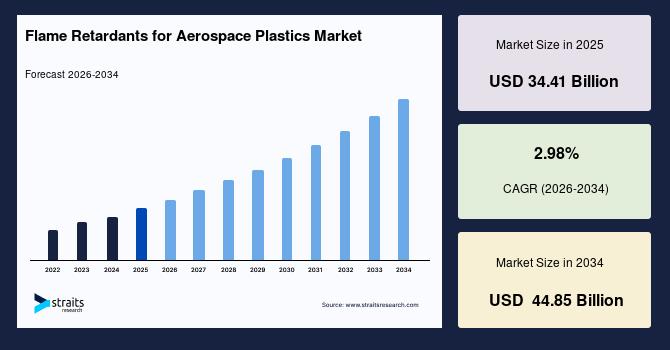
| Market Metric | Details & Data (2025-2034) |
|---|---|
| 2025 Market Valuation | USD 34.41 Billion |
| Estimated 2026 Value | USD 35.44 Billion |
| Projected 2034 Value | USD 44.85 Billion |
| CAGR (2026-2034) | 2.98% |
| Study Period | 2022-2034 |
| Dominant Region | Europe |
| Fastest Growing Region | Asia-Pacific |
| Key Market Players | Budenheim, Chemtura, Sinochem Clariant, DIC Corporation, DowDuPont |
Download Free Sample Report to Get Detailed Insights.
Flame Retardants for Aerospace Plastics Market Growth Factors A Rapid Increase in Demand for Lightweight MaterialsIn developing nations like India, commercial air travel is expanding quickly. Newer models replace older aircraft; there is a growing need for lightweight, affordable materials like carbon fibre reinforced plastic since they are low maintenance and effectively manage aircraft weight. For this reason, several firms, including Boeing and Airbus, have begun replacing the metallic framework of their aircraft with carbon fibre-reinforced plastic. Additionally, more cutting-edge materials, including polyamides and polycarbonates, are employed in interior components and seat covers. Carbon fibre-reinforced plastic and other cutting-edge materials were used to build the majority of a new fleet of commercial aircraft, such as the Airbus 350, in 2021, resulting in a 40% reduction in airframe maintenance costs and a 25% reduction in operating costs for operators in the upper widebody market segment. Carbon fibre aircraft would see more flight time because they require less maintenance.
Flame Retardants Are Becoming More Important in the Aviation IndustryAs flammability is considered a key contributing factor to aviation accidents, reducing fire dangers in confined and compact aircraft areas is vital. Therefore, this significant problem can be avoided by adequately utilizing flame retardant fibre material employed in aircraft design, manufacture, and interior furnishing. As a result, this material has exceptional chemical resistance, is resistant to smoke gas toxicity, and can survive high temperatures thanks to its coating of flame retardants. The need for such flame-resistant fibrous materials as carbon fibre reinforced plastic has grown in response to the aerospace industry's growing safety concerns. Thanks to technological breakthroughs, major manufacturers are introducing flame retardants of various types to the market. For instance, LANXESS introduced a glass fibre reinforced plastic compound consisting of 92% sustainable raw materials in 2021, and RTP Company introduced a new line of flame retardant products that may be utilized in air handling facilities.
Market Restraint Organization Stringent Regulatory PoliciesFlame retardants contain compounds that, when exposed to the human body, can harm health, even if they must provide materials with flame resistance benefits. As a result, it affects the immune system, produces neurologic malfunction, and disrupts the thyroid's endocrine system. Therefore, governments and organizations have established several rules to prevent the harmful effects of flame retardants on human or animal life. For instance, the Toxic Substance Control Act's Phenol, Isopropylated Phosphate, or PIP 3:1 rule, published by the US Environmental Protection Agency in January 2021, limits the use of flame retardants in industrial settings. Additionally, the European Union enacted regulation 2019/2021, a set of eco-design standards for electronic displays, in October 2019. This rule will limit the use of halogenated flame retardants in plastic casings. Therefore, these limitations have made using flame retardants in aerospace plastics a challenge.
Market Opportunity Increasing Demand for AircraftThe rise of flame retardant in the aerospace plastics market will be aided by the growing demand for commercial aircraft, which is expected to create various new opportunities. In addition, the Asia-Pacific region is the flame retardants for aircraft plastics market which is developing at the fastest rate. It is anticipated that increased air traffic in the region will lead to the creation of further opportunities in the years to come.
Regional InsightsEurope dominates the market with CAGR of 4.0% of the market share for flame retardants used in aerospace plastics, making it the region with the most significant share. It is because of several factors, such as the fact that the region is home to the headquarters of one of the world's largest aircraft manufacturers, namely Airbus, which has more than 12 manufacturing sites across Europe in countries such as the United Kingdom, France, Germany, Spain, and Italy. Specifically, the UK has the most manufacturing sites out of all of these countries. As a result, the need for commercial and military aircraft and the parts that go into them will increase throughout the region, increasing the demand for flame retardants.
Airbus increased the production rate of A320 Family aircraft from 43 in Q3 to 45 in Q4 in the production plant located in France, Germany, and Toulouse. Additionally, in 2021 Airbus increased the monthly production rate of A322 aircraft from 5 to 6 aircraft per month in Montreal, Quebec, and Mobile. Flame retardants will be in greater demand in Europe due to the increased production rates, which will positively affect the European aircraft plastics industry's demand for flame retardants.
Flame-Retardant Type InsightMetal Hydroxide dominated the flame retardant for the aircraft plastic market in 2021 a market share of over 30% it is due to elements including the fact that aluminium hydroxide, a typical flame retardant, has a very low rate of flame propagation, heat release, and smoke production and is economical and corrosion-resistant. Its coating produces phosphorous-rich crosslink-aromatic char that suppresses smoke. Consequently, it is frequently employed in the commercial aircraft market for nacelle skin and wing or tail edges.
Application InsightIn 2021, the aerospace plastics market for flame retardants was dominated by aircraft fuselage, with a share of over 40%. When combined with flame retardants, they produce carbon fibre reinforced plastics with unique qualities like not corroding like metals, requiring less maintenance, having high strength and stiffness, and being light in weight; this can be attributed to these factors.
Aircraft Type InsightHeavy aircraft retained the highest share, with a market share of over 35% in flame retardants for aerospace polymers in 2021. It is due to several factors, including an increase in the production rate of heavy aircraft types, such as a commercial airliners, at major aircraft producers like Airbus, Raytheon Technologies, United Aircraft Corporation, Boeing, etc., because of a rise in the number of domestic and international travellers.
List of Key and Emerging Players in Flame Retardants for Aerospace Plastics Market-
Budenheim
Chemtura
Sinochem Clariant
DIC Corporation
DowDuPont
Huber Engineered Materials
ISCA UK
BASF
Italmatch Chemicals
Plastics Color Corporation
PMC Polymer Products
J. Marshall Company
Rio Tinto
Royal DSM
RTP Company
Albemarle
Israel Chemicals
ICL Industrial Products.
-
May 2022- To provide customers with a comprehensive solution that will improve the sustainability and performance of particular plastic compounds and comply with strict fire safety regulations, BASF and THOR GmbH merged their experience in non-halogenated flame retardant additives.
| Report Metric | Details |
|---|---|
| Market Size in 2025 | USD 34.41 Billion |
| Market Size in 2026 | USD 35.44 Billion |
| Market Size in 2034 | USD 44.85 Billion |
| CAGR | 2.98% (2026-2034) |
| Base Year for Estimation | 2025 |
| Historical Data | 2022-2024 |
| Forecast Period | 2026-2034 |
| Report Coverage | Revenue Forecast, Competitive Landscape, Growth Factors, Environment & Regulatory Landscape and Trends |
| Segments Covered | By Type, By Product, By Flame Retardant Type, By Application, By Aircraft |
| Geographies Covered | North America, Europe, APAC, Middle East and Africa, LATAM |
| Countries Covered | US, Canada, UK, Germany, France, Spain, Italy, Russia, Nordic, Benelux, China, Korea, Japan, India, Australia, Taiwan, South East Asia, UAE, Turkey, Saudi Arabia, South Africa, Egypt, Nigeria, Brazil, Mexico, Argentina, Chile, Colombia |
Download Free Sample Report to Get Detailed Insights.
Flame Retardants for Aerospace Plastics Market Segments By Type-
Epoxies
Acetal/Polyoxymethylene (POM)
Acrylonitrile Butadiene Styrene (ABS)
Thermoset Polyimide
Polycarbonate
-
Antimony Oxide
Aluminum Trihydrate
Organophosphates/Phosphorous Compounds
Boron Compounds
Others
-
Boron Compounds
Metal Hydroxide
-
Aluminium Hydroxide
Magnesium Hydroxide
-
Organophosphorus
Halogenated flame retardant
-
Interior components
Aircraft Fuselage
Engine Pylons
Access doors
Aircraft Flooring
Wings Edges
Carbon Fiber Reinforced Plastic (CFRP)
Glass Reinforced Plastic (GRP)
-
Heavy Aircraft
-
Commercial Airliner
Cargo
-
Light Weighted
Helicopter
-
North America
Europe
APAC
Middle East and Africa
LATAM

Legal Disclaimer:
MENAFN provides the
information “as is” without warranty of any kind. We do not accept
any responsibility or liability for the accuracy, content, images,
videos, licenses, completeness, legality, or reliability of the information
contained in this article. If you have any complaints or copyright
issues related to this article, kindly contact the provider above.
Most popular stories
Market Research

More Story







Comments
No comment