




403
Sorry!!
Error! We're sorry, but the page you were looking for doesn't exist.
Generative AI In Software Development Lifecycle Market Size & Share Report By 2033
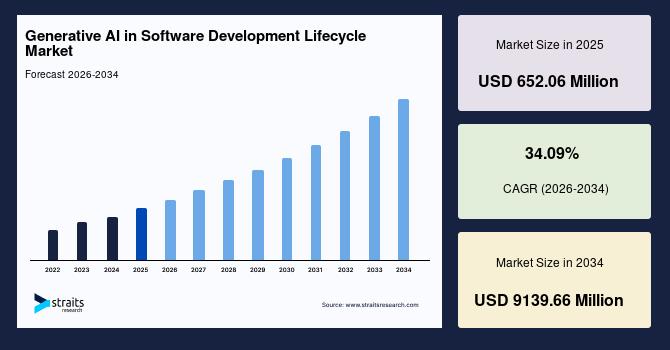
| Market Metric | Details & Data (2025-2034) |
|---|---|
| 2025 Market Valuation | USD 652.06 Million |
| Estimated 2026 Value | USD 874.36 Million |
| Projected 2034 Value | USD 9139.66 Million |
| CAGR (2026-2034) | 34.09% |
| Study Period | 2022-2034 |
| Dominant Region | North America |
| Fastest Growing Region | Asia-Pacific |
| Key Market Players | SAP SE, Thoughtworks Inc., Harness Inc., OpenAI OpCo LLC, Amazon Web Services Inc. |
Download Free Sample Report to Get Detailed Insights.
Market Growth Factors Increasing Demand for Agile and Devops PracticesThe rising adoption of Agile methodologies and DevOps practices is a significant driver fueling the growth of Generative AI in the Software Development Lifecycle (SDLC) market. Generative AI complements Agile and DevOps by automating repetitive tasks, accelerating development cycles, and facilitating seamless collaboration among cross-functional teams. By leveraging AI-driven tools for code generation, testing automation, and optimization, organizations can enhance productivity, reduce time-to-market, and deliver high-quality software products that meet evolving customer demands effectively.
According to a reliable source, 61% of firms utilize agile practices to accomplish software development and facilitate company-wide digital transformation. Additionally, according to an article published in StrongDM in 2021, 83% of IT decision-makers reported implementing DevOps practices to unlock higher business value. Thus, as the demand for Agile and DevOps practices continues to grow, the market for Generative AI in the SDLC is poised for further expansion.
Increasing Complexity of Software SystemsThe escalating complexity of modern software systems presents a compelling driver for adopting generative AI in the software development lifecycle (SDLC). As software architectures evolve to meet the demands of interconnected technologies, IoT, big data, and cloud computing, traditional development approaches struggle to manage the intricacies and dependencies within codebases. Generative AI systems offer a transformative solution by harnessing advanced algorithms capable of comprehending, analyzing, and adapting to complex software structures.
These AI-driven tools empower developers to navigate the complexities of software development more effectively, automating repetitive tasks, optimizing code quality, and identifying potential vulnerabilities. By augmenting human capabilities with machine intelligence, generative AI enables developers to tackle intricate challenges with greater efficiency and precision, accelerating the delivery of robust and scalable software solutions in an increasingly competitive market landscape.
Market Restraint Limited Understanding and ExpertiseThe adoption of Generative AI in the Software Development Lifecycle (SDLC) is impeded by a significant barrier: the limited understanding and expertise among developers and organizations. While the potential of Generative AI to revolutionize software development is evident, its practical implementation requires specialized knowledge and skills in AI, machine learning, and software engineering.
Many developers lack the expertise to integrate AI-driven tools seamlessly into existing workflows or understand the nuances of training and fine-tuning AI models for specific development tasks. Moreover, organizational reluctance to invest in upskilling initiatives or collaborate with AI experts further exacerbates this challenge. Without adequate understanding and expertise, the full potential of Generative AI in optimizing the SDLC remains untapped, hindering its widespread adoption and scalability in the market.
Market Opportunity Launch of New SolutionsThe market players are introducing novel generative AI solutions for the software development lifecycle. For instance, in February 2024, Cognizant introduced Cognizant FlowsourceTM?, a platform powered by generative AI (gen AI). This platform is designed to drive the advancement of software engineering for organizations in the future. Cognizant Flowsource seamlessly includes all phases of the software development lifecycle, integrating digital assets and technologies to facilitate cross-functional engineering teams in efficiently producing high-quality code with enhanced control and transparency.
-
Furthermore, in June 2023, Harness Inc., the Modern Software Delivery Platform® company, unveiled its pioneering generative AI assistant, AIDA (AI Development Assistant), a game-changer for the complete Software Development Life Cycle (SDLC). This innovative approach to AI for software delivery stands in contrast to traditional AI applications, which primarily focus on generating and assisting with code development. This all-inclusive AI solution will be seamlessly integrated into all Harness platform workflows and capabilities, and it is offered to all Harness customers at no cost. Such factors create opportunities for market expansion.
North America is the most significant global generative AI in software development lifecycle market shareholder and is expected to expand substantially during the forecast period. North America stands at the forefront of the Generative AI in the Software Development Lifecycle (SDLC) market, driving innovation and advancing technological advancements. The region's dominance is attributed to several key factors, including the presence of major technology hubs such as Silicon Valley, Seattle, and Boston, which serve as epicenters for AI research, development, and entrepreneurship. The United States, in particular, leads the market with its robust ecosystem of technology companies, venture capital funding, and a highly skilled workforce specializing in AI and software engineering. Moreover, North American organizations exhibit a strong appetite for innovation, continuously seeking ways to enhance productivity, efficiency, and competitiveness in the global market.
Furthermore, there has also been a rise in research on developing generative AI solutions in software development for several industries. For instance, in March 2024, research conducted by a research team from NYU Langone Health showed that the application of generative artificial intelligence (AI) has the potential to expedite the development of digital health software. The study examined the impact of ChatGPT on software advancement for preventing diabetes research. The software is specifically developed to utilize text messages to enhance patient involvement and promote modifications in behavior, such as engaging in physical activity and adopting a healthier diet. The researchers utilized ChatGPT to replicate the integrated, personalized automatic messaging system (PAMS) within the software. Researchers discovered that ChatGPT enhances communication among individuals with technical and non-technical backgrounds, expediting the development of computational solutions for medical issues. Consequently, these factors are estimated to boost the regional market growth.
Asia Pacific: Growing RegionThe Asia-Pacific (APAC) region is emerging as a dynamic and promising region. With rapid urbanization, burgeoning digital transformation initiatives, and a thriving tech startup ecosystem, APAC presents significant opportunities for the adoption and growth of Generative AI technologies. Nations like China, India, Japan, South Korea, and Singapore are in charge of AI innovation, leveraging Generative AI to enhance software development practices and drive digital innovation across industries. Currently, generative AI generates 13% of code and reduces the time spent by Indian coders by 16%.
Moreover, an article titled "The art of software: The new route to value creation across industries" predicts that India will account for 22% of code generation utilizing Gen AI within the next 12 months, saving 27% of time spent by coders. Furthermore, APAC's growing internet penetration, expanding middle class, and increasing demand for digital services create a conducive environment for Generative AI solutions in the SDLC. As businesses in the region seek to optimize software development processes, enhance product quality, and accelerate time-to-market, the adoption of Generative AI is poised to witness exponential growth in the coming years.
Segmental Analysis By ApplicationBased on application, the global market is bifurcated into code generation and auto-completion, natural language interfaces for development, personalized development tools, AI-enhanced design and UX, and others. The code generation and auto-completion segment dominates the market. Generative AI is revolutionizing code generation and auto-completion in the Software Development Lifecycle (SDLC) by augmenting developer productivity and efficiency. Through techniques like deep learning, Generative AI models learn from vast code repositories to understand patterns, syntax, and semantics. These models can assist developers in code generation by automatically generating boilerplate code, reducing repetitive tasks, and accelerating prototyping. Moreover, in auto-completion, they provide intelligent suggestions as developers type, speeding up coding and reducing errors.
Generative AI's ability to understand context and predict next actions significantly enhances developer workflows, from ideation to deployment. By seamlessly integrating into Integrated Development Environments (IDEs) and version control systems, these AI-powered tools empower developers to concentrate on high-level design and problem-solving while automating routine coding tasks. Consequently, generative AI is reshaping the SDLC landscape, fostering innovation and driving efficiency across the software development process.
By End-UserBased on the end-user, the global market is segmented into software engineers/DevOps professionals and security professionals/SecOps. The software engineers/DevOps professionals segment is estimated to own the highest market share. Generative AI, utilized by software engineers and DevOps professionals, enhances various stages of the Software Development Lifecycle (SDLC). It generates mockups and prototypes in the planning phase, facilitating clearer communication of project requirements. It assists in code generation during development, automating repetitive tasks and accelerating development cycles. In testing, it can create synthetic data sets to augment real-world scenarios, improving test coverage and efficacy.
Moreover, Generative AI enables predictive maintenance by analyzing historical data to anticipate and prevent potential issues in production environments. It also supports automatic documentation generation, ensuring comprehensive and up-to-date project documentation. Thus, integrating Generative AI into the SDLC empowers teams to streamline processes, enhance productivity, and deliver higher-quality software solutions efficiently.
List of Key and Emerging Players in Generative AI in Software Development Lifecycle Market-
SAP SE
Thoughtworks Inc.
Harness Inc.
OpenAI OpCo LLC
Amazon Web Services Inc.
Tabnine Ltd.
Replit
Google LLC
C3 AI Inc.
Reply
-
December 2023- Google launched Duet AI for Developers, later renamed Gemini, making it widely accessible. Duet AI for Developers offers coding assistance, an integrated development environment [IDE], console chat, and ops tooling. Its purpose is to seamlessly integrate support into the developers' existing workflow.
March 2024- HCL Tech announced that its generative AI platform, AI Force, will revolutionize the software development and engineering lifecycle by significantly improving quality and productivity. The GenAI platform, which is protected by a patent, is constructed using Azure OpenAI technology. It can be combined with Microsoft GitHub Copilot and is compatible with any operating system.
| Report Metric | Details |
|---|---|
| Market Size in 2025 | USD 652.06 Million |
| Market Size in 2026 | USD 874.36 Million |
| Market Size in 2034 | USD 9139.66 Million |
| CAGR | 34.09% (2026-2034) |
| Base Year for Estimation | 2025 |
| Historical Data | 2022-2024 |
| Forecast Period | 2026-2034 |
| Report Coverage | Revenue Forecast, Competitive Landscape, Growth Factors, Environment & Regulatory Landscape and Trends |
| Segments Covered | By Applications, By End-User |
| Geographies Covered | North America, Europe, APAC, Middle East and Africa, LATAM |
| Countries Covered | US, Canada, UK, Germany, France, Spain, Italy, Russia, Nordic, Benelux, China, Korea, Japan, India, Australia, Singapore, Taiwan, South East Asia, UAE, Turkey, Saudi Arabia, South Africa, Egypt, Nigeria, Brazil, Mexico, Argentina, Chile, Colombia |
Download Free Sample Report to Get Detailed Insights.
Generative AI in Software Development Lifecycle Market Segments By Applications-
Code Generation and Auto-Completion
Natural Language Interfaces for Development
AI-Enhanced Design and UX
Personalized Development Tools
Others
-
Software Engineers/DevOps Professionals
Security Professionals/SecOps
-
North America
Europe
APAC
Middle East and Africa
LATAM

Legal Disclaimer:
MENAFN provides the
information “as is” without warranty of any kind. We do not accept
any responsibility or liability for the accuracy, content, images,
videos, licenses, completeness, legality, or reliability of the information
contained in this article. If you have any complaints or copyright
issues related to this article, kindly contact the provider above.
Most popular stories
Market Research

More Story








Comments
No comment