




403
Sorry!!
Error! We're sorry, but the page you were looking for doesn't exist.
Accessibility Testing Market Size, Share & Growth Forecast By 2033
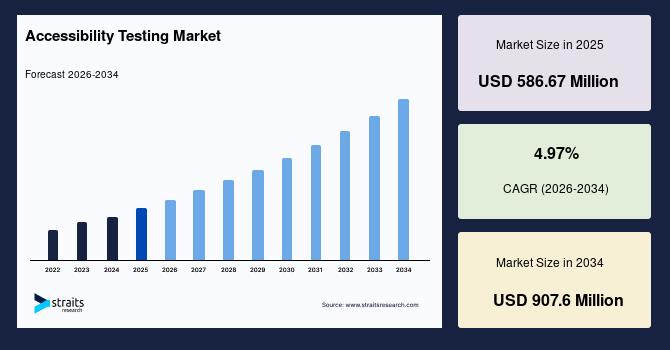
| Market Metric | Details & Data (2025-2034) |
|---|---|
| 2025 Market Valuation | USD 586.67 Million |
| Estimated 2026 Value | USD 615.81 Million |
| Projected 2034 Value | USD 907.6 Million |
| CAGR (2026-2034) | 4.97% |
| Study Period | 2022-2034 |
| Dominant Region | Europe |
| Fastest Growing Region | |
| Key Market Players | QualiTest, Paciello Group, Invensis, Knowbility, Planit |
Download Free Sample Report to Get Detailed Insights.
Accessibility Testing Market Growth Factors Growing Demand for Agile and Devops Test AutomationThe surge in demand for agile and DevOps test automation is revolutionizing software development and testing practices. Agile methodologies promote iterative development and continuous feedback loops, while DevOps emphasizes collaboration and automation across the software development lifecycle. By integrating accessibility testing into these methodologies, companies can ensure that accessibility considerations are embedded from the outset rather than treated as an afterthought. This proactive approach not only fosters the creation of more accessible products but also facilitates faster time-to-market and enhances the overall user experience for individuals with disabilities. By embracing agile and DevOps practices in accessibility testing, organizations demonstrate a commitment to inclusivity and compliance with accessibility standards.
By leveraging automated testing tools and incorporating accessibility testing into every stage of development, teams can identify and address accessibility issues early, reducing the risk of costly retrofits later in the development cycle. This proactive stance not only streamlines the development process but also cultivates a culture of accessibility and inclusivity within the organization. Ultimately, the integration of accessibility testing into agile and DevOps methodologies benefits both businesses and end-users. It enables companies to deliver accessible products that comply with regulatory requirements, meet user needs, and enhance the overall user experience, driving customer satisfaction and loyalty.
Market Restraint Lack of AdoptionThe reluctance to embrace accessibility testing practices presents a significant challenge in the market. Despite the increasing awareness of accessibility needs and legal obligations for inclusivity, some businesses may neglect or postpone accessibility testing within their software development workflows. This oversight can result in digital products that are inaccessible, leading to potential legal ramifications, diminished user engagement, and tarnished brand reputation. By disregarding accessibility standards, companies risk excluding a substantial portion of the population from accessing their products and services, thereby constraining their market reach and customer base.
Furthermore, delaying the incorporation of accessibility considerations until later stages of development can escalate costs and efforts required to rectify accessibility issues. To address this challenge and foster market growth, businesses must prioritize accessibility testing from the onset of product development. Integrating accessibility into design and development processes and adhering to accessibility standards are essential steps to creating inclusive digital experiences for all users.
Market Opportunity Increasing Emphasis on Inclusive Design and User ExperienceInclusive design and user experience present a compelling opportunity for Accessibility Testing companies. By prioritizing accessibility in digital product development, companies can design intuitive, easy-to-navigate interfaces that cater to all users. Inclusive design transcends mere compliance with accessibility standards, aiming to create products that meet users' diverse needs and preferences, thereby enhancing engagement and usability. Businesses that embrace inclusive design and accessibility testing stand to gain customer loyalty, bolster brand perception, and expand their market reach. By ensuring their digital products are accessible to individuals with disabilities, companies tap into a vast and often underserved market segment. Moreover, inclusive design fosters social responsibility and drives innovation by fostering creative solutions that benefit all users.
Regional Analysis Europe: Dominant RegionEurope's accessibility testing market is poised for rapid expansion, driven by several factors, notably the continent's growing aging population and the rising prevalence of age-related macular degeneration (AMD). With the aging demographic, the incidence of AMD is expected to rise, further fueling the demand for accessibility testing services across the region. In tandem with North America, Europe is witnessing significant growth in the accessibility testing service market, buoyed by the efforts of well-established businesses to drive innovation. These companies are channeling their resources into developing cutting-edge automation technologies aimed at broadening their customer base, which includes individuals with disabilities.
Furthermore, nations such as Germany, the UK, and France are at the forefront of driving growth in accessibility testing services in Europe. This can be attributed to the substantial presence of individuals suffering from AMD, estimated at approximately 34 million within the European Union alone. This demographic trend, coupled with the continent's aging population, underscores the pressing need for accessible digital platforms. Moreover, the rising demand for digital platforms prioritizing accessibility is propelling market growth. As consumers increasingly rely on digital services for various parts of their daily lives, there is a rising recognition of the importance of ensuring these platforms are accessible to users of all abilities. This is expected to propel regional market growth.
Type AnalysisThe mobile apps segment dominates the global market. The surge in demand for mobile accessibility testing services is attributed to the widespread adoption of mobile devices and the high growth of mobile applications. Recognizing the importance of accommodating disabled users and fostering inclusive digital experiences, technology providers are prioritizing the enhancement of mobile app accessibility. The imperative for accessible and user-friendly mobile apps catering to users of all abilities has heightened the significance of mobile accessibility testing.
This specialized testing evaluates various aspects, including screen reader compatibility, touch target size, and gesture accessibility, ensuring that mobile apps are easily accessible to individuals with disabilities. With smartphones and mobile apps becoming indispensable tools for various tasks, the dominance of the mobile application segment within the Accessibility Testing market is further reinforced. This prominence is underpinned by inclusive design practices, adherence to accessibility regulations such as the ADA and WCAG, and a steadfast commitment to creating accessible digital experiences for all users.
Applications AnalysisSMEs hold a significant market share due to their keen recognition of the advantages offered by accessible web and application design, including broader user reach and enhanced search engine visibility. Despite their smaller scale compared to large enterprises, SMEs are important in propelling the demand for accessibility testing services. As they strive to bolster their digital presence and extend their customer base, SMEs increasingly prioritize accessibility testing to ensure their digital assets cater to users of all abilities.
Moreover, the dominance of SMEs in the Accessibility Testing market is further underscored by the initiatives and programs tailored to assist smaller businesses in enhancing the accessibility and usability of their digital content. In many developing countries, governments and organizations are actively facilitating SMEs' efforts to improve the website and mobile app accessibility through targeted programs and regulations.
List of Key and Emerging Players in Accessibility Testing Market-
QualiTest
Paciello Group
Invensis
Knowbility
Planit
QualityLogic
Siteimprove
Ten10
Applause
Intopia
Interactive Accessibility
Happiest Minds
TestingXperts
Zoonou
Criterion 508
-
February 2024- Evinced, a provider of web and mobile accessibility solutions, saw its customer base triple by 2023 because of new prevention-focused tools such as Unit Tester and Design Assistant. These breakthroughs enable developers and designers to detect accessibility concerns well before release, signaling a shift in the industry toward prevention rather than post-hoc adjustments. The company's remarkable expansion has reinforced its place as a leading accessibility vendor, with partners including six of the top ten largest US and UK financial firms, as well as major media, SaaS, retail, and other elite businesses.
January 2024- Assistiv Labs, a leading provider of accessibility testing solutions, announced the availability of a new end-to-end accessibility testing service. The service offers a thorough and dependable method for ensuring that digital items are available to all consumers, regardless of ability. Assistiv Labs' end-to-end accessibility testing service differs from previous solutions in automating step validation via a user interface. This ensures that UI flows are both accessible and meet WCAG criteria. The service also interfaces with code deployment pipelines (CI/CD), allowing customers to test every code change and ensure that their products are always available.
| Report Metric | Details |
|---|---|
| Market Size in 2025 | USD 586.67 Million |
| Market Size in 2026 | USD 615.81 Million |
| Market Size in 2034 | USD 907.6 Million |
| CAGR | 4.97% (2026-2034) |
| Base Year for Estimation | 2025 |
| Historical Data | 2022-2024 |
| Forecast Period | 2026-2034 |
| Report Coverage | Revenue Forecast, Competitive Landscape, Growth Factors, Environment & Regulatory Landscape and Trends |
| Segments Covered | By Type, By Applications |
| Geographies Covered | North America, Europe, APAC, Middle East and Africa, LATAM |
| Countries Covered | US, Canada, UK, Germany, France, Spain, Italy, Russia, Nordic, Benelux, China, Korea, Japan, India, Australia, Singapore, Taiwan, South East Asia, UAE, Turkey, Saudi Arabia, South Africa, Egypt, Nigeria, Brazil, Mexico, Argentina, Chile, Colombia |
Download Free Sample Report to Get Detailed Insights.
Accessibility Testing Market Segments By Type-
Web Application
Mobile Application
-
Small and Medium Enterprise
Large Enterprise
-
North America
Europe
APAC
Middle East and Africa
LATAM

Legal Disclaimer:
MENAFN provides the
information “as is” without warranty of any kind. We do not accept
any responsibility or liability for the accuracy, content, images,
videos, licenses, completeness, legality, or reliability of the information
contained in this article. If you have any complaints or copyright
issues related to this article, kindly contact the provider above.
Most popular stories
Market Research

More Story








Comments
No comment