




403
Sorry!!
Error! We're sorry, but the page you were looking for doesn't exist.
The 21St Century's Biggest Art Trend Is Not A Style.
(MENAFN- USA Art News)
Why“systems art” is suddenly hard to ignore again
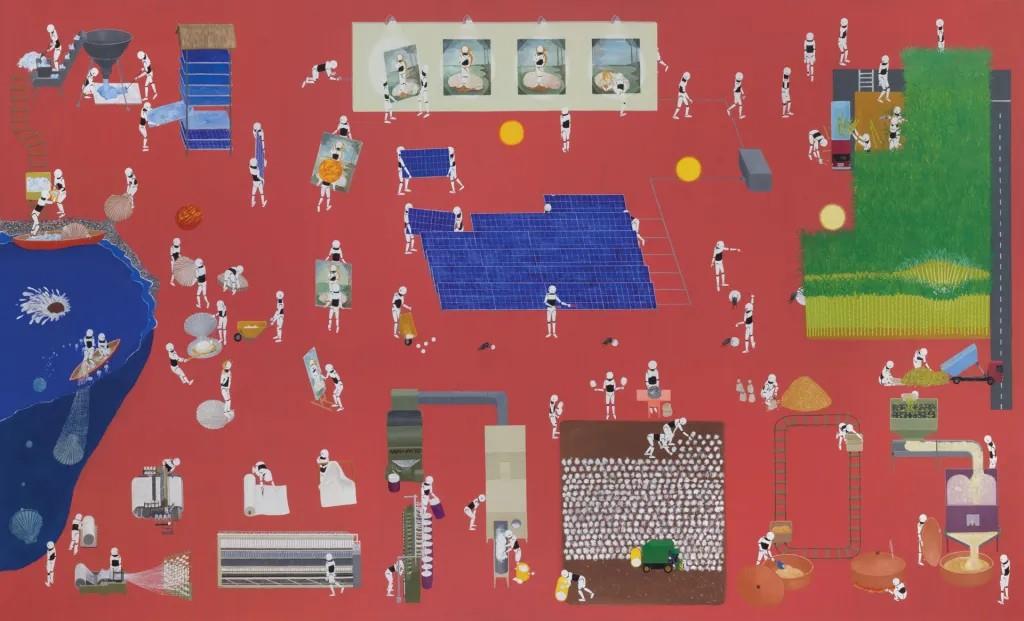
A term coined in 1968 now feels newly suited to the present. As algorithms, global finance, supply chains, and structural inequities shape daily life, the logic of systems art - once a niche label from the late 1960s - reads less like a historical footnote than a working description of how contemporary life is organized.
Jack Burnham introduced the phrase in Artforum in 1968, at a moment when Cold War protocols were expanding across politics, technology, and everyday experience. He used it to describe artists whose work relied on rules, seriality, repetition, and modular structure. Kenneth Noland, Robert Morris, and Dan Flavin are among the names most often associated with that early history, even if they are better remembered as Minimalists.
Their work treated making as a procedural system rather than an expression of individual feeling. Robert Morris's modular units, for example, could be standardized and reconfigured. Donald Judd's later serial works, including *100 untitled works in mill aluminum* (1982–86), extended that interest in structure, light, and repetition. The artist became less a heroic subject than a node within a larger set of relations.
Hans Haacke and Adrian Piper offer the clearest bridge from that formal language to the social and political uses of systems art. Piper's *Sixteen Permutations of a Planar Analysis of a Square* (1968) explored geometric permutations. Haacke's *Weathercube* (1963), later renamed *Condensation Cube*, turned light, air, and moisture into a miniature atmospheric process. In that work, the system was not metaphorical; it was physically present, visible in the condensation forming inside the Perspex box.
By the early 1970s, Haacke had pushed the idea into institutional critique. His *Shapolsky et al. Manhattan Real Estate Holdings, a Real-Time Social System, as of May 1, 1971* used text and archival images to expose slumlord practices tied to a Guggenheim Museum board member. The museum canceled his planned retrospective after objecting to the work, a confrontation that remains one of the clearest examples of systems art colliding with institutional power.
That history helps explain why the term fell out of favor. Burnham's writing was entangled with military and techno-utopian thinking, and the label itself became difficult to sustain once artists were working directly with political, legal, and economic structures. Yet the underlying method never disappeared. If anything, it has become more legible in an era when so much of life is governed by systems we can feel but rarely see.

Legal Disclaimer:
MENAFN provides the
information “as is” without warranty of any kind. We do not accept
any responsibility or liability for the accuracy, content, images,
videos, licenses, completeness, legality, or reliability of the information
contained in this article. If you have any complaints or copyright
issues related to this article, kindly contact the provider above.
Most popular stories
Market Research

More Story








Comments
No comment