




403
Sorry!!
Error! We're sorry, but the page you were looking for doesn't exist.
Arthur Jafa: 'America Has Always Been A Demonic State. And We Love It' The Art Newspaper International Art News And Events
(MENAFN- USA Art News)
Richard Prince and Arthur Jafa Meet in Venice With a Show About America
Venice's Biennale season is producing its own argument about the United States, and it is unfolding not in the American pavilion but inside a 17th-century palazzo on the Grand Canal. At the Prada Foundation's Ca' Corner della Regina, Nancy Spector has organized Helter Skelter: Richard Prince and Arthur Jafa, a more than 50-work exhibition that places two of the most consequential American artists of the last several decades in direct conversation.
Spector, the former artistic director and chief curator of the Guggenheim New York, describes the project as her first institutional survey since leaving the museum in 2020. The pairing is not casual. Jafa chose the title, and the exhibition brings together new, existing, and previously unexhibited works that probe appropriation, authorship, race, property, spirituality, popular music, and violence through distinctly American imagery.
Prince, whose 2007 retrospective at the Guggenheim was also organized by Spector, has spent decades unsettling ideas of originality. Since the late 1970s, he has rephotographed commercial images and recast them as his own work, turning the mechanics of borrowing into a central artistic strategy. Jafa, 65, came to wider prominence in 2016 with the New York debut of Love Is The Message, The Message is Death, his seven-minute video compilation that remains one of the most searing meditations on Black life in contemporary art.
In Helter Skelter, Spector links that work to the solar intensity of Prince's Sunset photographs from the early 1980s. The exhibition's first encounter is telling: Jafa's Big Wheel II (2018), a massive truck tire suspended in chains, is installed beside Prince's previously unexhibited Blasting Mats, a nest of slashed-rubber ribbons that hangs like a limp effigy. The pairing is formally taut and thematically charged, evoking labor, domination, and bodily vulnerability.
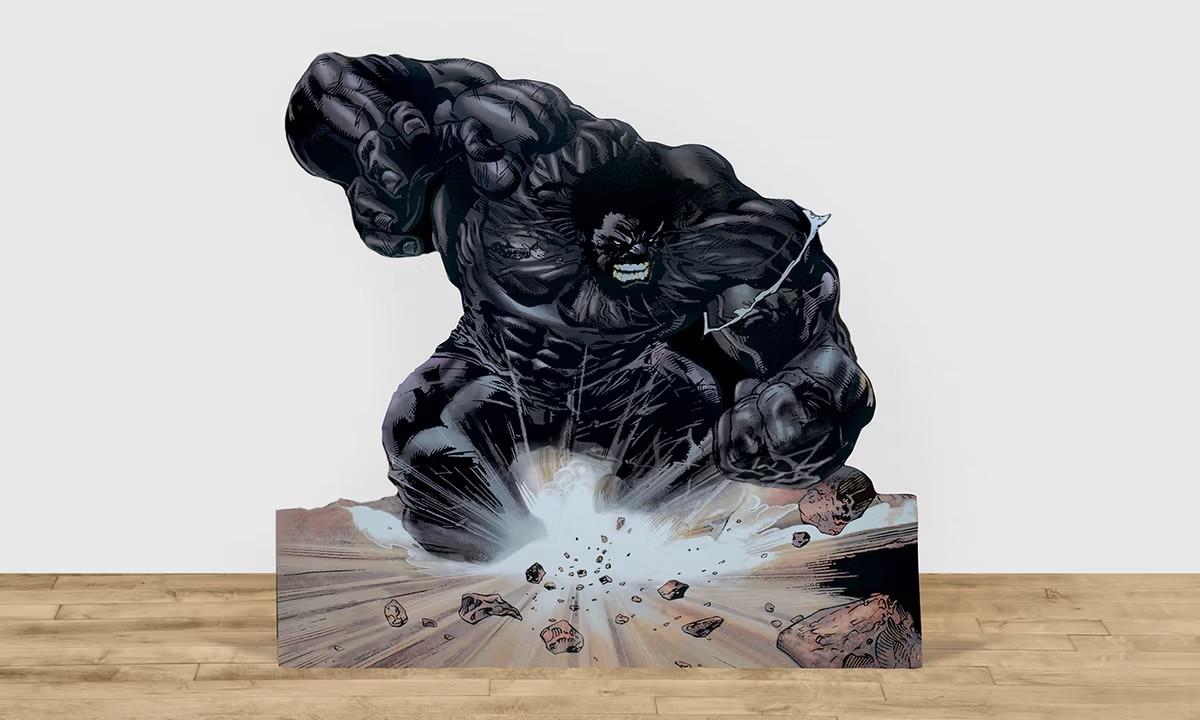
The exhibition continues through similarly pointed juxtapositions. Prince's Gangs pasteups of biker girlfriends appear alongside Jafa's Vinconium, an array of aluminum cutouts of Black political figures and performers made for the show. Other references move between Bob Dylan and Miles Davis, self-portraiture, and spirituality. Jafa has said that violence is central to his work and, more broadly, to the American project, calling America“a demonic state.”
Spector has also made the building part of the argument.“We decided to own the building and not pretend it's just a venue,” she says. Visitors will be given earphones so the sound from the film works does not bleed from one gallery into the next, a practical choice that also preserves the exhibition's careful pacing.
Spiritual America is not included, though the title is represented by a rarely seen 1923 Alfred Stieglitz photograph, the source from which Prince took the name. Prince and Jafa have also collaborated on a zine, Don't Look Now, extending the exhibition beyond the galleries.
For all its friction, Helter Skelter is less a simple pairing than a study in how American images circulate, mutate, and carry different meanings depending on who claims them. In Venice, that question feels especially pointed.

Legal Disclaimer:
MENAFN provides the
information “as is” without warranty of any kind. We do not accept
any responsibility or liability for the accuracy, content, images,
videos, licenses, completeness, legality, or reliability of the information
contained in this article. If you have any complaints or copyright
issues related to this article, kindly contact the provider above.
Most popular stories
Market Research

More Story








Comments
No comment