




403
Sorry!!
Error! We're sorry, but the page you were looking for doesn't exist.
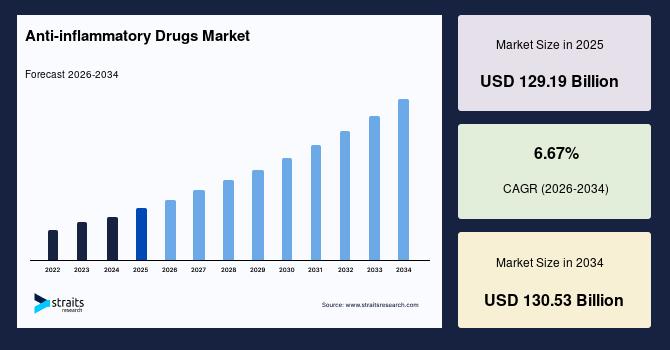
Anti-Inflammatory Drugs Market Size, Share & Growth Graph By 2034
| Market Metric | Details & Data (2025-2034) |
|---|---|
| 2025 Market Valuation | USD 129.19 Billion |
| Estimated 2026 Value | USD 137.57 Billion |
| Projected 2034 Value | USD 130.53 Billion |
| CAGR (2026-2034) | 6.67% |
| Study Period | 2022-2034 |
| Dominant Region | North America |
| Fastest Growing Region | Asia Pacific |
| Key Market Players | Johnson & Johnson Services Inc., Pfizer Inc., AbbVie Inc., Hoffmann-La Roche Ltd., AstraZeneca |
Download Free Sample Report to Get Detailed Insights.
Emerging Trends in Anti-inflammatory Drugs Market Shift toward Selective Cytokine Inhibition Targeting IL-23 and IL-17 PathwaysKey trend in the market is the shift toward selective cytokine inhibition targeting IL-23 and IL-17 pathways in immune-mediated diseases. Drugs like Risankizumab and Secukinumab demonstrate superior efficacy in psoriasis and psoriatic arthritis by precisely blocking inflammatory signaling without broadly suppressing immunity. Clinical data show sustained skin clearance and reduced relapse rates, driving physician preference. This precision reduces systemic side effects and supports long-term disease control, particularly in biologic-experienced patient populations.
Oral Small Molecule JAK Inhibitors Replacing Injectable BiologicsThe rapid adoption of oral JAK inhibitors as alternatives to injectable biologics improves convenience and patient compliance. Drugs such as Upadacitinib and Tofacitinib are gaining traction in rheumatoid arthritis and ulcerative colitis by offering fast symptom relief through intracellular pathway modulation. Real-world usage shows strong uptake among patients preferring oral dosing over injections. However, regulatory scrutiny on cardiovascular risks is shaping labeling and usage guidelines, influencing prescribing behavior and driving the development of next-generation selective JAK inhibitors.
Anti-inflammatory Drugs Market Drivers Growth of Gut-targeted Biologics in IBD Treatment and Rising Osteoarthritis Burden Linked to Obesity Drives MarketThe anti-inflammatory drugs market is driven by the development of gut-selective biologics that minimize systemic immunosuppression in inflammatory bowel diseases. Therapies like Vedolizumab specifically target α4β7 integrin, blocking lymphocyte migration to intestinal tissue without affecting whole-body immunity. Clinical use shows sustained remission in ulcerative colitis and Crohn's disease with lower infection risks compared to TNF inhibitors. This targeted mechanism improves safety profiles, enabling long-term therapy adoption and expanding biologic penetration in gastroenterology-focused treatment pathways.
Increasing obesity rates are driving osteoarthritis prevalence, boosting demand for anti-inflammatory therapies. Excess body weight accelerates joint degeneration in knees and hips, increasing chronic pain cases. For example, according to National Centers for Biomedical Technology, over 595 million people globally live with osteoarthritis in 2025, with cases projected to grow sharply due to high BMI trends. This prevalence expands demand for Celecoxib and biologics such as Adalimumab. Healthcare systems report rising joint-related consultations, reinforcing sustained demand for long-term anti-inflammatory treatment solutions.
Anti-inflammatory Drugs Market Restraints Safety Risks Restricting Long-term Use of JAK Inhibitors and Legal Risks Limiting NSAID–PPI Co-prescription Use Restrain Anti-inflammatory Drugs Market GrowthA critical restraint in the anti-inflammatory drugs market is the safety concern surrounding JAK inhibitors, particularly cardiovascular and thrombotic risks. Drugs like Tofacitinib and Baricitinib carry boxed warnings after clinical evidence showed increased risk of major adverse cardiac events and blood clots in rheumatoid arthritis patients. Regulatory agencies have restricted use to patients unresponsive to TNF inhibitors, reducing prescription volumes. This limits broader adoption and slows market expansion of oral targeted therapies.
Increasing legal scrutiny around proton pump inhibitor co-prescriptions restrains the anti-inflammatory drugs market, especially for chronic NSAID therapies. PPIs like Omeprazole are routinely prescribed with NSAIDs to reduce gastrointestinal risk, but recent lawsuits link long-term use to kidney disease and bone fractures. This raises liability concerns for physicians and manufacturers. As a result, prescribers adopt more cautious treatment approaches, limit prolonged NSAID use, and shift toward alternative therapies, reducing overall demand for conventional anti-inflammatory drug combinations.
Anti-inflammatory Drugs Market Opportunities Expansion into Neuroinflammation and Development of Inhaled Anti-inflammatory Biologics Offer Growth Opportunities for MarketThe anti-inflammatory drugs market is targeting neuroinflammation in Alzheimer's and other neurodegenerative diseases. Emerging therapies focus on modulating microglial activation and cytokine signaling in the brain. For example, Lecanemab shows reduced amyloid plaques alongside inflammation control in early Alzheimer's patients. Research indicates chronic neuroinflammation plays a key disease-driving role, encouraging pharmaceutical investment in CNS-penetrating anti-inflammatory biologics. This expands the market beyond traditional indications into high-value neurology segments with significant unmet clinical need.
A key opportunity lies in inhaled delivery of biologic anti-inflammatory drugs for respiratory diseases, improving localized action and reducing systemic exposure. Companies are exploring inhalable formulations of monoclonal antibodies targeting IL-5 and IL-4 pathways. For instance, Dupilumab demonstrates strong efficacy in asthma and is being studied for alternative delivery approaches. This innovation enhances drug deposition directly in lung tissue, improves patient compliance, and opens new commercial pathways in chronic obstructive pulmonary disease and severe asthma treatment markets.
Regional Analysis North America: Market Leadership through Rapid Adoption of Biologics and Strong Presence of Leading PlayersThe North America anti-inflammatory drugs market accounted for a share of 38.26% in 2025, propelled by propelled by rapid adoption of direct-to-consumer biologic advertising and patient assistance programs improving access to high-cost therapies like Adalimumab. Strong uptake of outpatient infusion centers for monoclonal antibody delivery enhances treatment continuity. The widespread use of real-world evidence platforms in the US accelerates label expansion and reimbursement approvals for targeted anti-inflammatory drugs across autoimmune and inflammatory disease indications.
The US anti-inflammatory drugs market growth is attributed to strong integration of pharmacy benefit managers, shaping formulary access and tier placement for biologic drugs. Expansion of copay accumulator programs influences biologic switching patterns. Additionally, high adoption of specialty pharmacies for cold-chain biologics improves adherence and distribution efficiency. Strong presence of leading players such as AbbVie and Pfizer, enabling rapid commercialization and continuous biologics innovation, which, in turn, supports US market growth.
The Canada anti-inflammatory drugs market is supported by strong biosimilar switching mandates in provinces like British Columbia, driving higher adoption of cost-effective alternatives to biologics such as Infliximab. National clinical guideline alignment ensures standardized prescribing practices across provinces. Growing investment in remote patient monitoring and tele-rheumatology services also improves access in rural regions, supporting consistent use of anti-inflammatory therapies and expanding overall treatment coverage.
Asia Pacific: Fastest Growth Driven by Expansion of Hospital-based Biologic Infusion Centers and Strong Domestic Manufacturing InitiativesThe Asia Pacific anti-inflammatory drugs market is expected to register the fastest growth with a CAGR of 8.90% during the forecast period, due to rapid expansion of hospital-based biologic infusion centers in countries like Japan and South Korea, enabling higher uptake of advanced therapies such as Tocilizumab. Additionally, increasing local manufacturing of biosimilars in India and South Korea reduces dependency on imports and lowers treatment costs. Rising government-supported rheumatology screening programs also improve early diagnosis and accelerate prescription volumes.
The China anti-inflammatory drugs market is expanding due to the continued high reliance on hospital-prescribed corticosteroids, driven by centralized procurement systems that favor low-cost, high-volume drugs. Corticosteroids are widely used across hospitals for rapid inflammation control due to affordability and inclusion in national essential drug lists. Increasing rheumatology and dermatology specialty clinics also drive higher diagnosis rates of autoimmune conditions, supporting sustained demand for anti-inflammatory drugs in China.
The India anti-inflammatory drugs market growth is supported by strong domestic biologic manufacturing by companies like Biocon and Zydus Lifesciences, producing cost-effective biosimilars. High dependence on branded generics in private clinics drives sustained NSAID and corticosteroid usage. Expansion of government-backed Jan Aushadhi stores also improves access to affordable anti-inflammatory drugs in semi-urban and rural populations. These factors collectively drive market growth in India.
Anti-inflammatory Drugs Market Segmentation Analysis By Drug ClassThe anti-inflammatory biologics segment dominated the market with a revenue share of 33.09% in 2025, driven by strong clinical preference for long-acting monoclonal antibodies like Ustekinumab, expansion of self-injectable pen devices improving adherence, and continuous label expansion across multiple autoimmune indications, increasing patient pool and lifetime treatment duration.
The non-steroidal anti-inflammatory drugs segment is expected to grow at a CAGR of 7.24% during the forecast period due to strong over-the-counter availability, rapid onset of pain relief, and low cost of drugs like Ibuprofen. Their versatility across acute injuries, fever, and chronic musculoskeletal disorders, along with wide physician familiarity and easy accessibility, continues to drive high prescription and consumer usage globally.
By ApplicationAutoimmune diseases led the technology segment with a share of 31.69% in 2025. This dominance is attributed to availability of multiple targeted pathways (TNF, IL-6, IL-17), and routine biomarker-based disease monitoring, enabling precise treatment adjustments and sustained patient retention. Rising disease prevalence with earlier diagnosis through advanced imaging and autoantibody testing, increasing treatable patient pools, which drives continuous product demand.
The respiratory diseases segment is expected to have the fastest growth, registering a CAGR of 7.49% during the forecast period due to increasing use of fixed-dose inhaled corticosteroid–bronchodilator combinations like Budesonide/Formoterol for maintenance therapy, rising adoption of home-based nebulization in chronic COPD management, and wider spirometry-led early diagnosis programs enabling timely initiation of anti-inflammatory treatment in moderate disease stages.
By Route of AdministrationOral segment dominated the market, with a revenue share of 45.11% in 2025, driven by key advantages such as ease of administration without clinical supervision, high patient convenience for chronic therapy, cost-effectiveness compared to injectables, and rapid scalability in mass treatment. Drugs like Ibuprofen further support widespread use due to accessibility and consistent therapeutic outcomes.
Parenteral segment is projected to grow at a CAGR of 8.03% during the forecast period, as it enables precise dosing and immediate bioavailability in acute inflammatory flares, supports administration of complex biologics and benefits from rising use of hospital infusion centers and prefilled autoinjectors for chronic autoimmune disease management. Weight-based IV dosing in hospital settings allows personalized treatment adjustments, which further drives segment growth.
By Distribution ChannelThe hospital pharmacies segment accounted for a share of 47.24% in 2025. This dominance is driven by immediate drug availability during acute inflammatory emergencies, seamless coordination with inpatient treatment protocols, and access to multidisciplinary care teams ensuring optimized therapy selection. Availability of advanced cold-chain storage also supports handling of temperature-sensitive drugs, reinforcing hospital preference.
The online pharmacies segment is projected to grow at a CAGR of 8.35% during the forecast period as it benefits from doorstep delivery of chronic anti-inflammatory prescriptions, improved digital prescription verification systems reducing dispensing errors, and rising patient preference for discreet and cost-transparent purchasing of drugs like Ibuprofen, especially in long-term pain and arthritis management.
Competitive LandscapeThe anti-inflammatory drugs market is moderately consolidated, with large pharmaceutical companies dominating biologics and advanced therapies. Key players include AbbVie, Pfizer, Johnson & Johnson, Novartis, and Eli Lilly and Company, focusing on TNF inhibitors, interleukin blockers, and JAK inhibitors. These firms invest in next-generation biologics and lifecycle management strategies. Biosimilar competition intensifies pricing pressure, especially for blockbuster drugs. Smaller biotech companies develop niche pathway inhibitors but face high clinical, regulatory, and commercialization barriers, limiting large-scale market penetration and global expansion opportunities across therapeutic segments.
List of Key and Emerging Players in Anti-inflammatory Drugs Market Johnson & Johnson Services Inc. Pfizer Inc. AbbVie Inc. Hoffmann-La Roche Ltd. AstraZeneca Amgen Inc. Novartis AG Merck & Co., Inc. Sanofi GSK plc Bristol-Myers Squibb Lilly Gilead Sciences Regeneron Pharmaceuticals UCB Bayer AG Boehringer Ingelheim Teva Pharmaceutical Industries Viatris Inc. Recent Developments-
In January 2026, the US FDA accepted the supplemental Biologics License Application (sBLA) for LEQEMBI IQLIK (lecanemab subcutaneous formulation), advancing review for expanded at-home maintenance and initiation dosing in Alzheimer's disease treatment.
In December 2025, Eisai and Biogen presented new clinical and real-world data showing that continued LEQEMBI (lecanemab) treatment provides sustained and expanding benefits in slowing Alzheimer's disease progression in early-stage patients.
In July 2025, Novartis entered a strategic collaboration with Matchpoint Therapeutics worth up to USD 1 billion to develop oral anti-inflammatory drugs targeting key inflammatory disease pathways.
| Report Metric | Details |
|---|---|
| Market Size in 2025 | USD 129.19 Billion |
| Market Size in 2026 | USD 137.57 Billion |
| Market Size in 2034 | USD 130.53 Billion |
| CAGR | 6.67% (2026-2034) |
| Base Year for Estimation | 2025 |
| Historical Data | 2022-2024 |
| Forecast Period | 2026-2034 |
| Report Coverage | Revenue Forecast, Competitive Landscape, Growth Factors, Environment & Regulatory Landscape and Trends |
| Segments Covered | By Drug Class, By Application, By Route of Administration, By Distribution Channel |
| Geographies Covered | North America, Europe, APAC, Middle East and Africa, LATAM |
| Countries Covered | US, Canada, UK, Germany, France, Spain, Italy, Russia, Nordic, Benelux, China, Korea, Japan, India, Australia, Singapore, Taiwan, South East Asia, UAE, Turkey, Saudi Arabia, South Africa, Egypt, Nigeria, Brazil, Mexico, Argentina, Chile, Colombia |
Download Free Sample Report to Get Detailed Insights.
Anti-inflammatory Drugs Market Segments By Drug Class-
Anti-inflammatory Biologics
Non-steroidal Anti-inflammatory Drugs
Corticosteroids
Other Drug Classes
-
Autoimmune Diseases
-
Arthritis
Multiple Sclerosis
Other Diseases
-
Chronic Obstructive Pulmonary Diseases
Asthma
Other Diseases
-
Oral
Parenteral
Inhalation
-
Hospital Pharmacies
Drug Stores & Retail Pharmacies
Online Pharmacies
-
North America
Europe
APAC
Middle East and Africa
LATAM

Legal Disclaimer:
MENAFN provides the
information “as is” without warranty of any kind. We do not accept
any responsibility or liability for the accuracy, content, images,
videos, licenses, completeness, legality, or reliability of the information
contained in this article. If you have any complaints or copyright
issues related to this article, kindly contact the provider above.
Most popular stories
Market Research

More Story








Comments
No comment