



403
Sorry!!
Error! We're sorry, but the page you were looking for doesn't exist.
Blockchain In Smart Home Market Size, Share & Growth Graph By 2034
| Market Metric | Details & Data (2025-2034) |
|---|---|
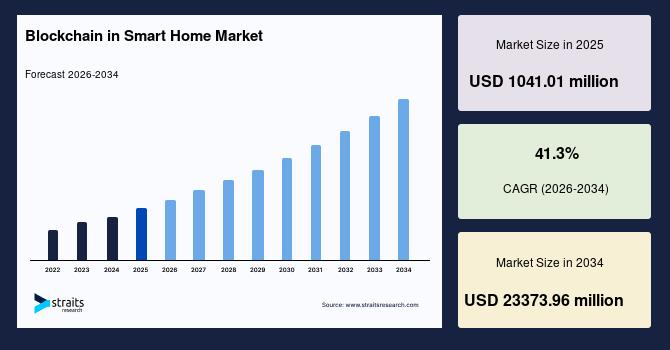
| 2025 Market Valuation | USD 1041.01 million |
| Estimated 2026 Value | USD 1470.94 million |
| Projected 2034 Value | USD 23373.96 million |
| CAGR (2026-2034) | 41.3% |
| Study Period | 2022-2034 |
| Dominant Region | North America |
| Fastest Growing Region | Asia Pacific |
| Key Market Players | OSIZ Technologies Private Ltd, Telstra, Comcast, Blockchain App Factory (S A Eonsofttech Pvt Ltd), Teksun |
Download Free Sample Report to Get Detailed Insights.
Emerging Trends in Blockchain in Smart Home Market Growing Adoption of Distributed Identity Management for DevicesAdoption of distributed identity management for devices is increasing as smart home ecosystems expand with multiple connected endpoints. Each device receives a unique digital identity, which improves secure communication across networks. Decentralized verification reduces reliance on central servers and lowers the risk of single-point failures. Device authentication becomes more reliable, supporting seamless interaction between sensors, appliances, and control systems. Secure identity frameworks help prevent unauthorized device access within connected environments.
Increasing Shift toward Edge-enabled Blockchain ProcessingA shift toward edge-enabled blockchain processing is gaining traction as smart home systems require faster and localized data handling. Processing transactions at the device level reduces latency and improves response time for real-time control functions. Edge integration limits dependency on centralized cloud networks, strengthening system resilience during connectivity issues. Local data validation enhances security by reducing exposure of sensitive information across external networks. Manufacturers focus on combining edge computing with lightweight blockchain frameworks to support resource-constrained devices.
Market Drivers Increase in Remote Control Applications and Growth of IoT-enabled Applications Drives MarketAn increase in remote control applications is supporting the adoption of blockchain in the smart home market by enabling users to manage and authenticate connected devices securely from remote locations. Blockchain enhances trust in remote operations by providing decentralized verification of commands, reducing the risk of unauthorized access or data manipulation. This is particularly important for functions such as locking systems, surveillance control, and energy management, where secure remote access is critical. As consumers increasingly rely on mobile apps and cloud-based platforms to control home environments, demand for secure and transparent remote management solutions continues to grow.
Growth in IoT-enabled applications is driving blockchain integration in smart home ecosystems by increasing the number of interconnected devices that require secure communication and data exchange. Blockchain helps ensure device identity, data integrity, and secure peer-to-peer interaction across IoT networks, reducing dependency on centralized control systems. With rising adoption of smart appliances, sensors, and automation systems, the complexity of managing device interactions is increasing. Blockchain provides a trusted framework for coordinating these devices efficiently while minimizing cybersecurity risks, which strengthens its role in enabling scalable and secure smart home infrastructures.
Market Restraints High Cost of Adoption and Third-party Access to User Data Restrain Market GrowthThe high cost of adoption is limiting the scalability of blockchain in the smart home market, as implementation requires significant investment in infrastructure, software integration, and compatible IoT devices. The need for advanced computing resources and secure blockchain platforms increases upfront costs for both manufacturers and end users. Integration with existing smart home ecosystems often involves complex upgrades, further raising deployment expenses. These cost barriers can slow adoption, particularly among price-sensitive consumers and small-scale developers.
Third-party access to user data concerns is also acting as a restraint, as smart home ecosystems often involve multiple service providers handling sensitive user information. In blockchain-enabled environments, ensuring proper data governance and controlling access across distributed networks remains challenging. While blockchain improves transparency, risks related to data sharing with external platforms and service providers still exist. This raises privacy concerns among users and may reduce trust in adopting fully connected smart home solutions.
Market Opportunities Expansion of Home Automation Platforms and Smart Rental & Property Management Systems Offer Growth Opportunities for Market PlayersExpansion of blockchain-enabled home automation platforms is creating strong opportunities for technology providers, smart home platform developers, IoT device manufacturers, and cybersecurity solution vendors in the smart home market by improving secure control of connected devices across residential environments. Integration of blockchain technology supports seamless coordination between lighting, security systems, and energy management tools through a unified digital framework. Home users gain better transparency in device operations, which improves trust in automated systems. The platform enables secure access sharing among family members and service providers without compromising control. Growing use of mobile-based home control solutions further strengthens adoption across urban households, benefiting mobile app developers and digital service integrators.
Adoption in smart rental and property management systems is creating opportunities for real estate companies, property management firms, proptech startups, and digital identity solution providers in the blockchain-enabled smart home market. Property owners are increasingly using digital platforms to manage rentals with secure access control and automated verification of tenants. Blockchain integration supports transparent rental agreements by recording ownership, lease terms, and payment history in tamper-resistant systems. Smart access systems allow remote unlocking and monitoring of properties, improving convenience for both parties. Property managers benefit from faster onboarding of tenants through digital identity verification and reduced manual paperwork. Integration with IoT-enabled home devices helps in monitoring energy usage and maintenance needs in real time, creating additional scope for IoT analytics providers and facility management service companies. Rental platforms also gain efficiency through automated smart contracts that streamline rent collection and security deposit handling, supporting fintech firms and blockchain infrastructure providers.
Regional Insights North America: Market Leadership through Matured Smart Home Ecosystem and Increasing Focus on Secured Digital InfrastructureNorth America accounted for the largest regional share of 42.19% in 2025 in the blockchain in smart home market. The region benefits from a highly developed smart home infrastructure that supports early adoption of advanced digital technologies. Mature smart home ecosystems across residential and commercial spaces create strong demand for secure and interoperable systems. High penetration of connected home platforms encourages seamless integration of distributed ledger solutions across multiple applications. Continuous upgrades in home automation standards also support scalability of blockchain-based solutions.
The US market is driven by rapid expansion of blockchain-based home sharing and rental authentication platforms. Digital property platforms increasingly use blockchain to validate tenant identity and ensure secure rental agreements. Smart contracts automate rental processes, reducing manual intervention in property transactions. Rental ecosystems benefit from tamper-resistant documentation that strengthens trust between landlords and tenants. Blockchain-enabled authentication also improves dispute resolution by maintaining immutable transaction histories.
A strong focus on secure digital infrastructure in smart residential communities drives the blockchain in smart home market in Canada. Residential developers are increasingly integrating blockchain systems to enhance trust in connected home environments. Property developers adopt decentralized frameworks to improve transparency in housing operations and resident data handling. Smart residential communities use blockchain to support secure access control and automated service management. Advanced connectivity solutions also help improve reliability in multi-device residential setups. The emphasis on secure digital architecture encourages wider acceptance of blockchain-enabled smart home solutions.
Asia Pacific: Fastest Growth Driven by Rapid Growth of Digital Housing Platforms and Smart City Development ProgramsAsia Pacific is emerging as the fastest-growing region in the blockchain in smart home market and is projected to register a CAGR of 16.8% during the forecast period, driven by rapid urban expansion and digital housing transformation. Large-scale urban housing projects increasingly integrate decentralized automation to manage connected devices across residential clusters. Smart city development programs strengthen the deployment of blockchain-based home coordination systems in high-density urban areas. Residential construction growth strengthens deployment of secure multi-device communication systems across apartments and gated communities. Ongoing infrastructure improvements in emerging Asian economies enable smooth integration of blockchain-based smart home platforms.
Increasing advancements in intelligent housing digital frameworks drive demand for blockchain in smart homes in China. National policies encourage integration of blockchain into smart housing systems to improve coordination across residential and urban platforms. Smart city programs strengthen deployment of digital home management frameworks that connect multiple devices under unified governance systems. Government-backed urban development projects such as the Xiongan New Area smart city initiative, Wanxiang Innova City in Hangzhou, and Sanya smart city development program promote standardized intelligent housing solutions across major cities in China.
The India blockchain in smart home market is supported by the rapid growth of digital housing platforms integrating secure access systems. Property technology platforms are increasingly combining blockchain-based verification with housing management tools to improve transparency in residential transactions. Digital housing ecosystems enable secure authentication for tenants, buyers, and property managers through unified access frameworks. Smart residential platforms also support faster onboarding by linking identity verification with automated housing services. Integration of blockchain improves trust in digital property records and reduces manual dependency in housing workflows.
By ComponentHardware accounted for the largest share of 50.61% of the component segment in 2025. Core components, such as secure chips, sensors, gateways, and embedded control units, are used in smart homes. Expansion of sensor-based devices requiring tamper-resistant components strengthens segment dominance. Smart homes rely on secure physical modules to support trusted device-level operations. Rising installation of connected sensors increases demand for durable and protected hardware elements. Manufacturers focus on integrating security features directly into device architecture. Continuous growth in connected device ecosystems sustains hardware demand across residential environments.
Software is projected to register a CAGR of 8.25% during the forecast period in the blockchain in smart home market, by component. Software platforms play a critical role in managing device communication, security protocols, and automation workflows across connected environments. Growth in middleware solutions enabling cross-device communication strengthens seamless interaction between diverse smart home devices. Software innovation also enhances scalability of blockchain integration across large residential networks. Expanding digital home ecosystems further accelerates adoption of advanced software-driven smart home management solutions.
By Blockchain TypePrivate blockchain accounted for the largest share of 48.68% of the blockchain in smart home market, by blockchain type, in 2025. Residential deployments favor restricted network structures for better control. Strong preference for controlled access networks in residential environments supports segment growth. Homeowners prioritize secure data handling within limited participant systems. Closed network architecture supports faster validation and stable performance. Technology providers design private frameworks aligned with household-level control needs. Reliable governance models sustain wide deployment across smart home ecosystems.
The hybrid blockchain segment is expected to register a CAGR of 18.33% during the forecast period. Hybrid models gain traction through flexible architecture that combines open and restricted network features. Increasing adoption in multi-stakeholder smart home ecosystems supports coordination between residents, service providers, and platform operators. Shared environments such as gated communities and managed housing projects require balanced data visibility and control. Hybrid frameworks enable selective data sharing while maintaining privacy across different participants. Integration across diverse service layers improves operational alignment within connected home ecosystems.
By ApplicationHome security accounted for a share of 37.64% of the application segment in 2025. Security-focused deployments dominate across residential smart home installations. Blockchain records ensure reliable storage of surveillance and access events. Secure logging strengthens trust in alarm systems and intrusion detection mechanisms. Homeowners prefer verifiable records for incident tracking and audit purposes. Robust security frameworks sustain high adoption across connected residential environments.
Home healthcare is expected to register a CAGR of 11.82% during the forecast period due to strong traction across connected living environments. Decentralized platforms enable safe transfer of patient data between multiple stakeholders without data manipulation risks. Remote patient monitoring devices generate continuous health data that requires secure storage and controlled access. Healthcare providers rely on verified data streams for accurate diagnosis and treatment decisions.
By End UserThe commercial segment accounted for a 63.48% share in 2025 in the blockchain in smart home market, by end user. Continuous requirement for secure customer identity validation across operations supports widespread adoption in banking, retail, hospitality, and enterprise environments. Large-scale transaction volumes in commercial ecosystems demand reliable authentication systems for smooth customer interactions. Financial organizations rely on these systems to reduce identity-related risks during high-frequency transactions. Retail and service industries also implement biometric authentication to improve customer trust and transaction accuracy.
The residential segment is expected to grow at a CAGR of 12.34% during the forecast period, fueled by higher consumer focus on privacy and personalized security solutions at home supports, which increased demand for advanced authentication tools integrated into digital payment and smart home systems. Growing use of biometric cards for household financial transactions enhances user control over personal data access. The increasing awareness of digital fraud risks further strengthens interest in residential-grade security solutions.
Competitive LandscapeThe blockchain in smart home market remains highly fragmented, with participation from technology providers, IoT manufacturers, cybersecurity firms, real estate platform developers, and smart appliance companies, each contributing different layers of the ecosystem. Established players compete mainly on technology scalability, system interoperability, security strength, ecosystem partnerships, and integration capability with existing smart home infrastructures. They also focus on long-term platform reliability and global deployment capacity across residential networks. In contrast, emerging players target innovation in low-cost blockchain solutions, niche smart home applications, faster deployment models, and flexible integration with new IoT devices to gain market entry. Competition is also influenced by user experience efficiency, data security architecture, and adaptability to evolving smart home standards. Strategic alliances between hardware and software providers further intensify competition across the value chain.
List of Key and Emerging Players in Blockchain in Smart Home Market OSIZ Technologies Private Ltd Telstra Comcast Blockchain App Factory (S A Eonsofttech Pvt Ltd) Teksun SoluLab TokyoTechie Hager Tata Consultancy Services Limited Xage Security Inc. Recent Developments-
In May 2025, Hager partnered with SEALSQ (WISeKey Group) to deploy blockchain-backed PKI and device attestation for Matter-compliant smart home devices.
| Report Metric | Details |
|---|---|
| Market Size in 2025 | USD 1041.01 million |
| Market Size in 2026 | USD 1470.94 million |
| Market Size in 2034 | USD 23373.96 million |
| CAGR | 41.3% (2026-2034) |
| Base Year for Estimation | 2025 |
| Historical Data | 2022-2024 |
| Forecast Period | 2026-2034 |
| Report Coverage | Revenue Forecast, Competitive Landscape, Growth Factors, Environment & Regulatory Landscape and Trends |
| Segments Covered | By Component, By Blockchain Type, By Application, By End User |
| Geographies Covered | North America, Europe, APAC, Middle East and Africa, LATAM |
| Countries Covered | US, Canada, UK, Germany, France, Spain, Italy, Russia, Nordic, Benelux, China, Korea, Japan, India, Australia, Taiwan, South East Asia, UAE, Turkey, Saudi Arabia, South Africa, Egypt, Nigeria, Brazil, Mexico, Argentina, Chile, Colombia |
Download Free Sample Report to Get Detailed Insights.
Blockchain in Smart Home Market Segments By Component-
Hardware
Software
Services
-
Public
Private
Consortium
Hybrid
-
Home Security
Home Automation
Home Entertainment
Home Healthcare
Others
-
Residential
Commercial
Industrial
-
North America
Europe
APAC
Middle East and Africa
LATAM

Legal Disclaimer:
MENAFN provides the
information “as is” without warranty of any kind. We do not accept
any responsibility or liability for the accuracy, content, images,
videos, licenses, completeness, legality, or reliability of the information
contained in this article. If you have any complaints or copyright
issues related to this article, kindly contact the provider above.
Most popular stories
Market Research

More Story








Comments
No comment