



403
Sorry!!
Error! We're sorry, but the page you were looking for doesn't exist.
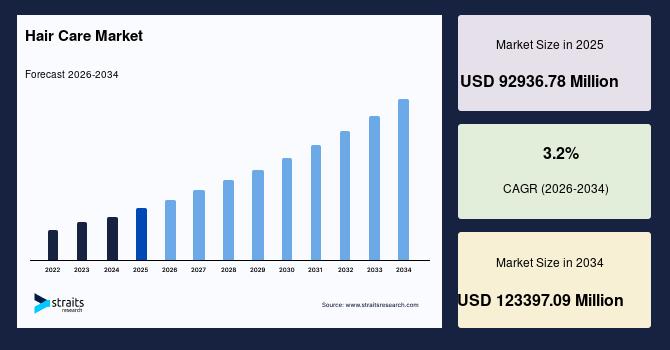
Hair Care Market Size, Share & Growth Graph By 2034
| Market Metric | Details & Data (2025-2034) |
|---|---|
| 2025 Market Valuation | USD 92936.78 Million |
| Estimated 2026 Value | USD 95910.76 Million |
| Projected 2034 Value | USD 123397.09 Million |
| CAGR (2026-2034) | 3.2% |
| Study Period | 2022-2034 |
| Dominant Region | North America |
| Fastest Growing Region | Asia Pacific |
| Key Market Players | Shiseido Co. Ltd, Johnson and Johnson Services Inc., Unilever PLC, Amway Corporation, Procter and Gamble |
Download Free Sample Report to Get Detailed Insights.
Emerging Trends in Hair Care Market Shift toward AI-powered Virtual Hair Consultation ToolsAdoption of AI-powered virtual hair consultation tools is reshaping how consumers select hair care products and styling solutions for personal hair care. Digital platforms analyze hair type, scalp condition, and damage levels to suggest suitable hair care treatments in real time. These tools reduce dependency on physical salon visits for basic hair assessment and product guidance. Beauty brands integrate AI systems into mobile apps to improve customer engagement and personalization. Virtual simulations allow users to preview hair color changes and styling outcomes before application. Growing digital literacy and smartphone usage support wider acceptance of these consultation technologies across urban consumers, boosting the idea of personalized hair care treatments.
Shift toward Fragrance-free and Hypoallergenic Hair Care SolutionsThe shift toward fragrance-free and hypoallergenic hair care solutions is gaining traction as consumers become more selective about product safety and scalp comfort. Brands are reformulating shampoos, conditioners, and treatments with fewer irritants to suit sensitive users. Demand for fragrance-free hair care solutions is rising in urban markets where exposure to pollution and chemical treatments has increased scalp sensitivity concerns. Manufacturers are focusing on gentle cleansing agents and simplified ingredient lists to improve product acceptance. Dermatologist-tested positioning is becoming more common across mainstream product ranges to build consumer trust. The trend is also influencing premium and mass segments, pushing wider availability of mild and irritation-free formulations.
Hair Care Market Drivers Increased Demand for Anti-damage Products and Rising Preference for At-home Salon-grade Hair Care Solutions Drives MarketRising consumer concern over hair damage caused by heat styling, chemical treatments, pollution, and frequent coloring is driving strong demand for damage-repair and protective hair care solutions. This shift is encouraging brands to develop formulations focused on strengthening hair fibers, reducing breakage, and restoring moisture balance through ingredients like keratin, bond-repair complexes, and natural oils. As consumers prioritize hair health over purely cosmetic styling, hair care product manufacturers are expanding their repair-focused portfolios to capture this growing need for preventive and restorative care. Olaplex has capitalized on this trend with its bond-building technology-based products designed to repair damaged hair at a molecular level, making it a widely recognized solution in the damage-repair hair care segment.
Rising consumer preference for salon-grade hair care solutions at home is reshaping purchase behavior across urban and semi-urban markets. People are selecting professional-quality products to replicate salon results without visiting physical salons. Improved product formulations now offer advanced repair, smoothening, and nourishment benefits suitable for home application. Social media exposure to professional styling outcomes is influencing expectations for premium results in daily routines. Easy availability of these products through retail and online platforms supports wider adoption among different income groups. Brands are also focusing on simplified usage formats that allow consumers to achieve consistent salon-like results with minimal effort.
Hair Care Market Restraints Availability of Counterfeit Products and Short Shelf Stability of Clean-label Hair Care Products Restrain Market GrowthThe increasing presence of counterfeit and imitation hair care products restrains market growth by undermining consumer trust and diverting demand away from authentic brands. Fake shampoos, oils, and styling products often replicate packaging from established companies but use inferior or unsafe ingredients, leading to concerns over product efficacy and scalp health. This not only damages brand reputation and reduces sales of genuine products from companies such as L'Oréal S.A. and Unilever but also increases regulatory and enforcement costs for manufacturers. As counterfeit distribution expands through informal retail channels and unregulated online platforms, it creates pricing pressure and weakens overall market confidence.
Short shelf stability of clean-label hair care products limits their broader adoption in commercial retail channels. Reduced use of synthetic preservatives shortens the product usability period after opening. Natural formulations often lose effectiveness faster when exposed to heat, light, or moisture during storage and usage. This creates challenges for retailers in maintaining consistent inventory turnover and product freshness. Consumers may hesitate to repurchase when product performance declines before full usage is completed. Preservative-free shampoos stored in humid environments can show texture or fragrance changes over time, reducing user satisfaction.
Hair Care Market Opportunities Growing Collaboration Between Hair Care Brands and Professional Salons and Adoption of Clinical Hair Restoration Treatments Offer Growth OpportunitiesGrowing collaboration between hair care brands and professional salons is creating opportunities for product visibility and service integration. Brands are partnering with salons to introduce exclusive treatment ranges designed for in-salon use and customer retail purchase. This approach helps consumers experience products during professional services, improving trust and product acceptance. Salons benefit from access to advanced formulations that enhance service quality and client satisfaction. Training programs from brands support stylists in product application techniques and personalized hair care recommendations. Salons offering premium keratin or bond-repair treatments often retail matching home hair care kits to maintain results.
Adoption of clinical hair restoration treatments is creating opportunities in the hair care market. Consumers are increasingly seeking science-backed solutions for hair thinning, alopecia, and severe hair damage. Clinics and dermatology centers are integrating advanced topical therapies, PRP procedures, and peptide-based treatments to improve hair regrowth outcomes. PRP scalp therapy is gaining acceptance in urban wellness clinics as a non-surgical restoration option. Hair care brands are also collaborating with medical professionals to develop clinically tested product ranges. Growing trust in dermatology-led solutions is supporting wider acceptance of professional hair restoration services across both men's and women's segments.
Regional Insights North America: Market Leadership through Premium Brand Penetration and Specialized Retail ExpansionNorth America accounted for the largest share of 32.66% in the hair care market in 2025. High penetration of premium professional hair care brands across retail and salon networks strengthens the region's leadership position. Well-established salon chains and specialty beauty retailers ensure wide availability of advanced shampoos, conditioners, treatments, and styling products. Strong distribution systems support seamless product access across urban and suburban consumer bases. High consumer spending on personal grooming encourages consistent adoption of premium and clinically developed formulations. Professional hairstylists play a key role in influencing product preferences through salon-based recommendations.
The US hair care market is supported by rising adoption of multi-step hair care routines influenced by global beauty trends. Consumers are moving beyond basic cleansing and are incorporating structured regimens that include cleansing, conditioning, treatment, and protection stages. This shift is driven by increased exposure to international beauty standards through social media and digital content platforms. Premium hair care brands are introducing bundled product systems that support complete routine-based usage. Salon professionals are also encouraging clients to follow layered care approaches for improved hair health outcomes.
Canada's hair care market is driven by the rise of boutique beauty retailers and specialty outlets in urban centers. These channels offer curated, premium, and niche products with personalized consultation. Growing demand for ingredient transparency and tailored solutions is accelerating this shift. Experiential retail formats further enhance engagement by allowing product testing before purchase. Expansion of salon-linked retail models is also strengthening premium product penetration.
Asia Pacific: Fastest Growth Driven by Expansion of Social Commerce and Youth-led Consumer BaseThe Asia Pacific hair care market is expected to grow at a CAGR of 9.4% during the forecast period, driven by an expanding middle-income population to support higher discretionary spending on personal care, which strengthens demand for advanced hair care products across the region. Rising purchasing power is encouraging consumers to upgrade from basic cleansing products to premium shampoos, conditioners, serums, and treatment-based solutions. Urban households are allocating more budget toward grooming and self-care routines, supporting consistent product consumption. Growing awareness of hair health and appearance management is further influencing adoption of multi-step hair care regimens.
China's hair care market is driven by strong social commerce penetration, shaping product discovery and purchase behavior among urban consumers. Platforms like livestreaming and short-video apps are transforming how users explore hair care products. Influencer-led recommendations are accelerating brand awareness and purchase decisions. Social media ecosystems and online communities are enhancing engagement, trust, and adoption of trending premium products.
The hair care market in India is supported by an expanding youth population driving experimentation with modern hair care products across urban and semi-urban regions. Younger consumers are showing higher interest in advanced shampoos, serums, and treatment-based formulations influenced by global beauty trends. Rising exposure to digital content and social media platforms is shaping product awareness and trial behavior among this demographic group. Increased willingness to try new formulations is encouraging demand for specialized solutions such as anti-hair fall, damage repair, and scalp care products. Urban lifestyle changes are further supporting adoption of structured hair care routines like skincare regimens.
By Product TypeShampoos led the product type segment with a 36.64% share in 2025, driven by their essential role in daily hair cleansing across urban and rural households. Strong penetration ensures consistent demand across mass and premium segments. Wide availability across retail, pharmacy, salon, and online channels enhances accessibility. Diverse variants such as anti-dandruff, moisturizing, volumizing, and herbal further expand consumer reach.
The hair serums & treatments segment is expected to grow at a CAGR of 11.8% during the forecast period. Rising focus on targeted solutions for hair damage, frizz, and scalp imbalance supports strong adoption across urban and semi-urban consumers. These formulations deliver concentrated active ingredients that directly address specific hair concerns, improving overall hair texture and manageability. Increasing preference for leave-in products enhances convenience-driven usage patterns in daily routines. Advanced treatment-based products are gaining traction as consumers shift toward results-oriented hair care rather than basic cleansing alone.
By NatureThe conventional segment is projected to grow at a CAGR of 16.8%, driven by its wide product availability, affordability, and broad applicability across hair care needs. Diverse formulations for cleansing, nourishment, anti-dandruff, and conditioning, along with strong retail presence, support adoption across both urban and rural consumers.
The organic segment is expected to grow at a CAGR of 6.4%, supported by rising demand for plant-based, clean-label formulations. Increasing awareness of ingredient transparency and eco-conscious preferences is driving adoption, particularly among premium and urban consumer segments.
By FormThe liquid segment accounted for 54.22% share in the form segment in 2025, driven by its widespread use in shampoos, conditioners, and treatment products. Easy application, rinsability, and compatibility with diverse formulations support its dominance across mass and premium hair care segments.
The spray segment is projected to grow at a CAGR of 10.9%, supported by rising demand for heat protection, detangling, and quick-use styling solutions. Its lightweight, residue-free application makes it popular for daily grooming, particularly among younger consumers.
By Distribution ChannelBy distribution channel, supermarkets/hypermarkets accounted for the largest share of 38.92% in 2025, driven by their one-stop shopping convenience and wide product availability across hair care categories. Organized retail layouts and strong consumer trust in established chains support continued dominance.
The online stores segment is projected to grow at a CAGR of 13.6%, supported by rising preference for doorstep delivery and wider product access. Digital platforms enable easy comparison, personalized recommendations, and access to international and niche brands, driving growth.
By End UserWomen accounted for 62.38% of the end-user segment in 2025 due to high usage patterns of specialized hair care solutions and multi-step routines covering cleansing, nourishment, repair, and styling. Strong product availability and targeted offerings for concerns like damage, frizz, and color protection support sustained demand.
The men's segment is projected to grow at a CAGR of 10.7%, supported by rising focus on scalp health and hair thinning prevention. Increasing awareness and adoption of structured grooming routines are driving demand for targeted hair care products among male consumers.
Competitive LandscapeThe hair care market remains highly fragmented, with a mix of global multinational corporations, regional brands, salon-exclusive product manufacturers, and fast-growing direct-to-consumer startups. Established players such as large FMCG and beauty companies focus on brand strength, extensive distribution networks, strong R&D capabilities, and premium product portfolios that emphasize clinically tested formulations and global brand trust. These companies also compete through innovation in advanced treatments, ingredient science, and large-scale marketing investments. Emerging players, on the other hand, compete by targeting niche segments such as clean beauty, natural formulations, cruelty-free products, and personalized hair care solutions, often leveraging digital platforms and social media-driven branding to build rapid consumer engagement. Price flexibility, product customization, and influencer collaborations further strengthen their position in competitive urban markets.
List of Key and Emerging Players in Hair Care Market Shiseido Co. Ltd Johnson and Johnson Services Inc. Unilever PLC Amway Corporation Procter and Gamble LOreal SA Henkel AG KGaA Natura and Co. Beiersdorf AG The Estee Lauder Companies Himalaya Global Holdings Ltd Dabur India Ltd Kao Corporation Oriflame Group Recent Developments-
In March 2026, L'Oréal S.A. completed the acquisition of Kering Beauté, strengthening its luxury beauty and hair-related portfolio through exclusive long-term brand licenses.
In March 2026, Henkel AG announced acquisition of Olaplex (premium bond-building hair care brand) for USD 1.4 billion.
In June 2025, L'Oréal S.A. acquired Color Wow to strengthen its portfolio in frizz control and color-treated hair solutions.
| Report Metric | Details |
|---|---|
| Market Size in 2025 | USD 92936.78 Million |
| Market Size in 2026 | USD 95910.76 Million |
| Market Size in 2034 | USD 123397.09 Million |
| CAGR | 3.2% (2026-2034) |
| Base Year for Estimation | 2025 |
| Historical Data | 2022-2024 |
| Forecast Period | 2026-2034 |
| Report Coverage | Revenue Forecast, Competitive Landscape, Growth Factors, Environment & Regulatory Landscape and Trends |
| Segments Covered | By Types, By Distribution Channel |
| Geographies Covered | By Product Type, By Nature, By Form, By Distribution Channel, By End User |
| Countries Covered | Shampoo, Conditioner, Hair Oil, Hair Styling Products, Hair Colorants, Hair Serums & Treatments, Conventional, Organic, Liquid, Cream, Oil, Gel, Spray, Supermarkets/Hypermarkets, Specialty Stores, Pharmacies & Drug Stores, Online Stores, Salons & Professional Channels, Women, Men, Unisex |
Download Free Sample Report to Get Detailed Insights.
Hair Care Market Segments By Types-
Shampoo
Conditioner
Hair Color
Hair Oil
Hair Creams
Masks
Hair Styling Products
Other Types
-
Supermarkets/Hypermarkets
Specialty Stores
Online Stores
Drug Stores/ Pharmacies
Convenience Stores
Other Distribution Channels
-
By Product Type
By Nature
By Form
By Distribution Channel
By End User

Legal Disclaimer:
MENAFN provides the
information “as is” without warranty of any kind. We do not accept
any responsibility or liability for the accuracy, content, images,
videos, licenses, completeness, legality, or reliability of the information
contained in this article. If you have any complaints or copyright
issues related to this article, kindly contact the provider above.
Most popular stories
Market Research

More Story








Comments
No comment