



403
Sorry!!
Error! We're sorry, but the page you were looking for doesn't exist.
Over Past 7 Years, JPMC Contributed JD885 Million To State Treasury, Says Chairman
(MENAFN- Jordan News Agency)
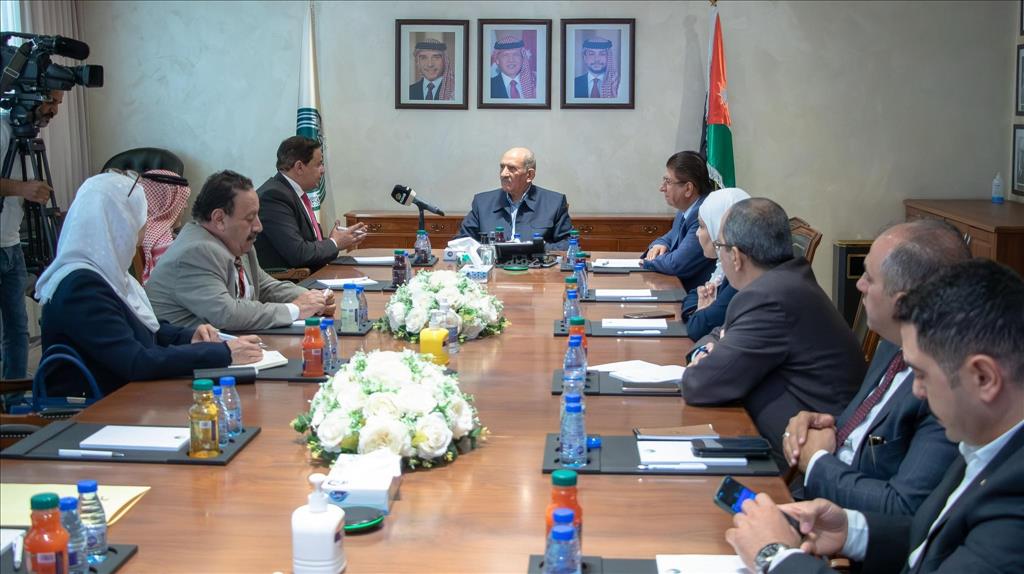
Amman, May 10 (Petra) -- The Lower House Energy and Mineral Resources Committee visited the Jordan Phosphate Mines Company (JPMC) on Sunday to review its operational performance, future investment strategies, and ongoing development projects.
Led by Ayman Abu Hania, the parliamentary delegation praised JPMC as a cornerstone of the national economy, highlighting the company's significant growth across production, operations, and investment sectors.
During the visit, JPMC Chairman Mohammad Thneibat presented the board's roadmap for future investments in mining, manufacturing industries, and infrastructure development. Thneibat noted that the company has played a pivotal role in supporting Jordan's balance of payments and trade balance, with cumulative sales reaching 8.616 billion dinars ($12.15 billion) between 2018 and 2024.
Thneibat detailed the company's financial performance, stating that cumulative net profits from 2018 to 2025 reached approximately JD2.7 billion ($3.8 billion). Over the past seven years, JPMC contributed JD885 million to the state treasury in income tax and mining fees, while the government and the Social Security Corporation received JD868.5 million as their share of post-tax net profits.
The chairman reported a sharp increase in mining volumes, with phosphate rock extraction rising from 8 million tonnes in 2018 to 12 million tonnes in 2025. Phosphoric acid production grew by 50% to 1.35 million tonnes in 2024, while phosphate fertilizer production rose 48% to 1.1 million tonnes during the same period.
Chief Executive Officer Abdul Wahab Alrowwad confirmed that the company achieved record-breaking performance in 2025, reaching new highs in production, sales, and profitability.
Alrowwad stated that phosphoric acid sales exceeded 2.5 million tonnes of solution. At the Aqaba industrial complex, fertilizer production, primarily Diammonium Phosphate (DAP), surpassed 1 million tonnes. Additionally, the Nippon Jordan Fertilizer Company (NJFC) produced more than 300,000 tonnes of specialized fertilizers.
Regarding supply chain management, Alrowwad said JPMC successfully navigated regional logistical challenges by establishing strategic reserves of sulfur and ammonia. This strategy ensured uninterrupted production and optimized export flows through the phosphate terminal at the Port of Aqaba.
The CEO unveiled a suite of strategic projects currently underway, including a new sulfuric acid unit with an annual capacity of 900,000 tonnes and a phosphoric acid unit with a 300,000-tonne capacity under the second Indo-Jordanian project. He also highlighted a joint venture with the Arab Potash Company to produce purified acid and specialized fertilizers.
Expansion plans include a partnership with Oman's OQ to build a phosphoric acid plant in Jordan and a fertilizer plant in Salalah, Oman. The Salalah facility will produce DAP and Monoammonium Phosphate (MAP), a move intended to enhance industrial integration and secure access to new international markets.
//Petra// AF

Legal Disclaimer:
MENAFN provides the
information “as is” without warranty of any kind. We do not accept
any responsibility or liability for the accuracy, content, images,
videos, licenses, completeness, legality, or reliability of the information
contained in this article. If you have any complaints or copyright
issues related to this article, kindly contact the provider above.
Most popular stories
Market Research

More Story







Comments
No comment