





403
Sorry!!
Error! We're sorry, but the page you were looking for doesn't exist.
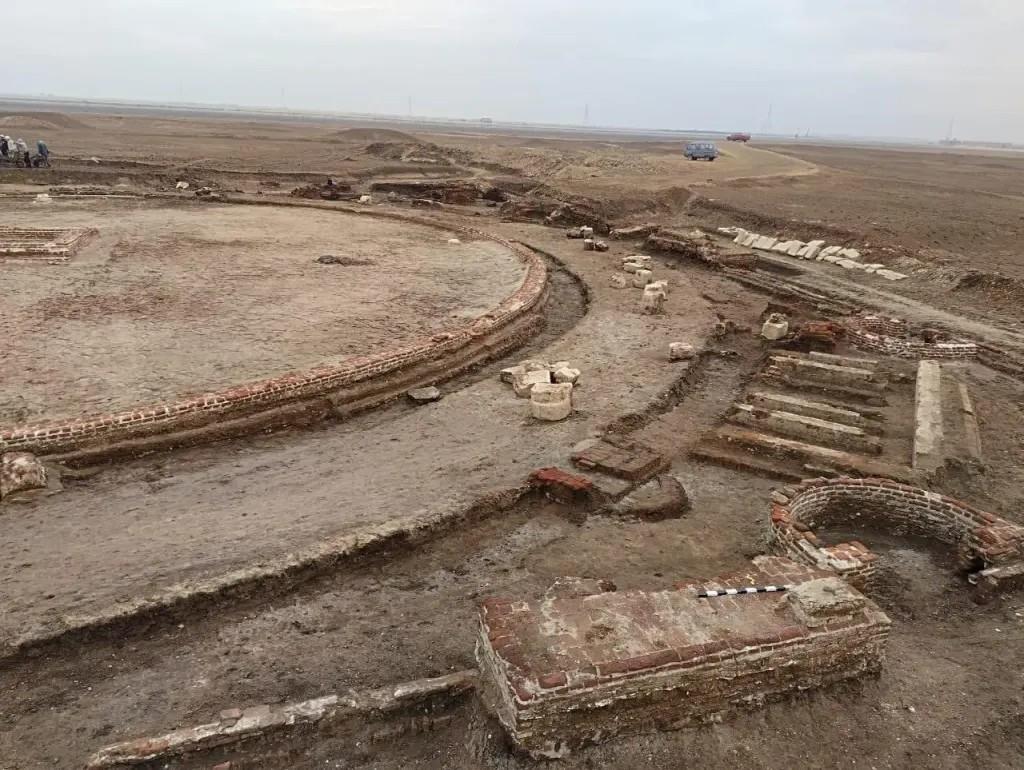
Ruins Of A 'Unique' Temple Complex Discovered In Northern Sinai
(MENAFN- USA Art News)
Temple Complex in Northern Sinai May Confirm a Long-Lost Cult of Pelusius
An Egyptian archaeological mission has identified a temple complex at Tell el-Farama, the site of ancient Pelusium in northern Sinai, that may shed rare light on a deity known largely from Classical literature. The structure, first uncovered in 2019, was initially mistaken for a civic building. New excavation and comparative analysis have led researchers to a different reading: a sacred water installation used in religious rituals.
The complex centers on a circular basin roughly 100 feet in diameter, once connected to an eastern branch of the Nile that has long since dried up. Drainage channels ring the basin, and a square plinth at its center may have supported a statue of Pelusius, the local god associated with the city. Dr. Hisham Hussein, head of the Central Department for Maritime Antiquities and Sinai and supervisor of the excavation, said the evidence now points away from a political function.“We now know this was a sacred water installation used in religious rituals,” Hussein said,“not a political structure.”
Stratigraphic evidence suggests the temple was built in the 2nd century BC and remained in use through the 6th century AD. Its Egyptian, Greek, and Roman features reflect the layered history of Pelusium itself, a city founded around 800 BC on the edge of the Nile Delta. In Pharaonic times, it served as a fortress and customs post on Egypt's eastern frontier; later, it became a Roman provincial capital.
The discovery is notable not only for its scale, but for what it may clarify about Pelusius. The deity is mentioned in Plutarch's Isis and Osiris, yet little else is known about him. Egyptologist Steve Harvey said that if the structure can be confirmed as a cult site dedicated to Pelusius, it would be a significant example of a temple for a god previously attested only in Classical sources.
For scholars of ancient religion, the site offers something unusually concrete: a possible material record of worship that has so far survived mostly as a name in texts. In a city shaped by trade, conquest, and shifting empires, the basin at Tell el-Farama may prove to be one of the clearest surviving traces of Pelusium's spiritual life.

Legal Disclaimer:
MENAFN provides the
information “as is” without warranty of any kind. We do not accept
any responsibility or liability for the accuracy, content, images,
videos, licenses, completeness, legality, or reliability of the information
contained in this article. If you have any complaints or copyright
issues related to this article, kindly contact the provider above.
Most popular stories
Market Research

More Story





Comments
No comment