




403
Sorry!!
Error! We're sorry, but the page you were looking for doesn't exist.
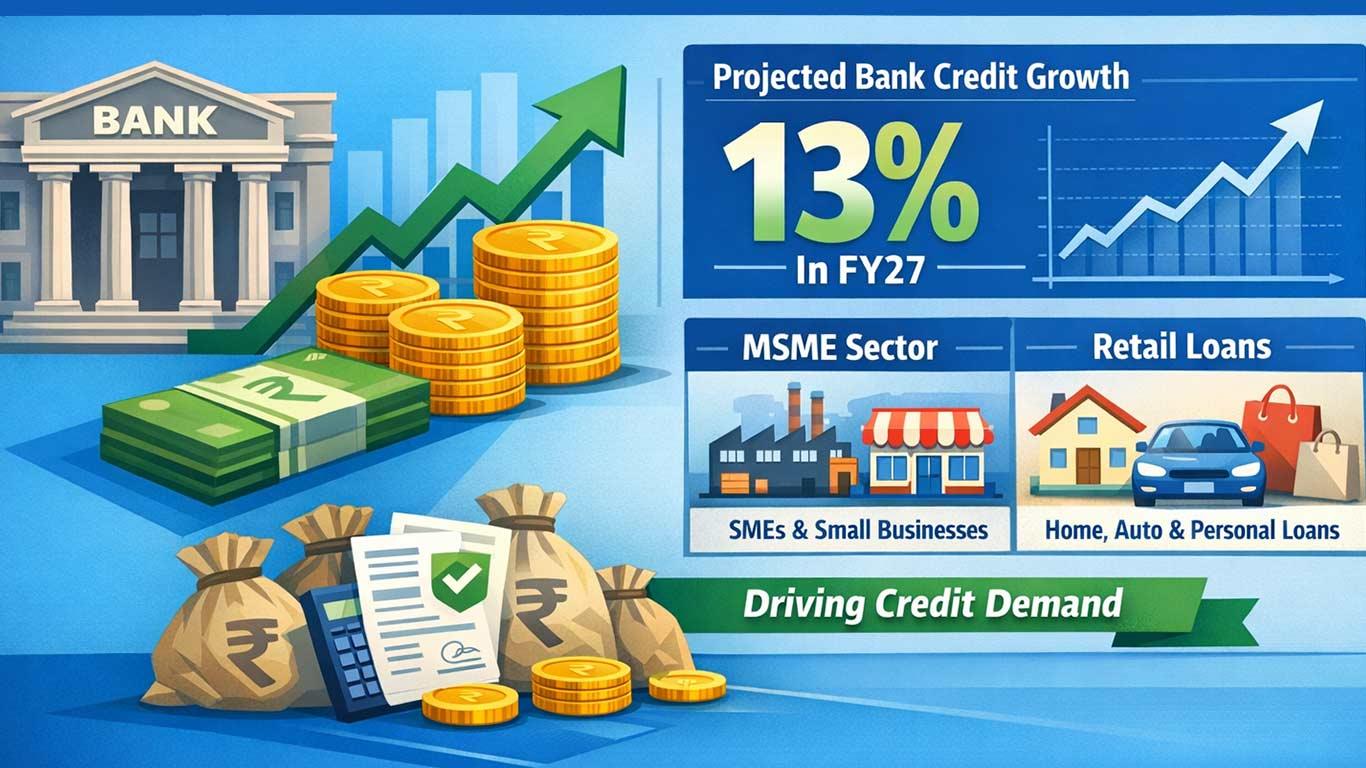
Bank Credit Growth Seen At 13% In FY27 Msmes & Retail To Support Demand: Crisil Ratings
(MENAFN- KNN India)
New Delhi, Apr 9 (KNN) Bank credit growth in India is projected to moderate to around 13 per cent in the current fiscal, slightly lower than the estimated 14 per cent growth in FY26, according to a report by Crisil Ratings.
The report said the expansion will be supported by steady demand from micro, small and medium enterprises (MSMEs) and the retail segment, along with corporates increasingly preferring bank loans over bond issuances due to favourable interest rate dynamics.
Corporate Borrowing Supported by Rate Advantage
Crisil Ratings Director Subha Sri Narayanan noted,“Credit growth in the corporate sector (36 per cent of domestic bank credit) is seen growing 9-10 per cent, in line with 10 per cent in fiscal 2026.”
“After a subdued start, corporate credit growth accelerated in the second half of fiscal 2026, supported by lower interest rates on bank loans relative to corporate bonds,” Narayanan added.
“The ongoing West Asia conflict would have a dual impact on wholesale credit growth. On the one hand, the associated uncertainties could weigh on a broad-based revival in private sector capex. On the other hand, supply-chain disruptions and higher input prices would increase demand for working capital debt in the short term,” the report highlighted.
MSME Segment to Lead Growth
The MSME segment, contributing around 19 per cent of total bank credit, is expected to remain the fastest-growing category, with growth projected at over 22 per cent in FY27, albeit lower than the 24–25 per cent seen in FY26.
Government initiatives, including enhanced collateral-free loan limits and targeted support measures announced in the Union Budget, are expected to improve credit access and liquidity for MSMEs. Improved digital infrastructure is also helping lenders better assess risks in this segment.
The report emphasised,“Heightened caution by banks in lending to export-oriented MSMEs focused on West Asia, or those dependent on crude oil/ liquefied natural gas (LNG), could temper growth in the near term.”
Retail Lending Remains Resilient
The report noted that retail loans, which make up about 33 per cent of bank lending, are expected to grow at around 14 per cent in FY27. Although slightly slower than the latter half of FY26, the segment continues to benefit from strong demand in housing and auto loans.
Banks are likely to maintain their dominance in home loans due to competitive pricing, while growth in unsecured lending may improve as asset quality stabilises.
“Inflationary pressures from a prolonged West Asia conflict and the resultant higher interest rates could weigh on retail consumption demand,” the report said.
Deposit Growth Emerges as Key Constraint
A key risk to sustained credit growth is the widening gap between credit and deposit growth. As of mid-March 2026, the gap stood at around 300 basis points, with deposit growth lagging behind.
Vani Ojasvi, Associate Director, Crisil Ratings, said,“Regulatory measures such as the phased reduction in the cash reserve ratio have released liquidity for banks, providing support during the recent muted deposit growth.”
“Banks are also utilising their excess statutory liquidity ratio buffers and tapping certificates of deposit (CDs) to fund credit growth. Notably, against overall deposit growth of 10.8 per cent on-year as on March 15, 2026, growth in CDs was ~27 per cent, albeit on a much smaller base. However, this comes at a higher cost,” Ojasvi added.
While the overall outlook for bank credit growth remains stable, much will depend on deposit mobilisation and evolving global conditions, the report concluded.
(KNN Bureau)

Legal Disclaimer:
MENAFN provides the
information “as is” without warranty of any kind. We do not accept
any responsibility or liability for the accuracy, content, images,
videos, licenses, completeness, legality, or reliability of the information
contained in this article. If you have any complaints or copyright
issues related to this article, kindly contact the provider above.
Most popular stories
Market Research

More Story







Comments
No comment