




403
Sorry!!
Error! We're sorry, but the page you were looking for doesn't exist.
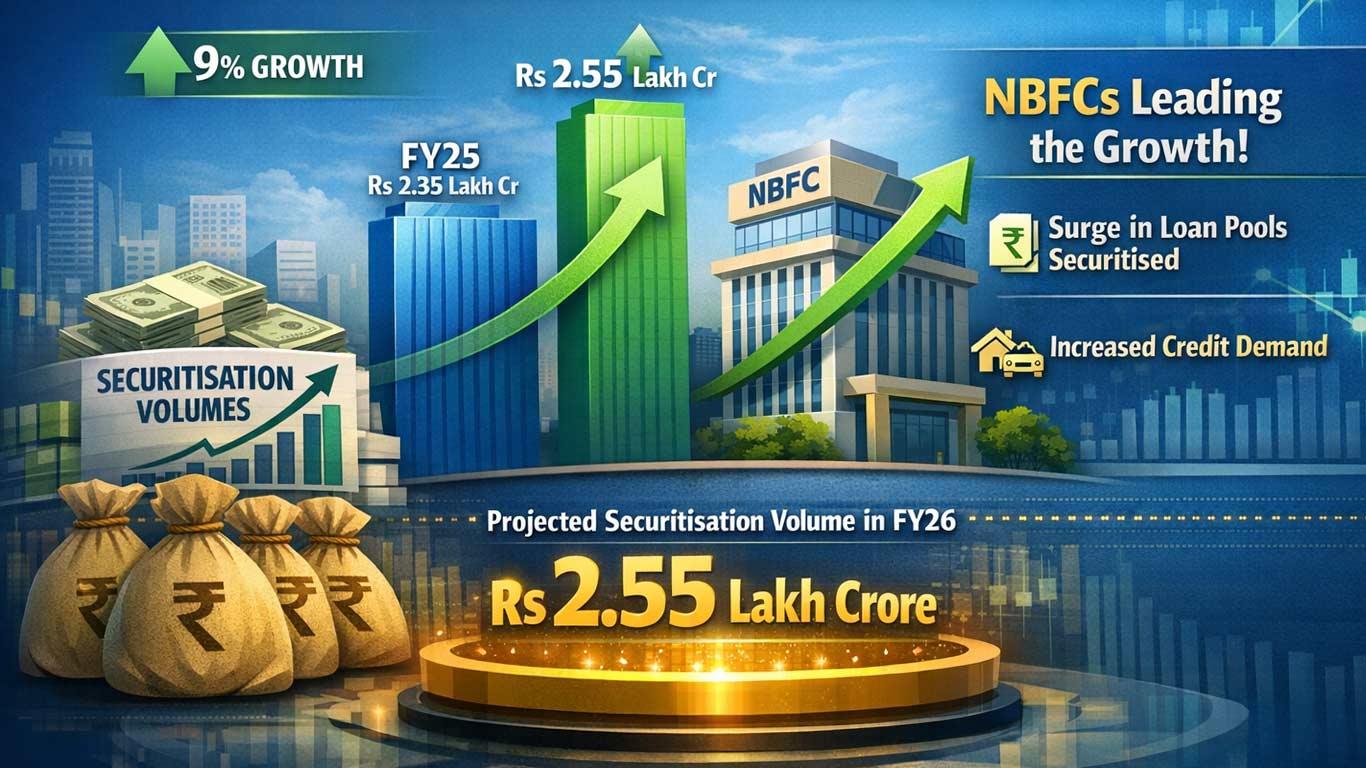
India's Securitisation Volumes Jump 9% To Rs 2.55 Lakh Cr In FY26, Nbfcs Lead Growth: Crisil Ratings
(MENAFN- KNN India)
New Delhi, Apr 9 (KNN) Securitisation transactions in India surged to over Rs 65,000 crore in the January–March quarter of FY26, taking the full-year total to a record Rs 2.55 lakh crore, according to Crisil Ratings.
This reflects a 20 per cent year-on-year (YoY) rise in the fourth quarter and an overall 9 per cent increase for the fiscal.
NBFCs Drive Market Expansion
The Crisil Ratings report said growth was largely driven by non-banking financial companies (NBFCs), whose securitisation originations rose about 30 per cent YoY.
Their strong performance offset subdued activity by banks, whose share dropped sharply to just 3 per cent of total issuances in FY26 from 26 per cent in the previous fiscal.
Aparna Kirubakaran, Director, Crisil Ratings, noted,“Increased NBFC activity reinforces the attractiveness of securitisation as a strong alternative fund-raising tool, especially for mid-sized players.”
“Robust performance of cherry-picked pools and structural credit enhancements in pass-through certificates (PTCs) continue to support investor confidence in this market,” Kirubakaran added.
Market Broadens, Though Concentration Persists
While the market continues to be dominated by large players, participation has widened. The number of originators increased to over 190 in FY26 from 175 a year earlier, and the share of the top 20 players declined to 65 per cent from 71 per cent, indicating gradual diversification.
Shift in Asset Mix
Kirubakaran highlighted,“Among NBFCs, while originations by vehicle financiers remained strong, gold-loan backed securitisation emerged as the second-largest asset class, surpassing mortgages, last fiscal.”
Vehicle loans accounted for 40 per cent of total volumes, though their share declined from 47 per cent a year earlier. Gold loan-backed securitisation contributed 15 per cent of total transactions, overtaking mortgage-backed deals.
Mortgage securitisation saw its share fall to 14 per cent from 22 per cent, partly due to lower participation by a major private sector bank. Meanwhile, business and personal loans together edged up to 17 per cent, and microfinance increased marginally to 12 per cent.
PTCs Gain Dominance Over Direct Assignments
Payal Anand, Associate Director, Crisil Ratings, said,“PTC originations have achieved all-time high volumes, accounting for ~60 per cent of total market. PTCs are clearly gaining favour across asset classes, especially in the unsecured space. Investors in unsecured loan transactions, like microfinance, are preferring PTC route, due to the support provided by external enhancement, following the asset quality challenges that emerged in the previous fiscal.”
In contrast, the share of direct assignments (DAs) declined to about 40 per cent from 46 per cent in the previous fiscal.
“PTCs accounted for 69 per cent of microfinance securitisation transactions last fiscal, compared with 30 per cent in fiscal 2025. DAs, on the other hand, continue to be the preferred route for mortgages and gold loans,” Anand added.
Investor Base Expands
Banks-both public and private sector-continued to be the primary investors, although participation from mutual funds, foreign banks, insurers, and pension funds increased during the year.
The report noted,“NBFCs will likely continue to drive the issuance momentum in fiscal 2027, as securitisation provides them with a valuable tool for resource mobilisation and investor diversification, enabling efficient fundraising.”
(KNN Bureau)

Legal Disclaimer:
MENAFN provides the
information “as is” without warranty of any kind. We do not accept
any responsibility or liability for the accuracy, content, images,
videos, licenses, completeness, legality, or reliability of the information
contained in this article. If you have any complaints or copyright
issues related to this article, kindly contact the provider above.
Most popular stories
Market Research

More Story







Comments
No comment