




403
Sorry!!
Error! We're sorry, but the page you were looking for doesn't exist.
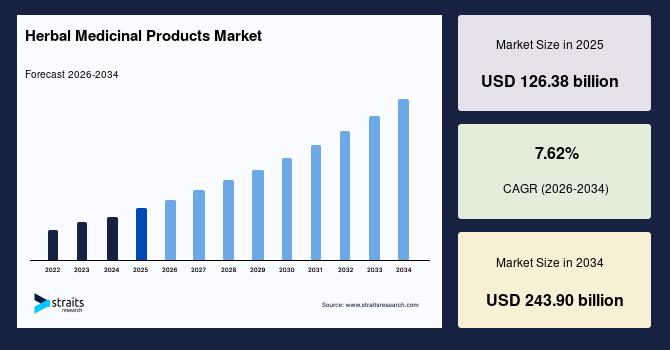
Herbal Medicinal Products Market Size, Share & Growth Graph By 2034
| Market Metric | Details & Data (2025-2034) |
|---|---|
| 2025 Market Valuation | USD 126.38 billion |
| Estimated 2026 Value | USD 135.56 billion |
| Projected 2034 Value | USD 243.90 billion |
| CAGR (2026-2034) | 7.62% |
| Dominant Region | Europe |
| Fastest Growing Region | North America |
| Key Market Players | AMA Herbal Group, GreenWay Herbal Products, LLC, Giosun Healthcare, PT Phytochemindo Reksa, Arkopharma |
Download Free Sample Report to Get Detailed Insights.
Emerging Trends in Herbal Medicinal Products Market Shift toward Natural RemediesConsumers increasingly prefer natural remedies over synthetic drugs due to perceived safety and fewer side effects. This shift encourages manufacturers to develop standardized herbal formulations and branded phytopharmaceuticals. As a result, the market for herbal medicinal products is expanding rapidly, with broader acceptance in both preventive and therapeutic use.
Shift toward Traditional Medicine SystemsHerbal products are increasingly incorporated into traditional medicine systems like Ayurveda, Traditional Chinese Medicine (TCM), and naturopathy. This integration expands their usage in clinical settings and wellness clinics. Consequently, herbal products gain credibility and adoption, bridging conventional and alternative healthcare practices.
Herbal products are evolving into functional and fortified forms, targeting immunity, stress, digestion, and cardiovascular health. This innovation attracts health-conscious consumers seeking preventive solutions. Over time, herbal medicinal products are positioned not just as treatments, but as daily wellness solutions, boosting consistent market demand.
Market Drivers Growing Adoption of Standardized Herbal Formulations and New Cultivation Projects Drives MarketPhysicians and alternative medicine practitioners increasingly recognize the efficacy of standardized herbal formulations. This impacts demand as more clinicians recommend herbal products for preventive care and adjunct therapy. Companies scale supply to meet prescriptions and clinic-based distribution. The result is greater adoption in formal healthcare settings and integration with conventional treatments.
New cultivation projects in Asia, Africa, and Latin America increase the availability of medicinal herbs like turmeric, ginseng, and ashwagandha. This strengthens supply reliability and reduces production costs for herbal manufacturers. Stable supply enables higher production and broader geographic distribution. Consequently, market growth accelerates as products become accessible in both developed and emerging markets.
Market Restraints Varying Safety Standards and Insufficient Clinical Trials Restrains Herbal Medicinal Products Market GrowthDifferent countries have varying standards for herbal product registration, safety, and efficacy testing. This creates delays and increased compliance costs for manufacturers trying to sell internationally. As a result, product launches slow down, and adoption is limited in regions with stricter regulations.
Many herbal products have insufficient clinical trials to support efficacy claims for specific health conditions. Healthcare professionals and regulatory authorities hesitate to recommend these products without robust evidence. Thus, market adoption remains constrained, particularly in regulated or institutional channels.
Market Opportunities Advancements in Genomics and User-friendly Delivery Systems Offers Growth Opportunities for Herbal Medicinal Products Market PlayersAdvances in genomics and metabolomics allow the creation of herbal products tailored to individual health profiles. This opens opportunities for companies to develop personalized formulations targeting specific conditions like stress, digestion, or immunity. Personalized products can improve efficacy and consumer satisfaction, encouraging repeat usage. Customized herbal therapies become a standard part of preventive and integrative healthcare.
Consumers seek convenient and effective ways to consume herbal medicines, such as gummies, effervescent tablets, patches, and inhalable forms, opening avenues for companies to create user-friendly, high-bioavailability products. Innovative delivery can increase adherence, particularly among younger or urban populations. In the future, novel formats may drive market expansion and differentiate brands in a crowded market.
Regional Analysis Europe: Market Dominance through Acceptance of Plant-based Treatments and HomeopathyEurope's herbal medicinal products market had a share of 33.17% in 2025 due to regulatory support, strong traditional medicine culture, and increasing consumer focus on natural health. For example, Germany's Commission E framework provides official guidance for approved herbal therapies, boosting consumer confidence and product uptake. In France, the Agence Nationale de Sécurité du Médicament (ANSM) allows simplified registration for traditional herbal medicinal products, supporting wider market availability. Meanwhile, the UK's NHS herbal formularies promote select evidence-based herbal remedies in clinical practice, encouraging physician-led recommendations. Together, these frameworks and examples help standardize herbal usage and drive sustained adoption across the region.
Germany dominates the European herbal medicinal products market due to its strong phytotherapy tradition and high consumer acceptance of plant-based treatments, with over 70% of the population using herbal medicines regularly. The country also benefits from a well-established regulatory and pharmacy distribution system, with more than 20,000 pharmacies actively dispensing herbal medicinal products, ensuring wide accessibility. In addition, integration of herbal therapies into conventional medical practice and physician recommendations further supports demand. High awareness of preventive healthcare and preference for natural remedies continue to drive consistent consumption across age groups.
The France herbal medicinal products market is driven by its strong culture of homeopathy and plant-based formulations, with homeopathic medicines accounting for a significant share of pharmacy sales and used by nearly 50% of the population at least occasionally. The country also has a well-established botanical ecosystem, with over 148 medicinal plants officially recognized for therapeutic use, supporting product diversity and formulation innovation. The country shows stronger demand through physician-prescribed and pharmacist-recommended herbal therapies, particularly for stress, sleep disorders, and digestive health. Growing preference for organic-certified and locally sourced botanicals is further shaping product development and premiumization.
North America is anticipated to register a CAGR of 9.62% during the forecast period. The market is experiencing strong growth due to increasing consumer preference for natural and preventive healthcare solutions. High awareness of wellness trends, combined with strong purchasing power, drives demand for herbal supplements, functional beverages, and plant-based medicines. The region benefits from established distribution networks, e-commerce penetration, and supportive regulatory frameworks that allow standardized herbal products to reach mainstream consumers. Integration of herbal products into wellness programs, clinics, and complementary medicine practices encourages higher adoption, sustaining market growth.
The US herbal medicinal products market is expanding due to the strong role of dietary supplements and wellness-driven consumption, with over 80% of adults using dietary supplements, many of which include herbal ingredients. The country also shows high retail penetration through alternative channels, with more than 35,000 health food stores and specialty supplement outlets supporting widespread availability beyond pharmacies. Growth is further driven by increasing demand for functional products targeting immunity, stress management, and energy, rather than traditional therapeutic use. In addition, the rise of e-commerce and direct-to-consumer brands is accelerating access to herbal products across diverse consumer groups.
Canada's herbal medicinal products market is growing steadily due to strong regulatory support under the Natural Health Products framework, which ensures product safety, efficacy, and consumer trust. The country emphasizes evidence-based herbal formulations, leading to higher acceptance among healthcare practitioners and integration into routine wellness practices. Rising preference for preventive healthcare and natural remedies is driving demand across both urban and aging populations. In addition, increased availability through pharmacies and online platforms is improving product accessibility nationwide. Notably, over 70% of Canadians use natural health products, including herbal medicines, highlighting a well-established consumer base and sustained market demand. (Source: A Health Canada-linked evaluation report)
By TypeTraditional Chinese medicines dominated the herbal medicinal products market with a share of 33.45% in 2025, driven by their long-established clinical acceptance, standardized formulations, and strong integration into formal healthcare systems, particularly in Asia. Government support and increasing global exports further strengthens demand. Their proven efficacy and regulatory recognition continue to position this segment as the leading contributor to market revenue.
The Ayurvedic medicines segment is expected to grow at a CAGR of 8.12% during the forecast period, supported by rising global preference for natural and preventive healthcare solutions. Increasing consumer awareness, expanding product commercialization, and government initiatives promoting traditional Indian medicine drive growth. The segment benefits from clean-label positioning and holistic healing appeal, accelerating its adoption across both domestic and international markets.
By FunctionGeneral wellness dominated the market with a 42.34% share in 2025 due to increasing consumer focus on preventive healthcare and daily health maintenance. Herbal products are widely used for immunity boosting, stress relief, and overall vitality. The shift toward lifestyle management and natural supplements continues to drive demand, making this segment the primary application area in the herbal medicinal products market.
The cognitive health segment is expected to grow at a CAGR of 8.78% during the forecast period, fueled by rising concerns over mental well-being, stress, and age-related cognitive decline. Growing demand for natural nootropics and brain health supplements is accelerating segment expansion. Increased research into herbal ingredients supporting memory and focus further contributes to its rapid growth trajectory in the market.
By FormulationPowder formulations dominated the market with a 47.20% share in 2025 due to their traditional usage, ease of formulation, and higher shelf stability. They are widely preferred in systems like Ayurveda and Traditional Chinese Medicine for their versatility in consumption. Cost-effectiveness and minimal processing requirements further support their widespread adoption, maintaining their leading position in the market.
The syrups segment is expected to grow at a CAGR of 8.15% during the forecast period, driven by increasing demand for convenient and palatable dosage forms. They are particularly popular among pediatric and geriatric populations. Improved flavoring, ease of consumption, and enhanced bioavailability make syrups an attractive option, contributing to their rapid growth within the herbal medicinal products market.
Competitive LandscapeThe herbal medicinal products market is highly fragmented, with a mix of large multinational pharmaceutical and nutraceutical companies, regional herbal specialists, and small local producers actively participating. Established players typically compete on factors such as brand recognition, global distribution networks, quality certifications, and clinical validation of products. Emerging players focus on niche formulations, traditional or ethnobotanical expertise, cost competitiveness, and innovative delivery formats to capture specific consumer segments.
List of Key and Emerging Players in Herbal Medicinal Products Market AMA Herbal Group GreenWay Herbal Products, LLC Giosun Healthcare PT Phytochemindo Reksa Arkopharma TSUMURA and CO Bio Botanica, Inc. Ricola Himalaya Herbal Healthcare The Natures Bounty Co Herbal Africa Young Living Essential Oils Schaper and Brummer Surya Herbal Ltd Recent Developments-
In March 2026, The Institute of Agricultural Sciences and Technology at Integral University signed an MoU with AMA Herbal Group to promote indigo cultivation and scientific farming practices, linking industry and academia for raw herb supply and processing development.
In January 2026, GreenWay Herbal Products, LLC received a US patent covering a proprietary 1:1 cannabidiol and cannabidiolic acid composition for inflammation and autoimmune support, representing formal intellectual property protection for a novel herbal-based formulation.
In November 2025, Giosun Healthcare showcased its Ayurvedic, herbal nutritional, and cosmetic contract manufacturing expertise at CMPL Delhi 2025.
In October 2025, PT Phytochemindo Reksa participated in the Indonesia Herbal Mini Expo (IDHAX) 2025 during the WHO IRCH meeting, showcasing its botanical extracts, essential oils, and formulation solutions to international delegates, highlighting its commitment to quality, innovation, and sustainable practices.
| Report Metric | Details |
|---|---|
| Market Size in 2025 | USD 126.38 billion |
| Market Size in 2026 | USD 135.56 billion |
| Market Size in 2034 | USD 243.90 billion |
| CAGR | 7.62% (2026-2034) |
| Base Year for Estimation | 2025 |
| Historical Data | 2022-2024 |
| Forecast Period | 2026-2034 |
| Report Coverage | Revenue Forecast, Competitive Landscape, Growth Factors, Environment & Regulatory Landscape and Trends |
| Segments Covered | By Type, By Function, By Formulation |
| Geographies Covered | North America, Europe, APAC, Middle East and Africa, LATAM |
| Countries Covered | US, Canada, UK, Germany, France, Spain, Italy, Russia, Nordic, Benelux, China, Korea, Japan, India, Australia, Taiwan, South East Asia, UAE, Turkey, Saudi Arabia, South Africa, Egypt, Nigeria, Brazil, Mexico, Argentina, Chile, Colombia |
Download Free Sample Report to Get Detailed Insights.
Herbal Medicinal Products Market Segments By Type-
Traditional Chinese Medicines
Homeopathic Medicines
Aromatherapy Medicines
Ayurvedic Medicines
Others
-
General Wellness
Cardiovascular Health
Gut & Digestive Health
Cognitive Health
Others
-
Powders
Syrups
Ointments
Oils
Capsules & Tablets
Extracts
Others
-
North America
Europe
APAC
Middle East and Africa
LATAM

Legal Disclaimer:
MENAFN provides the
information “as is” without warranty of any kind. We do not accept
any responsibility or liability for the accuracy, content, images,
videos, licenses, completeness, legality, or reliability of the information
contained in this article. If you have any complaints or copyright
issues related to this article, kindly contact the provider above.
Most popular stories
Market Research

More Story








Comments
No comment