




403
Sorry!!
Error! We're sorry, but the page you were looking for doesn't exist.
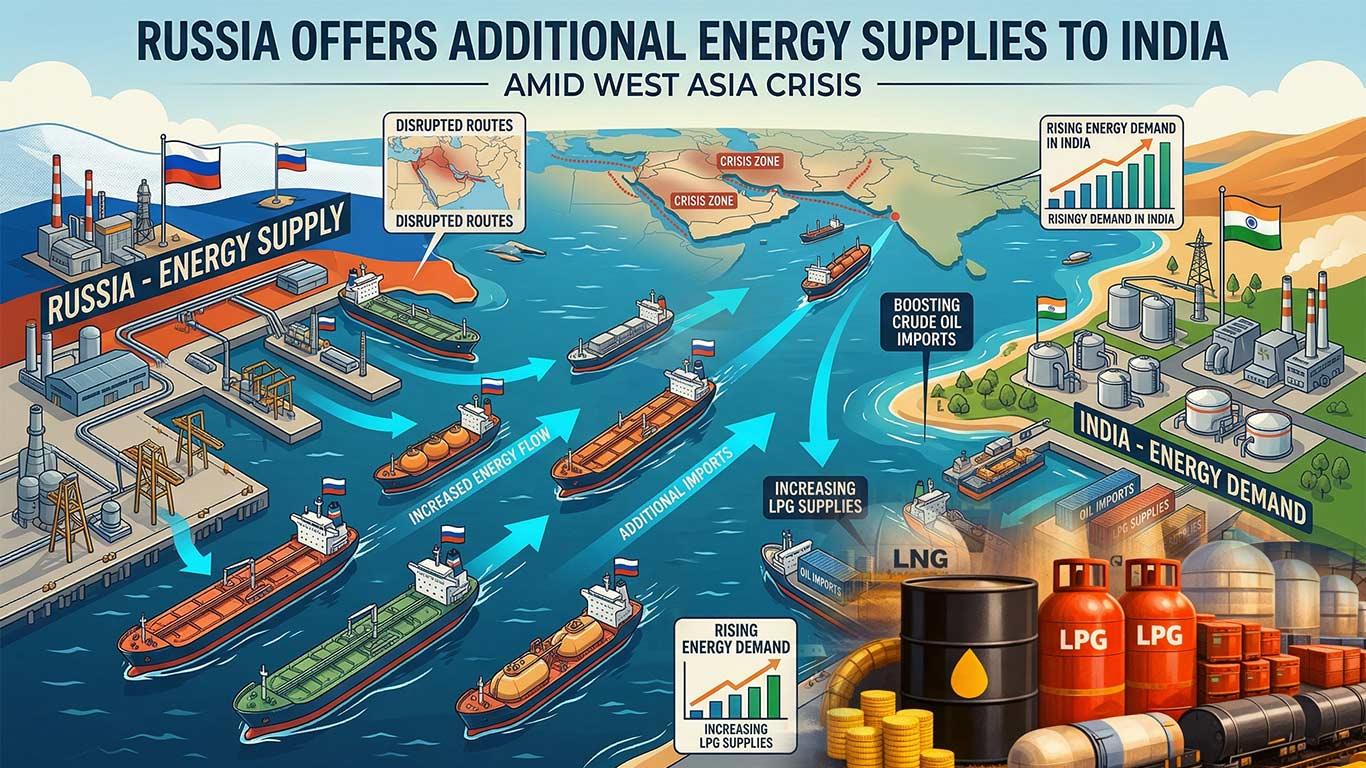
Russia Offers Additional Energy Supplies To India Amid West Asia Crisis
(MENAFN- KNN India)
New Delhi, Apr 4 (KNN) Russia has offered to increase oil and liquefied natural gas (LNG) supplies to India amid disruptions caused by the ongoing West Asia conflict, as supply chains face mounting pressure due to the near-closure of the Strait of Hormuz and attacks on energy infrastructure in the Gulf region.
Russia Assures Steady Supply Boost
According to a statement from the Russian Embassy, Denis Manturov, First Deputy Chairman of the Russian government, said Russian companies are capable of steadily ramping up energy exports to meet India's growing demand.
He also highlighted that Russia had increased fertiliser supplies to India by 40 percent by end-2025, with further commitments to ensure continued availability. A joint urea (carbamide) production project between the two countries is also currently under development.
Energy Cooperation Expands Beyond Oil
Beyond hydrocarbons, India and Russia are strengthening ties in nuclear energy cooperation, including ongoing work on power units at the Kudankulam Nuclear Power Plant.
Manturov noted that bilateral collaboration spans multiple strategic sectors, including energy, fertilisers, and infrastructure.
High-Level Talks in New Delhi
External Affairs Minister S Jaishankar held discussions with Manturov in New Delhi, focusing on expanding the India-Russia strategic partnership.
The talks covered trade and industrial cooperation, energy security and fertilisers, connectivity and mobility and technology, innovation, and critical minerals.
Jaishankar said both countries are working to identify new opportunities in emerging sectors, while also exchanging views on broader geopolitical developments, including the West Asia conflict.
Supply Chain Disruptions Intensify Concerns
The developments come at a time when India is facing heightened energy security risks, with the Strait of Hormuz disruption affecting global oil flows.
In a related development, a tanker carrying Iranian crude oil, expected to head to India, rerouted mid-voyage to China, reflecting uncertainty in global oil trade flows. The shipment would have marked India's first Iranian oil import in nearly seven years after recent sanction relaxations.
Russia's offer to boost energy supplies could help stabilise India's energy imports amid volatile global conditions. However, continued geopolitical tensions and disruptions in key shipping routes are likely to keep supply chains under pressure in the near term.
(KNN Bureau)

Legal Disclaimer:
MENAFN provides the
information “as is” without warranty of any kind. We do not accept
any responsibility or liability for the accuracy, content, images,
videos, licenses, completeness, legality, or reliability of the information
contained in this article. If you have any complaints or copyright
issues related to this article, kindly contact the provider above.
Most popular stories
Market Research

More Story






Comments
No comment