




403
Sorry!!
Error! We're sorry, but the page you were looking for doesn't exist.
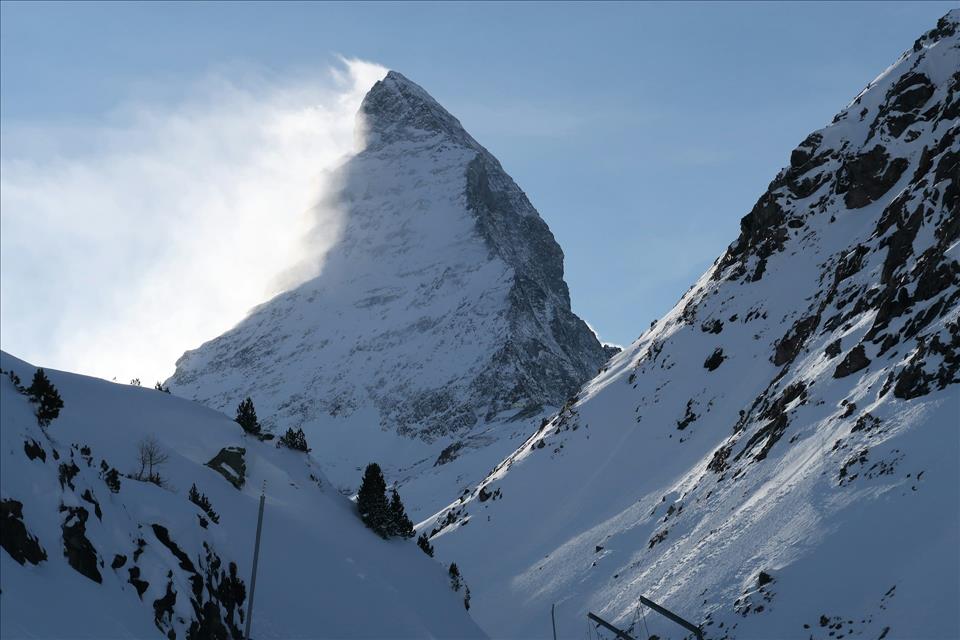
Stories Of Beauty, Mourning And 'Moments Of Being' Inspire In Claire Thomas' On Not Climbing Mountains
Author: Jessica Gildersleeve
(MENAFN- The Conversation) Over the past month, the world has watched with awe the tremendous feats of athletes at the 2026 Winter Olympics, many of which involve risky mountain sports.

Meanwhile, a man was found guilty of manslaughter after his girlfriend froze to death on Grossglockner, Austria's highest mountain. Two young men were found dead after they went missing while hiking on Snowdon, the highest mountain in Wales. Mountains in Europe and the United States have also claimed several lives during a particularly heavy snow season.
Review: On Not Climbing Mountains – Claire Thomas (Hachette)
After reading Claire Thomas's latest novel, the extraordinary and experimental On Not Climbing Mountains, these stories of the mountains have captured my attention. Thomas's narrative is itself a series of mountain scenes: beside mountains, on mountains, near mountains, looking at mountains, inspired by mountains, living and dying on mountains – but not climbing them.
One such vignette describes the childhood of mountaineer Sir Edmund Hillary, though not the details of his expeditions.
Waiting roomsOn Not Climbing Mountains is Thomas's third novel. Her first, Fugitive Blue (2008) won the Dobbie Award for Women Writers. Her second, The Performance (2021), was shortlisted for the Christina Stead Prize for Fiction. Both were longlisted for the Miles Franklin Literary Award.
Using Baedeker's Switzerland, a 19th-century guidebook to the region, as its structure, On Not Climbing Mountains moves through five parts, and five areas of Switzerland and their surrounds. In doing so, the novel spotlights the significance of the Swiss Alps to a wide range of authors, scientists, historians, artists and others.
The effect is to capture the ways our lives perpetually touch and move on from those of others, and the experience of a moment in time – what Virginia Woolf calls“moments of being”.
The novel's different parts are threaded together from the perspective of narrator Beatrice“Bee” Angst, a young woman mourning the recent death of her father and the long-ago death of her mother. Her literary journey through the mountains – or more strictly, beside the mountains – is coloured by her grief and loneliness.
The mountains, though they are typically a figure of the terrifying sublime, offer her comfort and a sense of connection to other people who have been similarly captivated by them.
Bee becomes fascinated with Jean-Frédéric Schnyder 's Wartsaal (Waiting Room): a series of 92 paintings of waiting rooms in Swiss train stations. Most of them feature, unsurprisingly, the benches, the walls, the ceilings, the clock.
In another scene, Bee is struck by the serendipity of an advertisement she sees on a train, which declares:“Life is too beautiful to spend it in a waiting room.” The sentiment suggests that waiting rooms are not life and not beautiful. But for Bee – and, it seems, for Schnyder – the opposite is true. Viewing the paintings, Bee is“engrossed in the possibilities of the rooms”. She feels
Bee's guidebook reminds her that“Zurich's primary pleasure is the beauty of its situation”. This situation includes the waiting rooms of its train stations.
The final painting, Bee notices,“details only a small portion of the waiting room”. It emphasises instead the“glimpse” through the window of the mountain view. Far from agreeing with that advertisement, then, Bee understands waiting rooms as places that pause the movement of life. They represent a suspended state of not knowing what is to come.“I could have known more,” Bee reflects of her lost father.
In this sense, the waiting rooms resonate with Bee's feelings of grief: the holding pattern of her state of mourning. In the last painting, with which the novel concludes, the waiting room signifies hope, the opportunity to move forward and reach, perhaps, the summit.
Home-woeAnother source of inspiration for Bee is Johanna Spyri's novel for children Heidi, a book she so loved as a child that
The recollection is significant, for it evokes what Bee later identifies as Heimweh, literally home-woe, or nostalgia. Her nostalgia is for the sense of homecoming she felt as she read Heidi, the oneness she felt with the girl in Switzerland, and the pure happiness they feel together in the mountains.
Bee returns the book after her father refers to it as“sentimental”, a term which embarrasses her, exposing the childishness of the fantasy she has indulged.
On Not Climbing Mountains also traces the significance of the Alps in the life and art of many other writers. These include Mary Shelley, who wrote Frankenstein while staying near Lake Geneva; James Baldwin, who wrote Go Tell It on the Mountain in Leukerbad; and Patricia Highsmith, who lived in Ticino and wrote about it in A Long Walk From Hell.
Monique Saint-Hélier lived and wrote in La Chaux-de-Fonds. Elizabeth von Arnim lived in Crans-Montana and wrote many works there, including In the Mountains, and her cousin Katherine Mansfield came to stay with her as a treatment for her tuberculosis and wrote several short stories there, many of which reflect on Mansfield's childhood in New Zealand, also famous for its mountains.
Indeed, Thomas's writing is very much of a piece with Mansfield's modernism. Mansfield was famous for her sharp, short observations of human character and the way her short stories often end with an epiphany about that very humanity.
The mountain is a symbolIn this work of appreciating the mountains, Bee comes to perform the work of mourning that allows her to grieve for her parents.
Thomas quotes Woolf's short story The Symbol, in which the protagonist observes:“The mountain [...] is a symbol.”
“But of what?” the story continues, although that sentence is not quoted by Thomas.
So what does the mountain symbolise in On Not Climbing Mountains? In Woolf's story, it is a symbol of a future point in time: a time of freedom, a time of moving beyond the time of waiting (in this case, for the death of the character's mother). The same appears to be true of the mountain view glimpsed in Schnyder's final waiting room, where Thomas's novel concludes.
On Not Climbing Mountains is a beautiful novel, itself a series of waiting rooms, a series of moments captured in time. It is also a love letter to the mountains, perpetual signs and symbols. Of what? Of so much.
Institution:University of Southern Queensland

Legal Disclaimer:
MENAFN provides the
information “as is” without warranty of any kind. We do not accept
any responsibility or liability for the accuracy, content, images,
videos, licenses, completeness, legality, or reliability of the information
contained in this article. If you have any complaints or copyright
issues related to this article, kindly contact the provider above.
Most popular stories
Market Research

More Story






Comments
No comment