




403
Sorry!!
Error! We're sorry, but the page you were looking for doesn't exist.
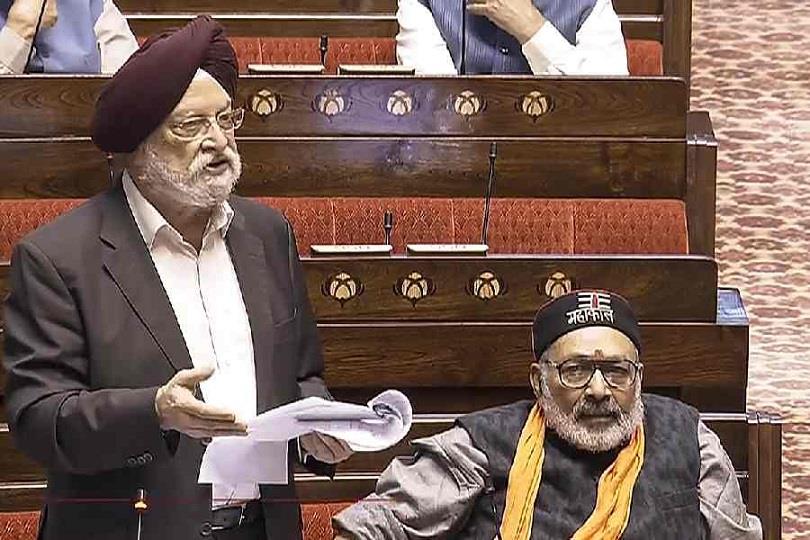
India's Oil Reserves Can Last 74 Days: Puri
(MENAFN- Kashmir Observer)
New Delhi- India's strategic petroleum reserve can last 74 days to meet the demand arising out of any global turbulence, Oil Minister Hardeep Singh Puri informed the Rajya Sabha on Monday.
ADVERTISEMENT
Replying to supplementaries during Question Hour, the minister said for any country like India, which is growing at a phenomenal pace, there must be a very viable and secure reserve so that it is not in a vulnerable situation in the case of global turbulence.
ADVERTISEMENT
He said India has several refineries both on the west coast and on the east.
“According to the International Energy Agency (IEA), today we are the world's third-largest consumer of crude oil. We have the world's fourth-largest refining capacity – currently around 260 million metric tonnes per annum going on to 320 million metric tonnes per annum. And we are also the world's fifth-largest exporter of petroleum products.
“The strategic petroleum reserve is designed to ensure that in case of total global turbulence, we must have enough stock left to meet our needs. The IEA stipulates that there should be about 90 days of holding as a strategic petroleum reserve,” the minister said.
Today, he said,“We calculate our reserves not only in caverns but also in our refineries. Our reserves in the caverns are in Andhra Pradesh and Karnataka, and we are hoping to get started in Odisha soon.”
“Together, if you look at the reserves in our caverns and what is held by our refineries and our floating platforms at our ports and our products, it comes to 74 days. Ideally, it should be 90 days. I feel, as the minister, safe with something at 74 days. But we can consider raising it going forward,” Puri said.
Read Also India Plays Down Threat Of Sanctions On Russian Oil Supplies Parliament Passes Bill To Amend Law Governing Oilfields Development“Overall, the strategic petroleum reserve is a very important component in economic stability. This is a very important component in our energy security,” he informed the House.
In his written reply to the question, the minister said,“The Government, through a Special Purpose Vehicle called Indian Strategic Petroleum Reserve Limited (ISPRL), has established Strategic Petroleum Reserves facilities with a total capacity of 5.33 million metric tonnes (MMT) of crude oil at 3 locations in Andhra Pradesh and Karnataka. Quantity of the crude available in the caverns varies depending on market conditions.”
“Currently, ISPRL has around 4.094 MMT of crude stock available, which is around 77 per cent of the total storage capacity. Out of total storage capacity, 50 per cent is utilised for commercial activities by ISPRL.
ADVERTISEMENT“Since the first purchase of crude oil for filling the reserves in 2015, crude oil prices (Indian basket) have fluctuated from a high of USD 80.08 per barrel in October 2018 to a low of USD 19.90 per barrel in April 2020 during the COVID period to as high as USD 112.87 per barrel in March 2022,” Puri said.
Taking advantage of low crude oil prices in April/May 2020, Strategic Petroleum Reserves (SPR) were filled to full capacity, leading to notional savings of approximately Rs 5,000 crore. The weighted average procurement cost of crude oil filled in SPRs from government budgetary support is still half of the currently prevailing crude oil prices, he said in his written reply.

Legal Disclaimer:
MENAFN provides the
information “as is” without warranty of any kind. We do not accept
any responsibility or liability for the accuracy, content, images,
videos, licenses, completeness, legality, or reliability of the information
contained in this article. If you have any complaints or copyright
issues related to this article, kindly contact the provider above.
Most popular stories
Market Research

More Story






Comments
No comment