




403
Sorry!!
Error! We're sorry, but the page you were looking for doesn't exist.
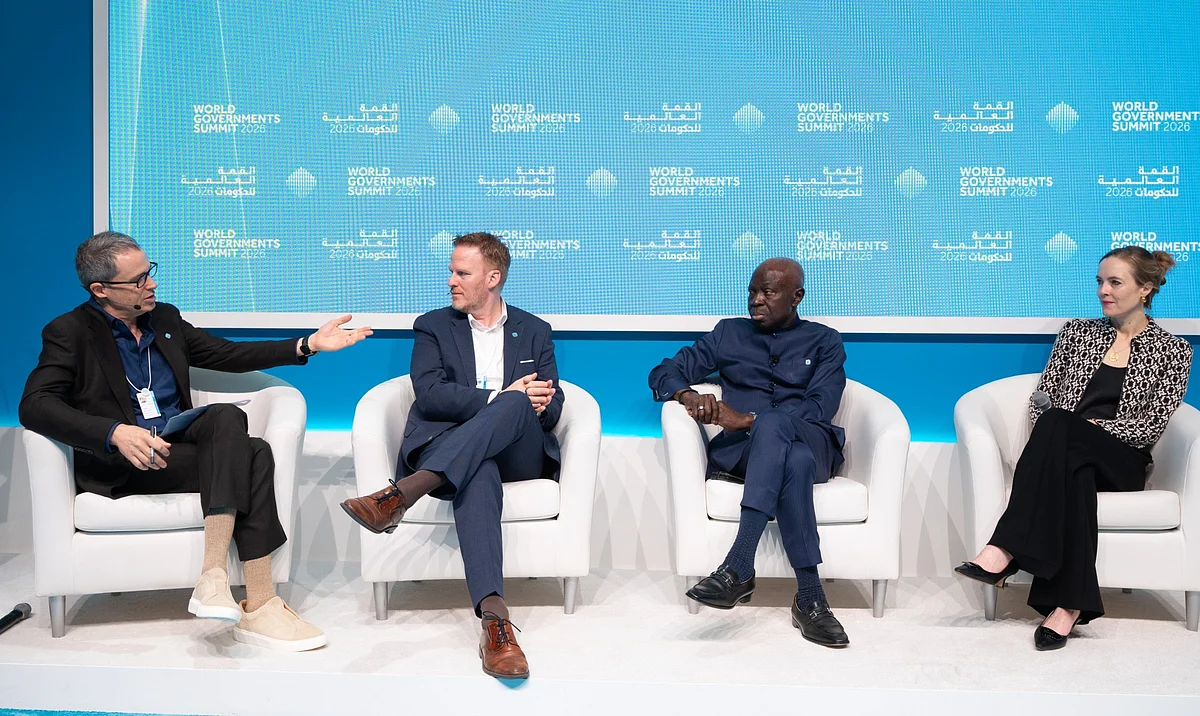
AI, Uncertainty, End Of Fixed Roles: Experts In Dubai Discuss Future Work Place
(MENAFN- Khaleej Times) As jobs become less permanent and career paths less linear, the panel agreed that good work cannot be defined by job titles alone
- PUBLISHED: Wed 4 Feb 2026, 5:17 PM UPDATED: Wed 4 Feb 2026, 7:02 PM
- By: Arwa Almazrouei
- Share:
In just thirty minutes, a panel of global experts in labour, leadership, and policy attempted to unpack what moderator Ted Kemp, chief content officer Khaleej Times, described as“the most ambitious title” at the World Government Summit - a deep dive into how the future of work is being reshaped by artificial intelligence (AI), shifting demographics, and growing economic uncertainty.
During the summit in Dubai, the session brought together Gilbert Houngbo, Director-General of the International Labour Organization, Robyn Scott, co-founder and CEO of Apolitical, and David Bach, President of IMD Business School. They discussed how governments, organisations, and individuals must adapt to an ever-evolving workplace.
Need for flexible institutions, not fixed plansRecommended For You Philippine Congress suspends vote on Marcos impeachment complaintsGilbert Houngbo stressed that governments should accept uncertainty as the new norm.“Five, 10, or 20 years from now, it is challenging to predict how the labour market will look,” he said, adding that the priority should be building strong, adaptable institutions rather than rigid workforce plans.
Stay up to date with the latest news. Follow KT on WhatsApp Channels.
He warned that while AI is delivering significant productivity gains, those gains are not automatically translating into better wages or job security.“The gap between productivity and wages is already wide," he said, calling on policymakers to act early to prevent future inequalities. Investment in skills, he added, is no longer optional but foundational.
Humans must stay above the algorithmRobyn Scott offered a blunt assessment of where AI could have the most significant immediate impact: government itself. "There is a $1.75 trillion productivity opportunity if governments harness AI properly,” she said, noting that AI thrives in bureaucratic environments where repetitive research, writing, and processing tasks dominate.
Rather than replacing workers, Scott argued for augmentation over automation, allowing AI to handle routine tasks while humans focus on judgment-heavy, complex cases. This shift, she said, requires constant retraining not as a one-off exercise, but as a“muscle for change management”.
One of her most striking warnings focused on human agency.“If agency is drained from humans and handed over entirely to algorithms, that becomes a zero-sum dynamic that is very dangerous for society,” she said. The key question for governments and employers, she added, is whether people are working below or above the algorithm.
Optimism is not naiveFor David Bach, the biggest risk the future of work faces is not technology itself, but fear. Citing global trust data, Bach pointed to stark contrasts in optimism between regions. While only a small minority in some Western countries believe the next generation will be better off, optimism in the UAE is significantly higher.
“When people aren't optimistic, they don't invest in their own skills. They don't support experimentation. Leadership today is about articulating an optimistic vision that acknowledges risk but mobilises people to act,” he said. Optimism, he stressed, is not about ignoring disruption, but about believing institutions can manage it.
Redefining 'good work' in the age of AIAs jobs become less permanent and career paths less linear, the panel agreed that good work cannot be defined by job titles alone. Houngbo emphasised that AI must be used to reduce hardship while ensuring decent wages, social protection, and fairness, particularly for women, who are disproportionately represented in repetitive roles most vulnerable to automation.
Scott added that as the 'half-life' of jobs shrinks, identity tied to a single profession will become fragile. "We need to shift motivation from external job identity to internal meaning," she said, warning that education systems built around credentials are no longer fit for purpose. Bach reinforced this by sharing an example of a hospital cleaner who found deep meaning in her work supporting cancer patients. "Good work isn't about prestige or technology," he said. "It's about meaning."
Organisation's will be redesigned, and so will careersLooking ahead, the panel predicted major shifts in organisational design. AI agents, Bach explained, will allow individual contributors to have greater impact without becoming people managers, breaking long-held assumptions about career progression.
Scott urged organisation's to stop thinking in terms of roles and titles, and instead focus on tasks and workflows, where AI is actually deployed. Culture, leadership principles, and safe spaces for experimentation, she said, will matter more than specific technical skills.
As Bach concluded, no one knows precisely which skills will matter most in the future.“What we do know,” he said,“is that people need direction, energy, and environments where they can learn, experiment, and fail safely.”
ALSO READ- UAE's distinctive AI approach: Embedding policy, ethics, infra into national vision 'New kind of humanity': UAE minister urges governments to rethink roles at WGS opening Dubai billionaire says India could lose millions of outsourcing jobs to AI

Legal Disclaimer:
MENAFN provides the
information “as is” without warranty of any kind. We do not accept
any responsibility or liability for the accuracy, content, images,
videos, licenses, completeness, legality, or reliability of the information
contained in this article. If you have any complaints or copyright
issues related to this article, kindly contact the provider above.
Most popular stories
Market Research

More Story







Comments
No comment