





403
Sorry!!
Error! We're sorry, but the page you were looking for doesn't exist.
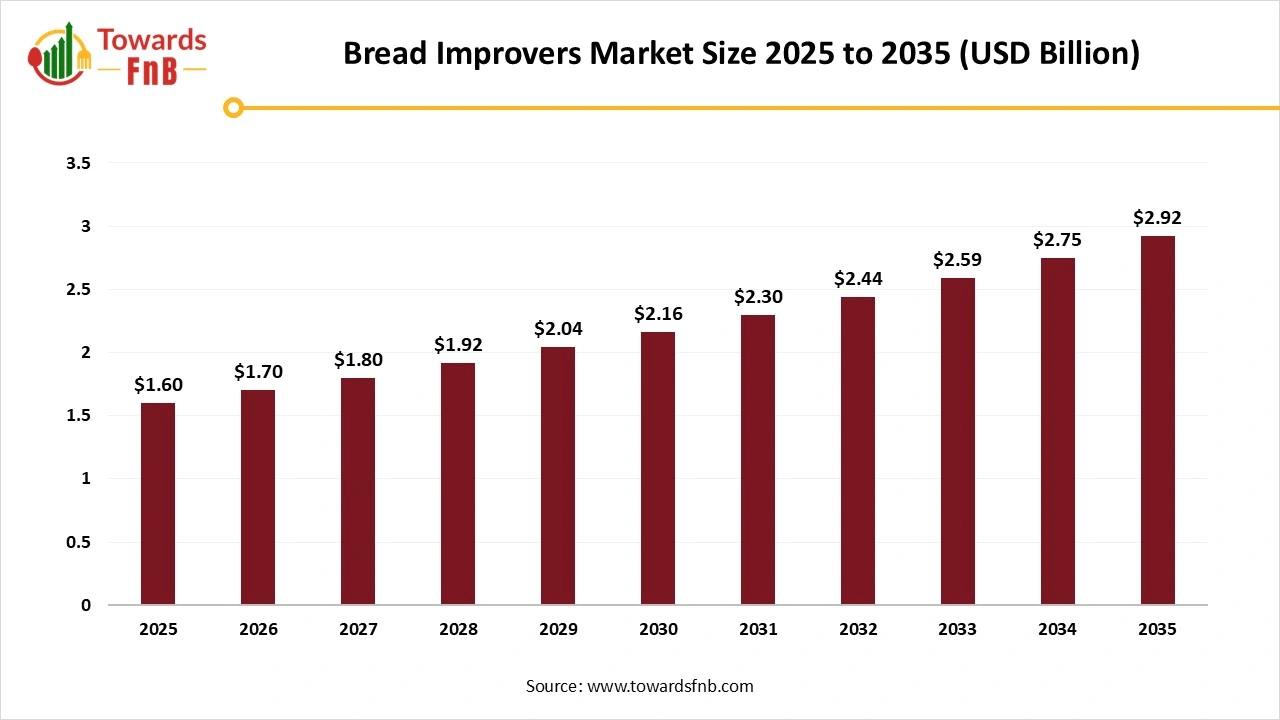
Bread Improvers Market Size To Exceed USD 2.92 Billion By 2035, Driven By Clean-Label, Functional Baking, And AI-Enabled Formulation
| Product Category | Description or Function | Common Forms or Variants | Key Applications or User Segments | Representative Brands or Product Types |
| Enzyme-Based Bread Improvers | Enzymatic systems that enhance dough strength, gas retention, crumb structure, and shelf life | Amylases, xylanases, proteases, glucose oxidase blends | Industrial bakeries, commercial bread manufacturers | Enzyme-based improver blends |
| Emulsifier-Based Improvers | Improve dough stability, volume, and crumb softness by strengthening gluten-starch interactions | DATEM, SSL, mono- and diglycerides | Industrial bakeries, frozen dough producers | Emulsifier-based bread improvers |
| Oxidizing Agents | Strengthen gluten network and improve dough tolerance during mixing and proofing | Ascorbic acid-based systems | Industrial and semi-industrial bakeries | Oxidation-based dough strengtheners |
| Reducing Agents | Improve dough extensibility and machinability by relaxing gluten structure | L-cysteine systems | Flatbread producers, automated dough lines | Reducing-agent dough conditioners |
| Hydrocolloid-Based Improvers | Enhance moisture retention, crumb softness, and freeze-thaw stability | Guar gum, xanthan gum, CMC blends | Packaged bread manufacturers, frozen bakery | Hydrocolloid-enriched bread improvers |
| Yeast Nutrient Systems | Support consistent yeast activity and fermentation performance | Mineral salts, enzyme-assisted nutrient blends | Industrial bakeries, high-speed bread lines | Yeast-support improver systems |
| Shelf-Life Extension Improvers | Delay staling and microbial spoilage in baked bread | Enzyme-preservative composite systems | Packaged bread and bun manufacturers | Anti-staling bread improvers |
| Clean-Label Bread Improvers | Functional improvers designed without chemical-sounding additives | Enzyme-only and fermentation-derived blends | Clean-label and premium bakery brands | Clean-label improver formulations |
| Frozen Dough Improvers | Maintain dough strength and yeast viability during freezing and thawing | Freeze-tolerant enzyme and emulsifier systems | Frozen bakery product manufacturers | Frozen dough improver blends |
For Detailed Pricing and Tailored Market Report Options, Click Here:
Bread Improvers Market Regional Analysis
North America dominated the Bread Improvers Market in 2025
North America led the bread improvers market in 2025, due to higher demand for healthier baked goods in the region by consumers of different age groups. The market also observes growth due to higher demand for options that have no or fewer additives and natural enzymes to enhance the flavor and texture of baked goods, further fueling the growth of the market.
Higher demand for clean-label and organic ingredients also helps to fuel the market's growth in the region. The US has made a major contribution to the growth of the market of the region due to higher demand for high-quality, premium, and fortified options by consumers of different age groups.
Asia Pacific is Observed to be the Fastest-growing Region in the Foreseen Period
Asia Pacific is observed to be the fastest-growing region in the foreseen period due to higher demand for bakery items and goods in different flavors and texture profiles, fueling the growth of the market. Changing consumer preferences leading to higher demand for premium and healthier choices also help to fuel the growth of the market. Countries like India, China, and Japan have made a major contribution to the growth of the market due to factors such as rising disposable income, changing consumer preferences, and higher demand for organic options, which also help to fuel the growth of the market in the foreseeable period.
Europe is observed to have a Notable Growth in the Foreseen Period
Europe is observed to have a notable growth in the foreseen period due to higher demand for bread and bakery items in the region by consumers of all age groups. The region also observes growth due to growing baking technology in the region, further fueling the growth of the market. Germany has made a major contribution to the growth of the market of the region due to higher demand for different types of breads and baked goods and rising technological innovations.
Trade Analysis for the Bread Improvers Market
What Is Actually Traded (Product Forms and HS Proxies)
- Composite bread improver blends, containing enzymes, emulsifiers, oxidizing agents, and processing aids, are commonly traded under HS 2106 as food preparations not elsewhere specified. Enzymes used specifically in baking, such as amylases, xylanases, and proteases, are typically declared under HS 3507 (enzymes; prepared enzymes). Emulsifiers used in bread improvers, including DATEM, mono- and diglycerides, and lecithin, are traded under HS 3824 or HS 2915 depending on chemical composition. Oxidizing and reducing agents used in dough conditioning, such as ascorbic acid, are commonly classified under HS 2936 (vitamins) when traded separately. Premix systems for industrial bakeries, combining functional ingredients in standardized ratios, are usually cleared under HS 2106.
Top Exporters (Supply Hubs)
- China: Major exporter of bread improver components and finished blends, supported by large-scale enzyme production, emulsifier manufacturing, and cost-efficient formulation capabilities. Germany: Exporter of high-specification bread improvers and baking enzymes, driven by strong food ingredient engineering and compliance with stringent EU bakery standards. France: Key exporter of bread improver systems linked to its industrial baking and milling ecosystem, supplying both intra-EU and international markets. United States: Exporter of proprietary bread improver formulations and clean-label enzyme systems used by global industrial bakery chains.
Top Importers (Demand Centres)
- United States: Significant importer of specialized bread improvers and enzyme systems used in large-scale commercial bakeries and frozen dough operations. European Union: Strong intra-EU and extra-EU imports driven by industrial bread production, frozen bakery expansion, and harmonized food additive regulations. Middle East: High import dependence due to limited domestic production of baking enzymes and improver blends, combined with high per capita bread consumption. Southeast Asia: Growing imports driven by expansion of packaged bread, QSR bakery formats, and modernization of milling and baking operations.
Typical Trade Flows and Logistics Patterns
- Finished bread improver blends are shipped via containerized sea freight from Europe, China, and North America to destination bakery markets. High-activity enzymes and sensitive improver components are transported using moisture-controlled packaging to preserve functional performance. Regional blending and repackaging facilities are often used to adapt formulations to local wheat quality and regulatory requirements. Imports are typically distributed directly to industrial bakeries, flour mills, or frozen dough manufacturers.
Trade Drivers and Structural Factors
- Industrial bakery expansion: Growth in packaged bread, buns, and frozen bakery products sustains demand for improvers. Wheat quality variability: Import-dependent countries rely on improvers to standardize dough performance across variable grain inputs. Clean-label reformulation: Enzyme-based improvers replace chemical oxidants in response to regulatory and consumer pressure. Shelf-life extension needs: Improvers that enhance softness and delay staling support long-distance distribution. Standardization by bakery chains: Multinational bakery operators drive repeat demand for approved improver systems.
Regulatory, Quality, and Market-Access Considerations
- Bread improvers must comply with food additive and processing aid regulations enforced by national food safety authorities. Enzyme approvals, usage limits, and labeling rules vary by jurisdiction, influencing formulation and trade access. Genetically modified production organisms are regulated even when not present in the final bread product. Documentation covering ingredient composition, allergen status, and manufacturing controls is required for import clearance.
Government Initiatives and Public-Policy Influences
- Food safety modernization programs influence approval timelines and compliance requirements for improver components. National grain and bakery sector policies indirectly affect demand for improvers through quality and yield standards. Trade facilitation measures and tariff structures impact the competitiveness of imported improver blends and enzymes.
Bread Improvers Market Report Scope
| Report Attribute | Key Statistics |
| Base Year | 2025 |
| Forecast Period | 2026 to 2035 |
| Growth Rate from 2026 to 2035 | CAGR of 6.2% |
| Market Size in 2026 | USD 1.70 Billion |
| Market Size in 2027 | USD 1.80 Billion |
| Market Size in 2030 | USD 2.16 Billion |
| Market Size by 2035 | USD 2.92 Billion |
| Dominated Region | North America |
| Fastest Growing Region | Asia Pacific |
| Regions Covered | North America, Europe, Asia-Pacific, Latin America and Middle East & Africa |
Have Questions? Let's Talk-Schedule a Meeting with Our Insights Team:
Bread Improvers Market Segmental Analysis
Product Type Analysis
The emulsifier segment dominated the bread improvers market in 2025, due to its higher usage in commercial baking for maintaining dough stability. It also helps to extend usability and yield softer textures, further fueling the growth of the market. Emulsifiers obtained from organic resources such as lecithin are also highly demanded by health-conscious consumers, further enhancing the growth of the market. Emulsifiers are highly useful for extending the shelf life of breads and baked goods and hence have made a major contribution to the growth of the market.
The stabilizers segment is expected to grow in the foreseen period due to higher demand for premium and artisanal baked goods with extended shelf life. They help to enhance the dough stability and inhibit starch issues to maintain the freshness and softness of bread. Hence, the segment has a major contribution to the growth of the bread improvers market in the foreseeable period. Extended shelf life and lower spoilage are other major factors for the growth of the market.
Form Analysis
The powder segment led the bread improvers market in 2025, due to its ease of use and handling, which helped fuel the growth of the market. Powdered bread improvers are highly used for commercial baking due to their ease of use and even distribution in dough. It helps to enhance the flavors, texture, and overall quality of the dough of baked goods, further fueling the market's growth.
The liquid segment is observed to grow in the foreseen period, as it is highly demanded in the commercial bakeries and large-scale food preparations. Liquid bread improvers are easy to mix and help to enhance the quality of the dough to maintain the freshness and shelf life of the final product. Liquid improvers are easily distributed evenly and allow even mixing in the dough for perfect taste and texture, fueling the growth of the market.
Application Analysis
The white bread segment led the bread improvers market in 2025, due to its higher consumption globally by consumers of different age groups. White bread is a staple food for most consumers globally and is also highly used by households and various food service platforms. Gluten-free, low-fat, and healthier versions of the bread also help to fuel the growth of the market.
The multigrain bread segment is expected to grow in the foreseen period due to higher demand for premium, high-quality, and artisanal breads, fueling the growth of the market. The market also observes growth due to the bread improvers used for the manufacturing of such breads to keep them fresh for a longer time with an extended shelf life.
Feel Free to Get in Touch with Us for Orders or Any Questions at: ...Additional Topics Worth Exploring:
- Tea Market: The global tea market Gluten Free Food Market: The global gluten free food market Organic Food Market: The global organic food market Canned Food Market: The global canned food market Dietary Supplements Market: The global dietary supplements market Canned Wines Market: The global canned wines market Plant-based Protein Market: The global plant-based protein market Frozen Food Market: The global frozen food market Beverage Packaging Market: The global beverage packaging market Vegan Food Market: The global vegan food market Food Additives Market: The global food additives market size Coconut Products Market: The global coconut products market
Top Companies in the Bread Improvers Market
- Calpro Foods Corbion NV Kerry group Cain Food Industries Fazer Group Lesaffre et Compagnie SA. OY India AB Enzymes Premia Food Additives (I) Pvt. Ltd. SwissBake
Segments Covered in the Report
By Product Type
- Emulsifiers Enzymes Stabilizers Others
By Form
- Powder Liquid
By Application
- White bread Whole wheat bread Baguettes Buns and rolls Multigrain bread Artisan bread Flatbreads Others
By Region
North America
- U.S. Canada
Asia Pacific
- China Japan India South Korea Thailand
Europe
- Germany UK France Italy Spain Sweden Denmark Norway
Latin America
- Brazil Mexico Argentina
Middle East and Africa (MEA)
- South Africa UAE Saudi Arabia Kuwait
Thank you for exploring our insights. For more targeted information, customized chapter-wise sections and region-specific editions such as North America, Europe, or Asia Pacific-are also available upon request.
For Detailed Pricing and Tailored Market Report Options, Click Here: Feel Free to Get in Touch with Us for Orders or Any Questions at: ... Unlock expert insights, custom research, and premium support with the Towards FnB Annual Membership. For USD 495/month (billed annually), get full access to exclusive F&B market data and personalized guidance. It's your strategic edge in the food and beverage industry:About Us
Towards FnB is a global consulting firm specializing in the food and beverage industry, providing innovative solutions and expert guidance to elevate businesses. With an in-depth understanding of the dynamic F&B sector, we deliver customized market analysis and strategic insights. Our team of seasoned professionals is committed to empowering clients with the knowledge needed to make informed decisions, ensuring they stay ahead of market trends. Partner with us as we redefine success in the rapidly evolving food and beverage landscape, and together, we'll navigate this transformative journey.
Web:Our Trusted Data Partners
Precedence Research | Statifacts | Towards Packaging | Towards Chemical and Materials | Nova One Advisor | Food Beverage Strategies | FnB Market Pulse | Nutraceuticals Func Foods | Onco Quant | Sustainability Quant | Specialty Chemicals AnalyticsFor Latest Update Follow Us:
LinkedIn Medium TwitterDiscover More Market Trends and Insights from Towards FnB:
➡️ Beverage Flavors Market: insights/beverage-flavors-market ➡️ Salt Market: insights/salt-market ➡️ Probiotic Food Market: insights/probiotic-food-market ➡️ Protein Bar Market: insights/protein-bar-market ➡️ Gluten-Free Bakery Market: insights/gluten-free-bakery-market ➡️ Europe Nutraceuticals Market: insights/europe-nutraceuticals-market ➡️ Canned Food Market: insights/canned-food-market ➡️ Non-Alcoholic Beverages Market: insights/non-alcoholic-beverages-market ➡️ Dry Fruit Market: insights/dry-fruit-market ➡️ Frozen Meat Market: insights/frozen-meat-market ➡️ Fish Oil Market: insights/fish-oil-market ➡️ Soft Drink Concentrates Market: insights/soft-drink-concentrates-market ➡️ Meal Kits Market: insights/meal-kits-market ➡️ Ethnic Food Market: insights/ethnic-food-market
Legal Disclaimer:
MENAFN provides the
information “as is” without warranty of any kind. We do not accept
any responsibility or liability for the accuracy, content, images,
videos, licenses, completeness, legality, or reliability of the information
contained in this article. If you have any complaints or copyright
issues related to this article, kindly contact the provider above.
Most popular stories
Market Research

More Story








Comments
No comment