




403
Sorry!!
Error! We're sorry, but the page you were looking for doesn't exist.
Does Anyone Really Like Trump's Foreign Policy?
(MENAFN- Asia Times)
A week after President Donald Trump published his government's National Security Strategy, a document that each American administration formulates as its guide to foreign policy, criticism of key aspects of it emerged from usually reliable supporters as well as opponents.

Could the Bondi Beach massacre have been prevented?
China's qinlao spirit driving the next leg of globalization Transatlantic unity shows cracks as America recasts its security strategy

Sign up for one of our free newsletters
After less than a year in office, the sudden bipartisan critiques mark the quick end of Trump's post-election political dominance.
The 33-page document indicates an isolationist revamping of US strategic thinking. It challenges assumptions behind American world leadership dating back to World War II that had remained largely intact through the Cold War. It indicates a retreat from US global leadership in line with Trump's“America First” orientation. Enriching the US becomes a primary virtue of policy while defending democracies and human rights become secondary considerations.
Soft references to autocratic Russia and China replace steadfast expressions of the responsibility to confront them. Like-minded allies are less important, even burdensome hangers-om.
These elements did not strike many observers as sound thinking.
“There is a lot to digest in the Trump administration's National Security Strategy – from its needlessly offensive tone toward Europe to its astonishingly transparent desire to normalize relations with Russia,” wrote the Brookings Institute, a US think tank.“Washington has far less confidence in the assumptions that underpinned US foreign policy for decades: the indisputable benefits of alliances, the virtues of globalization and America's role as an organizing power.”
Matthew Krenig, senior director of the Scowcroft Center for Strategy and Security, based in Washington, saw“strength” in the document's general support of traditional democratic values, but suggested that it ought to have focused more on“the threat from revisionist autocracies,” an apparent reference to Russia and China.
The debut coincided with criticism of Trump's handling of foreign policy from his own Republican Party, which has staunchly backed him on a variety of issues. Raw politics may be motivating Republicans to have second thoughts. The party currently controls slim majorities in both chambers of the US Congress, and there is fear of losing one or both due to declining public approval of Trump's oversight of international affairs as well as unresolved economic problems.
The NSS document's casual playing down of presumed strategic dangers posed by Russia and China raised eyebrows. Trump himself had pointed to such concerns in his first term in office, 2017-22. Then, his NSS declared Russia and China to be“revisionist powers” that sought“to weaken US influence.”
The new analysis suggests that adjusting relations with China requires only“rebalancing” America's economic relationship with the country. Fixing problems with Russia needs only managing European relationships with the Kremlin.
The assertions caught Trump backers off guard.
On his attitude toward Russia and its war in Ukraine, John Thune, the Republican leader in the Senate, declared,“There's no question who started the war.... Russia's the aggressor. There's no question about that, and hopefully we can find a path forward.”
Don Bacon, a Republican member of the lower House of Representatives, added,“Putin started this war. Putin committed war crimes. Putin is the dictator who murdered his opponents. Ukraine wants to be part of the West, Putin hates the West. I don't accept George Orwell's doublethink.”
Latest storiesCould the Bondi Beach massacre have been prevented?
China's qinlao spirit driving the next leg of globalization Transatlantic unity shows cracks as America recasts its security strategy
Trump's efforts to ease restrictions on American sales to China of advanced computing technology – restrictions he himself had recently favored – also drew Republican concerns. Politicians warned that Beijing will adopt, and even illicitly copy, the technology to challenge US advantages in developing artificial intelligence. China“will use these highly advanced chips to strengthen its military capabilities and totalitarian surveillance,” said Republican lawmaker John Moolenaar.
Some Republican lawmakers are also promoting legislation to restrict American investment in Chinese military and surveillance manufacturing firms. A 2024 legislative study asserted that private US funds steered $6.5 billion worth of high tech poducts to 63 Chinese companies that support government human rights abuses.
“Congress is sending a clear message: no more American money for the Chinese Communist Party to build missiles aimed at our troops, or the next spy balloon that will fly over our communities, or any other product that could harm Americans,” said Andy Barr, a Republican Congressional sponsor of the bill.
Trump, apparently unwilling to consider these critiques valid, launched a counterattack. He is resorting to talk of political heresy, accusing his Republican critics of betraying“peace through strength,” which was a mantra of Ronald Reagan, a late 20th Century Republican president who is held in high regard by the party faithful.
Hegseth the messengerThe vehicle used to carry this message: Pete Hegseth, Trump's Secretary of War.
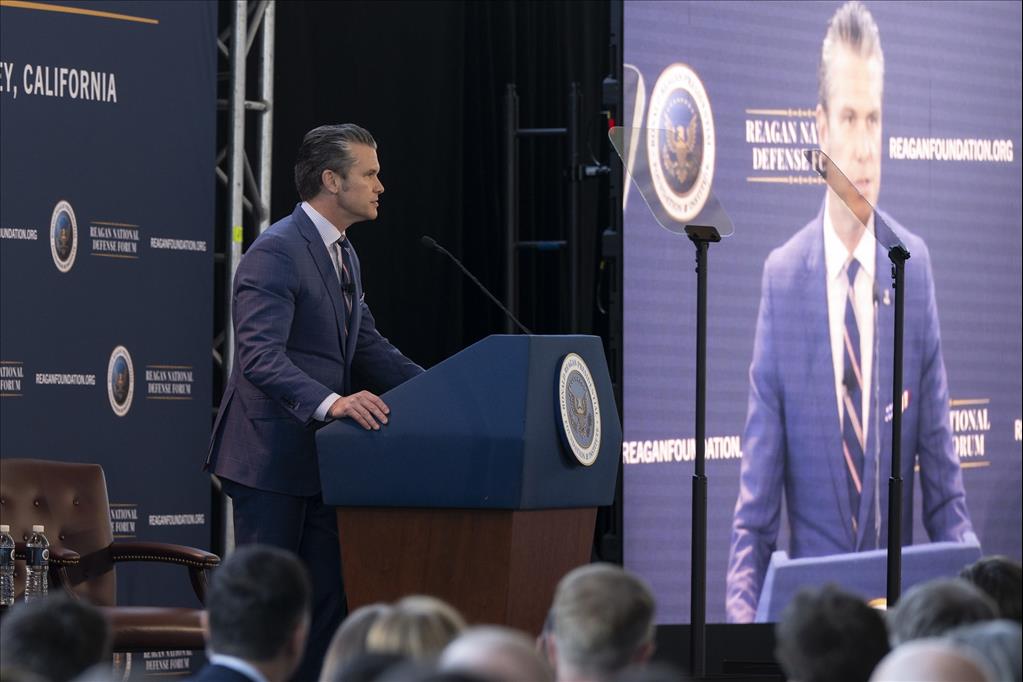
On December 6, following up the release of the NSS, Hegseth spoke at the Reagan National Defense Forum, an annual gathering of Republican politicians, businesspeople and theorists held at the Reagan Presidential Library in Simi Valley, California. Hegseth had been invited to expound on Trump's foreign policy goals.
He led off with aggressive intra-party criticism. He asserted that naysayers were betraying principles dear to none other than Reagan, of whom Trump is a faithful acolyte. Hegseth no sooner had arrived on the stage than he declared that“Donald Trump is the true and rightful heir of Ronald Reagan.”
Then he launched the accusation of heresy:“Since the end of the Cold War, a generation of self-proclaimed neo-Reaganites have touted Reagan's name, but didn't govern like him,” he said.
Hegseth argued that Trump, exactly like Reagan, was tough on both Russia and China and therefore unafraid to engage with both. Regan's toughness, exemplified by his military buildup, prompted Mikhail Gorbachev, who at the time headed the Soviet Union, to end hostility to the West and agree to negotiate nuclear weapons reductions. Reagan, an unyielding anti-Communist, also welcomed Chinese leader Deng Xiaoping's free-market tendencies and the presumed benefits of China trade with the West.
Trump, too, is unafraid to deal directly with“adversaries,” Hegseth proclaimed. In this case both Vladimir Putin, the ex-KGP officer who command Russia, and Xi Jinping, the current leader-for-life of China.“Like President Reagan, President Trump is willing to talk to rivals, from Mikhail Gorbachev to Deng Xiaoping in the 1980s to Vladimir Putin and Xi Jinping today,” Hegseth proclaimed.
“Folks in Washington like to criticize President Trump for doing so, but those critics forget that this is exactly what Ronald Reagan did, and America was better off for it.”
Hegseth ignores the context of the criticism he dismisses. Critics are not contesting the wisdom of engaging with foreign leaders. Rather, they believe Trump does not understand that present day adversaries are fundamentally different. In short, equating Gorbachev and Deng to Putin and Xi is faulty thinking, even fatuous.
To recap, Gorbachev was intent on reforming a decaying Soviet empire and so had taken steps to deescalate tensions with the West before dealing directly with Reagan on the issue of atomic weapons. Among Gorbachev' s early moves was to inform allied satellite countries in the Warsaw Pact that Moscow would not intervene to contain opponents of their failed domestic policies. He also purged his government of hardline anti-West officials.
Reagan, realizing that at least Gorbachev was amenable to change, saw him as a potential partner in reducing the threat of nuclear war.
Comparing Gorbachev to Putin is like comparing apples to atom bombs. Putin invaded neighboring Ukraine (which had been let loose by his predecessor Boris Yeltsin), threatens to unleash nuclear weapons on the Western countries if they interfere and demands that NATO abandon easternEuropean countries close to Russia's borders, the very same states that Gorbachev freed from Russia's grasp.
Relations between Deng Xiaoping and Reagan were also rockier than Hegseth imagines. Deng, who was overseing a vast transition of China from a closed and country into a global and stable marketplace, considered good relations with the West a useful tool, But there was a sticking point: He also opposed continued supply of American weapons to Taiwan. That put him at odds with Reagan, for whom Taiwan was a living symbol of his long-held anti-Communist leanings.
Yet, neither Reagan nor Deng was willing to end a relationship that had been birthed a scant three and a half years before. Both saw likely economic benefits for the US and China and a chance to reduce Pacific tensions. So they compromised: Deng was willing to let Reagan continue with the sales for some unspecified period so long as the US did not oppose the“peaceful reunification” by Beijing, which assumed Taiwan would eventually adhere to joining the mainland.
Sign up for one of our free newsletters
-
The Daily Report
Start your day right with Asia Times' top stories
AT Weekly Report
A weekly roundup of Asia Times' most-read stories
But four decades later, Xi turned“peaceful reunification” into warnings that Taiwan's resistance to absorption by China“cannot be passed on from generation to generation.” To back it up, Xi relies less on rhetoric than on military harassment of Taiwan. More to the concrete point, Xi's China is not the military weakling of Deng's time, which happened to include a small arsenal of nuclear weapons. Xi oversees China with the world's largest navy and is increasing the size of its nuclear from its current 600 warheads to 1,000 by the year 2030.
Trump's response to seemingly aggressive China is muddled. He wants no change in the current unstable“status quo,” wants to sell Taiwan weapons to defend itself – yet appears to believe that calling Xi a“friend” and a“great leader” will mollify Xi's unhappiness with Taiwan's resistance to joining the mainland. Trump also ignored the efforts of China to effectively take over the Taiwan Strait, an international waterway that links Japan and South Korea southward past the Philippines and Vietnam.
It's uncertain what the audience in Simi Valley thought about Hegseth's Trump-Reagan close comparison. There was neither applause nor booing during his performance. However, a survey released by the Ronald Reagan Institute, a Washington-based branch of the Reagan Forum, suggested that the US public, whether Democrat or Republican, isn't as isolationist as Trump presumes.
-
“A record” 64% of Americans say the US should be more engaged.
Seventy-nine percent of the survey respondents consider Russia an“enemy.” The same percentage of Trump's core constituency says the US ought to“take the lead in international affairs.” Fifty-seven percent of Democrats agree.
Sixty-two percent of the survey respondents want Ukraine to win the war with Russia. Sixty-four percent want the US to keep supplying weapons to Kyiv.
Sixty percent say the US should send troops to defend Taiwan if China invasdes.
“There's a great deal of talk of isolationism penetrating into the Republican Party,” said Roger Zackheim, director of the Institute.“We have seen that, actually, Republicans increasingly want the US to lead the world.”
That includes Europe, which Trump's security strategy writes off as“lacking self-confidence” and as destined to disappear under a flood of illegal immigration. The survey indicated that two-thirds of Americans,“with strong bipartisan support,” favor NATO, including the commitment that it“defend any alliance member under attack.”
The US Congress has indirectly rebuked Trump's notion that Europe is doomed and not worth spending blood or money on. As lawmakers passed a massive $900 billion US defense budget bill, Republican leaders insisted the US will keep“standing with its allies.”
Sign up here to comment on Asia Times stories Or Sign in to an existing accounThank you for registering!
An account was already registered with this email. Please check your inbox for an authentication link.
-
Click to share on X (Opens in new window)
Click to share on LinkedIn (Opens in new window)
LinkedI
Click to share on Facebook (Opens in new window)
Faceboo
Click to share on WhatsApp (Opens in new window)
WhatsAp
Click to share on Reddit (Opens in new window)
Reddi
Click to email a link to a friend (Opens in new window)
Emai
Click to print (Opens in new window)
Prin

Legal Disclaimer:
MENAFN provides the
information “as is” without warranty of any kind. We do not accept
any responsibility or liability for the accuracy, content, images,
videos, licenses, completeness, legality, or reliability of the information
contained in this article. If you have any complaints or copyright
issues related to this article, kindly contact the provider above.
Most popular stories
Market Research

More Story








Comments
No comment