




403
Sorry!!
Error! We're sorry, but the page you were looking for doesn't exist.
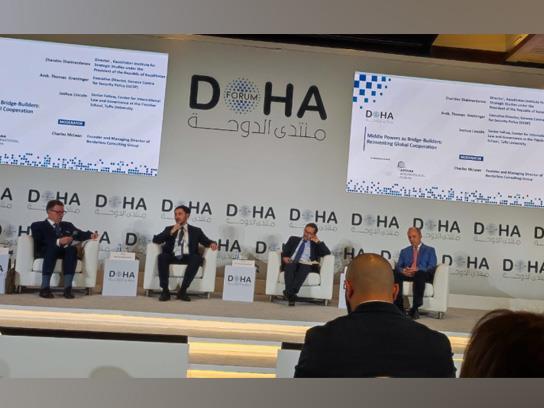
'Middle Powers Play Crucial Role In Ensuring Stability'
(MENAFN- The Peninsula)
M Mazharul Haque
|
The Peninsula
Doha, Qatar: Experts discussed deepening geopolitical polarisation and declining trust in traditional global institutions, and highlighted middle powers emerging as vital mediators and connectors at a session as part of Doha Forum 2025 on December 7.
The panelists were of the view that these countries play a crucial role in ensuring stability and effective global governance through their strategic autonomy, commitment to multilateralism, and contributions to international peace and security.
Held in partnership with Astana International Forum, the session examined how middle powers can foster peace and stability, particularly as international institutions face growing challenges and calls for reform.
One of the panelists, Director of Kazakhstan Institute for Strategic Studies Zhandos Shaimardanov said,“I believe that Kazakhstan experience will be useful in the context of today's session, as we are, in many ways, a new power and not because of our size or military strength, but because of the principles on which Kazakhstan has built its foreign policy within the last three decades.
“Our emergence as a middle power is based on a simple formula: predictability, balance, and respect for international power.
And based on these three principles, we earned trust. For us, autonomy is not about choosing a side. It's about diversifying our strategic partnerships. And you know that within the last three decades, we have established very strong relations and partnerships with the United States, with China, Russia, Europe Union, India, and of course, with other countries.
Every partnership strengthens different dimensions of our development. And in this context, the platforms, such as the Toko Forum, are critically important for middle powers.”
Asked by the moderator if it is the soft power with which his country deals with other powers, Zhandos Shaimardanov said,“There are many different instruments, such as diplomacy and infrastructure. We also invest in infrastructure. You know, the importance of the Middle Corridor has increased in recent years, and for us, it's not just the transfer corridor. It's a true economic corridor, which opens the opportunities for change, for diplomacy, for the future development of our region. We invest not only in infrastructure, but also into the stability of our region.”
Another panelist, Executive Director, Geneva Centre for Security Policy, Thomas Greminger, said,“Well, so if we assume that autonomy is the key feature of new powers, then obviously balancing relations with major powers, great powers, is absolutely crucial.
You have a great power that is currently trying to change order by military force. You have a great power that has aggressive, unpredictable, mercantilistic trade policies, you have a great power that is devising a more and more aggressive foreign policy. And in the midst of these great powers, balancing the relations is a challenge.
Now, I think as a middle power, you can be part of an alliance, but it cannot be an exclusive relationship. You cannot be fully dependent. You may have your core allies, but you would join coalitions depending on specific interests.
“And I think this is what you often refer to as flexilateralism, or you would call it multi-alignment. So basically, multilateralism at different configurations depends on your interests.
Now, having relations with different major powers in a polarised and fragmented world is a major asset. It allows you to be a bridge builder. It allows you to be a coalition builder.”

Legal Disclaimer:
MENAFN provides the
information “as is” without warranty of any kind. We do not accept
any responsibility or liability for the accuracy, content, images,
videos, licenses, completeness, legality, or reliability of the information
contained in this article. If you have any complaints or copyright
issues related to this article, kindly contact the provider above.
Most popular stories
Market Research

More Story





Comments
No comment